




The Last Mile: Where Brawn Meets Brains
There’s plenty of room to play in the last-mile space — the trick is learning that the consumer is king of this hill.

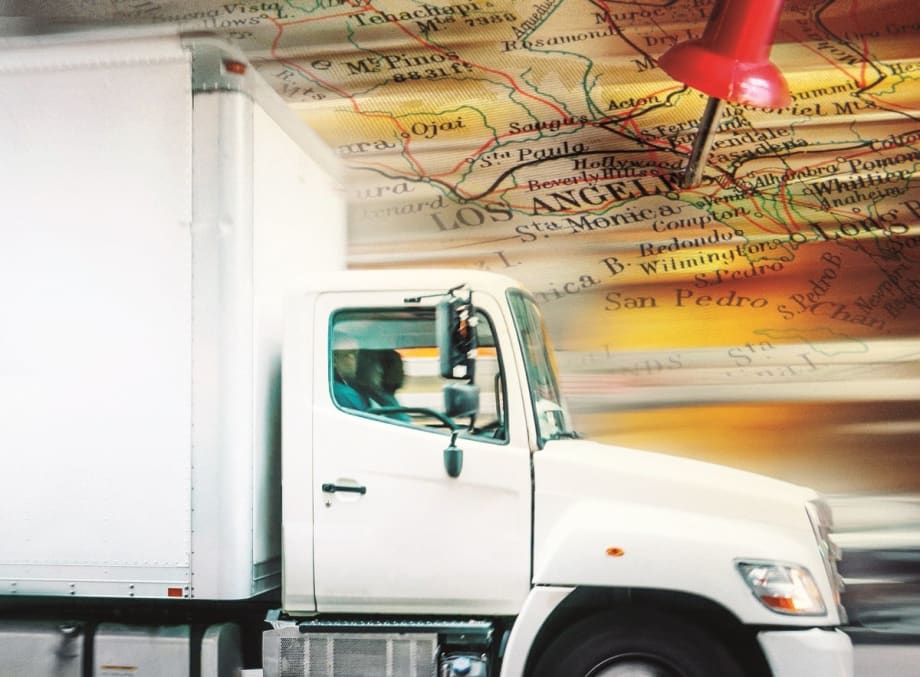
There’s plenty of room to play in the last-mile space — the trick is to learn the consumer is king of this hill.
HDT File Image
Call it last mile or final mile, but customer-friendly delivery to homes, offices, and even small jobsites of big and bulky items is a trend already in full swing. It’s being driven by leveraging technology to meet the demands of the American consumer, who is now comfortable ordering just about anything online or at a retail store for delivery to their front door, or even inside their home or office.
It will be a while before an autonomous truck pulls up to your house and robot delivery men clamber out and swiftly cart a new dishwasher, refrigerator, or massive HDTV into your house and even install it for you lickety-split. But in the meantime, providers of last-mile services are doing everything they can to make final delivery to consumers as fast, as simple, and nearly as hassle-free as, well, a robotic dream come true.
The last-mile realm is where brawn meets brain like never before. It’s also a segment that’s growing by leaps and bounds in tandem with the ongoing explosion in e-commerce. Growth expectations run sky high. The full-service residential delivery of big and bulky goods amounts to a whopping $9 billion market, according to a recent Bloomberg report.
Backing up that number is a survey conducted last fall by XPO Logistics, one of the largest last-mile providers in North America. The study of e-commerce behavior found that 37% of U.S. consumers plan to make an online purchase of furniture, appliances, or other big and bulky products (defined as more than 150 pounds) in the next 12 months.
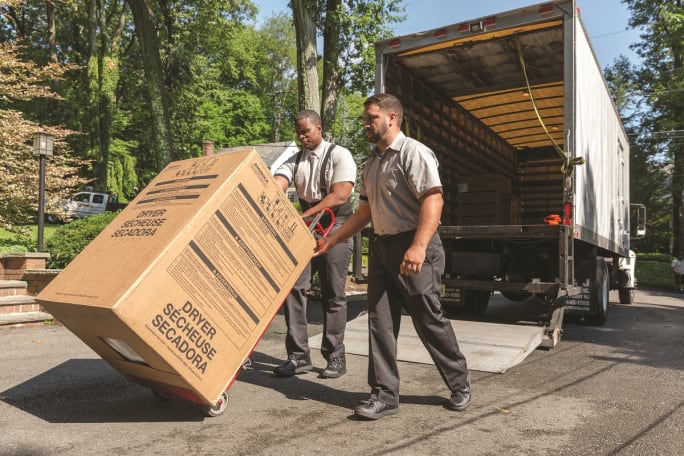
Last-mile delivery of this clothes dryer to a home will include installing it for the homeowner.
Photo: XPO Logistics
Big and bulky
Last-mile delivery is often thought of as the boxes delivered by the likes of FedEx, UPS, DHL, and the U.S. Postal Service. But the big and bulky stuff that last-mile truckers are delivering is freight that is either too heavy to be handled by the drivers of, or has dimensions that prevent it from moving through the sorting systems of, package-delivery firms.
It may seem, on a national scale anyway, that last-mile freight delivery is pretty much sewn up by the big players already in this arena, such as J.B. Hunt, Ryder System, and XPO. Yet there are opportunities for smaller trucking firms to join the party because of how last-mile service offerings typically are built out.
Consider last month’s announced acquisition by J.B. Hunt of Secaucus, New Jersey-based Cory 1st Choice Home Delivery for $100 million. Founded in 1934, Cory provides home delivery services of big and bulky products using 14 warehouses and other facilities. The company uses more than 1,000 independent contractors to complete over 2 million annual deliveries.
Short of being bought out, getting in the game can be as simple as signing on as a local or regional contract hauler for a nationwide last-mile operation. Or it could mean coming up with a new angle on serving the ever-higher expectations of today’s consumers, who want quick and transparent delivery of goods straight to their doors, if not to an exact spot inside, and will pay extra for installation of many products.
The ABCs of last mile
Scott Leveridge, U.S. president of Dallas-based TForce Final Mile, points out that the asset-light 3PL operation relies on 500 carrier partners who collectively field 6,000 delivery personnel operating primarily delivery vans and straight trucks.
“How we look at the market is in terms of the B2B and B2C segments,” he says. “B2B — delivery to businesses — is the traditional base for last mile. But the rapidly emerging space is B2C, that is, home delivery. And that runs the gamut in terms of service offerings.”
Leveridge further subdivides B2C (business-to-consumer) last mile into smaller packages (chiefly apparel); “non-conveyable” items, that are not so much big and bulky “but everything in between, like furniture flat in a box that needs two people to deliver;” and the heavy stuff, like appliances and patio furniture. The latter may require light assembly and/or installation by the delivery persons as well.
“We’re in all those categories,” he says. “The real interesting one is growth in non-conveyable. Amazon created this space. It can be odd-shaped, so it takes up too much space to go through the sorting systems set up by UPS and FedEx.”
TForce moves last-mile freight through 60 of its own facilities. “The name of the game is to get freight closer to consumers to deliver it to them faster,” Leveridge explains. “Our carrier partners use our digital supply-chain platform to handle deliveries and installations and provide visibility to customers. We have unique technology to push orders out seamlessly and have visibility through final delivery.”
Because last mile is all about customer service, the company has a team of carrier managers, each of whom interacts with 15 to 20 carrier partners on how service levels are being met. TForce also has in place a case management system “to allow a seller to open a case [with us] if a delivery issue arises. And along with push notifications on their deliveries, end consumers can put in a question or comment on their experience.”
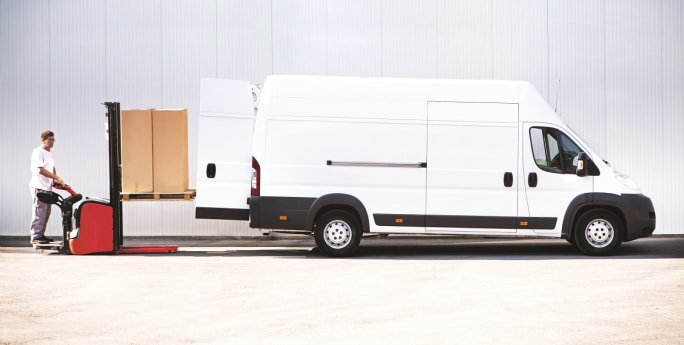
Last-mile is not just about big, heavy items shipped directly to consumers, but also lighter freight that’s too bulky to be handled by traditional parcel delivery operations.
Photo: Ryder System
Fast but smart
Whether fleets are running delivery vans for light but bulky items; liftgate-equipped straight trucks for sofas, appliances, and the like; or flatbeds kitted out with forklifts for loads of board lumber and bricks, speedily dealing with deliveries of big and bulky freight and keeping close track of it is critical to last-mile success.
While taking part as a contract carrier offers the lowest bar to entering the last-mile realm, an executive with one mega provider cautions that establishing a nationwide, let alone international, delivery network is no mean feat.
“It’s tough to enter,” says Patrick Coughlin, vice president and general manager of Ryder Last Mile. “We have [last mile] capability with e-commerce across the U.S. and Canada. LTL operations that might try to break in will have to develop partners across the country and have the technology in place to process the orders through to delivery. Technology is key to enter this market.”
On the other hand, he says Ryder Last Mile is “forging partnerships with operators as ‘authorized carriers’ that are 100% DOT-vetted with their own operating authority but specialize in various last-mile delivery services. Appliance delivery, for example, is very specialized vs. furniture.” These carriers typically operate 26-foot straight trucks that they own, or lease or rent on their own.
Coughlin says that “where the rubber meets the road [in last mile] is with the service level. While LTL can do a curbside delivery, going ‘over the threshold’ to deliver inside means scheduling the delivery and tracking it, as well as offering take-away and installation services as needed.”
He says Ryder can also “manage the linehaul piece for customers, such as outbound from a distribution point to one of our [hub] facilities, as well as bringing back returns for retailers.” In general, he adds, the goal is “to drive miles out of the delivery and get quicker cycle times, especially in metro areas.”
In October, Ryder announced it is expanding its last-mile operation to include partnerships in eight strategically located cities. Its e-fulfillment network now includes 136 facilities covering 95% of the U.S. and Canada within a two-day timeframe.
Those last-mile hubs are where Ryder preps deliveries, which may involve light assembly and setting up product installations. Coughlin says it’s where the “white glove” service that really sets last mile apart starts. “We would assemble products shipped to us in boxes, such as furniture, and maybe blanket-wrap it before heading out for delivery. Our delivery management system can pull together pieces, such as a living room set, coming from different places into one delivery and give visibility, including any returns.”
He says Ryder continues to invest heavily in “visibility technology.” That includes RyderView, which allows scheduling and tracking orders with photo-capture digital proof-of-delivery, which aids the claims management program. “For the customer, it really comes down to getting visibility into the whole process,” Coughlin adds.
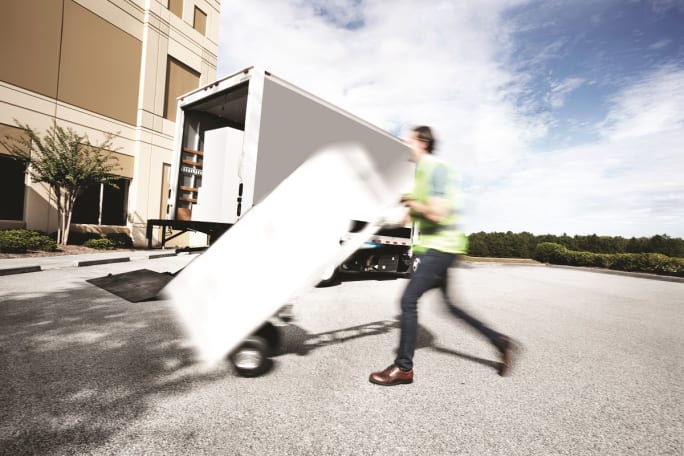
Nationwide last-mile providers typically partner with local and regional carriers that have their own operating authority and specialize in various delivery services.
Photo: Ryder System
Technology of visibility
Mario Harik, chief information officer for XPO Logistics, says the company leverages technology to give last-mile customers visibility and self-service options.
XPO contracts “100%” with carriers in local markets that send out two-person teams to deliver to the end consumer. The carrier onboarding process includes background checks, “as these drivers are going into someone’s home,” he notes. “We have 85 hub locations where we can ‘stage’ the product and complete any minor customizing before delivery. These hubs put us within 125 miles of 90% of the population.”
Driving it all, though, is the technology of visibility. Harik says XPO is the first provider to offer last-mile tracking of heavy goods through Google Search, which can be done on any internet-enabled device. “Google Search interacts with our last-mile technology, XPO Connect marketplace, and XPO Direct shared-space network, for a seamless digital experience.”
He adds that once a delivery is under way, XPO offers customers a choice of self-service options, including online order management, text updates, and voice-activated connectivity through Google Home and Amazon Echo, to keep the process as visible as possible.
“Consumer expectations are high for last mile,” Harik says. “That’s why our technology has to keep us close to them. We give them full tracking of the product, right on their phone. They can open a web app and ‘see’ the truck moving toward their house. They can specify a phone number or email for us to use, and we offer a 1-5 rating scale for customer feedback on the delivery. That’s to ensure we have the best contract carriers working for us.”
After all, the customer is king— especially when your work takes you to or right into their home.
More Fleet Management

Color Match Smarter: Tools That Restore & Perform
For fleet managers and collision repair professionals keeping heavy-duty trucks on the road, getting the color right the first time isn't just about appearance — it's about efficiency, turnaround time, and bottom-line results. Discover how today's digital color tools are transforming the repair process from guesswork to precision.
Read More →
FMCSA Pauses Biennial-Update Enforcement Amid Motus Transition
Carriers whose updates were due on or after June 1 have more time, while FMCSA works to stabilize its new registration system and warns of phishing sites impersonating its new carrier registration system, Motus.
Read More →
2026 Blueprint for Countering Smarter Supply Chain Theft
Cargo theft is no longer just the cost of doing business. It's a multi-billion-dollar criminal enterprise exploiting vulnerabilities across your fleet, drivers, and supply chain.
Read More →


How Telematics Improves Visibility, Control, and Performance in Refrigerated Fleets
Explore how telematics help refrigerated fleets improve visibility, uptime, efficiency, compliance, and cargo protection across connected cold chain operations.
Read More →
What the U.S.-Canada Trade War Means for Trucking
Escalating U.S.-Canada tariffs could disrupt cross-border freight, reduce truck volumes, raise costs, and create new uncertainty for carriers on both sides of the border.
Read More →
What Are Trucking’s Top Concerns for 2026?
The American Transportation Research Institute wants to know what's worrying trucking fleet managers, drivers, and other stakeholders in its annual Industry Issues survey.
Read More →
American Trucking Associations Looks for a New Leader
ATA President and CEO Chris Spear abruptly left his job at the association on August 21, at a pivotal time for the trucking industry.
Read More →
Public Wi-Fi Cybersecurity Risks: How Truck Drivers and Fleets Can Protect Their Data
Public Wi-Fi can expose truck drivers and fleets to credential theft, malware, and other cyber threats. Here’s how to reduce the risk on the road.
Read More →
For Nicky Cupp, Fleet Innovation Starts With Frustration
HDT Truck Fleet Innovator Nicky Cupp turns everyday pain points at Fraley & Schilling into opportunities for better technology and smarter processes.
Read More →
Adam Buttgenbach’s Approach to Electric Trucks: Start With Where They Fit
HDT Truck Fleet Innovator Adam Buttgenbach helped PepsiCo build one of North America’s largest EV fleets by focusing on where electric trucks make operational sense.
Read More →