




The Best Shop Investments a Fleet Can Make
You might be surprised to find what the experts recommend you spend money on to improve the efficiency and safety in your shop as well as to help with technician retention.

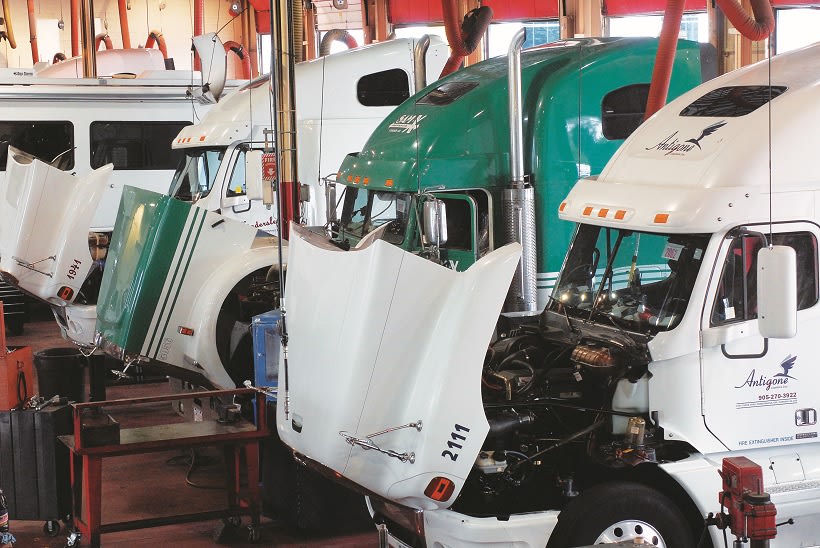
While lighting, technology, the right tools and easy access to parts are all important, the number-one investment you should make is training.
Photo: Jim Park
The number one investment a fleet can make in its shop isn’t better lighting or a vehicle lift or high-tech diagnostics. While all those are good choices, the single most important investment is training, says Dwayne Haug, principal owner of DOH Consulting.
Haug, who retired in 2015 after 26 years with Werner Enterprises, explains, “The equipment itself has changed by leaps and bounds and fleets are trying to keep diagnostic times to a reasonable level. Therefore, it is important that technicians of all skill levels be properly trained.”
Tanya Morrow, president of Ohio-based Ploger Transportation, says she has seen the need for training increase. “It is a constant training and learning process, especially since we have branched out from the Volvo product and are now running some Macks.” Adding new brands of trucks, and even purchasing new models of trucks from an existing supplier, are reasons for additional training.
One benefit of well-trained technicians, according to Haug, is reduced downtime. “The more downtime we avoid helps with driver retention. The worst thing is to have a truck tied up forever while the technician tries to find out what is wrong with it. The driver ends up sitting around being non-productive. Training comes down to production time, the generation of revenue, and maintaining and repairing the equipment with the goal of keeping the driver on the road and the trucks productive.”
Morrow works with her local dealer, who tells her about issues that are occurring in certain tractors. Either a representative from the dealership will come to Ploger’s shop to explain the issue to the technicians, or one of Ploger’s technicians will go to the dealership and get some training on the problem. Ploger technicians also go through Volvo’s online class and participate in training from other suppliers. “We are definitely willing to send them to training to ensure uptime for our equipment,” she says.
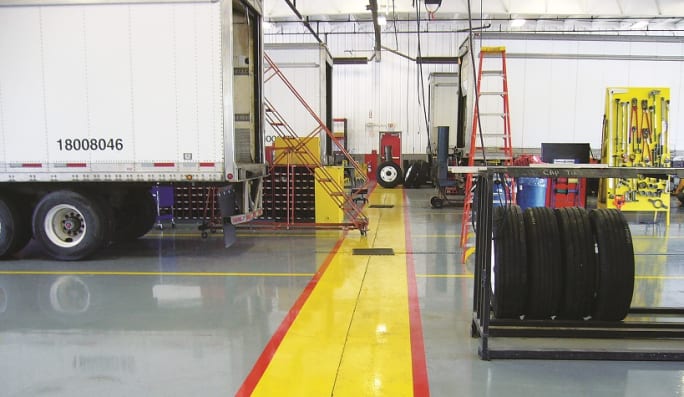
Highly polished, painted and sealed floors are easy to clean.
Photo: DWS Fleet Management
Keep up with technology
Proper training is not the only place you need to make investments when it comes to your shop. You also need to make sure those well-trained technicians have the proper technology to diagnose and repair today’s sophisticated trucks.
According to Lew Flowers, president of Flowers Fleet Service, “There is a lack of automation in the shop because of the expense of computerization. The shop is always the last place to get technology.”
And we’re not just talking scan tools. Too many fleets, Flowers says, do not have vehicle maintenance systems to track parts and labor or technician productivity.
He says all too often, upper management sees the shop as a necessary evil. “In other words, it is not a profit center; it is an expense,” he explains. But he says people expect technology in the workplace, so if fleets are going to attract technicians, they need to make investments in “the latest and greatest tools so there is state-of-the-art equipment in the shop.”
Bruce Stockton, president of Stockton Solutions, says, “The best case scenario is that the technicians have tablets where they get their work orders, scan parts, charge parts to repair orders, etc., but when they go to close out an order and write comments about a repair, they use a computer with a real keyboard.”
Stockton says one of the best places for that computer to be is in the service writer’s or shop manager’s office. “That way the technician’s work can be reviewed before the truck pulls out of the shop.” This gives the service manager the opportunity to note recurring problems, like a headlight bulb that has been replaced three times in the last six months. “He might suggest the technician check the wiring harness before sending the truck out. It presents a last look and affords the shop the opportunity to fix it right the first time,” Stockton says.
He also believes internet access is critical for technicians, because some of the OE programs have to be accessed via the internet. “Everything is in real time, updated and specific to the vehicle the technician is working on. The technician enters the VIN and is given diagrams and repair procedures for that particular truck.”
Stockton also thinks it is a good idea to give technicians access to YouTube. “They will search for someone who has handled the repair before and watch a three-minute video to find out, for example, where a wire cluster they need to find is located.” This can save time in the long run.
In its new shop, which is currently under construction, Ploger has added an office for the lead technician. “He can work inside an office while he is hooked up to the truck,” Morrow explains. “He can run diagnostics from inside and work in a clean environment.”
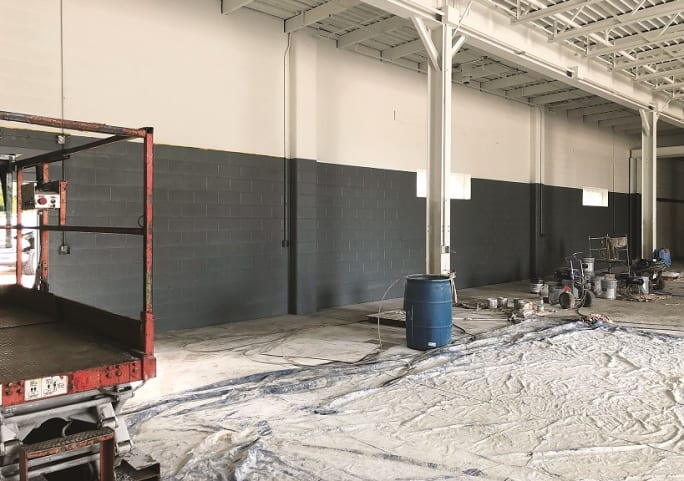
Ploger Transportation is consolidating its shop operation into one location. The new shop will be light and bright so technicians will have a good atmosphere to work in.
Photo: Ploger Transportation
Shop basics
While every shop needs to make investments in technology, there are some basics that should not be overlooked. Darry Stuart, president and CEO of DWS Fleet Management, is a firm believer in a neat and organized shop. “Everything in its place and a place for everything,” is his motto.
Stuart prefers highly polished, painted and sealed shop floors because “when you spill something it is very easy to wipe it up.” He also believes each bay should have a broom and shovel for cleaning up.
Much of what Stuart recommends is based on his contention that there’s not so much a shortage of technicians as there is “a shortage of a mindset on how to take care of them. If you go to a BMW or Cadillac dealership, those shops are pristine. Yet we want technicians to work in a truck shop where they can barely walk between the truck and the wall because there is so much clutter and junk.”
To attract technicians, Stuart says the shop needs to have plenty of lighting, the walls and ceilings need to be painted white with high-gloss paint that can reflect the light, and the shop needs to be clean so it “creates an environment that appears to be healthy.”
In fact, he would like to see the garage doors be all glass. “Insulated glass is expensive, but it allows for as much natural light as possible to be in the shop.”
Adequate air lines on reels are also important, as well as having enough electrical outlets in each bay and overhead reels for fluids.
Depending on the location of the shop, Stuart says fleets should invest in air conditioning. “Swamp coolers don’t necessarily work anymore.”
Stockton says when he was with a Missouri-based fleet, he tried to justify air conditioning for the shop because he saw technician productivity drop in the summer. “People slow down when it gets too hot and you lose productivity, especially given that technicians sometimes works 10-hour shifts.”
He says in the last several years, more shops are adding air conditioning, to “at least remove the humidity and keep the temperature to 80 degrees in the summer and 60 in the winter so people can be comfortable and productive.”
In addition to air conditioning, ceiling fans are a good way to move air around the shop for additional comfort.
Lifts are another important addition to the shop, given that many trucks today have aerodynamic fairings that make it difficult for a technician to get underneath. If you are going to have lifts in the shop, however, they must be kept in perfect working condition, Stockton says. “In addition, if the lift is not working properly, technicians need to have the authority to say, ‘I can’t jack the truck up because something is wrong.’”
While Stockton is a proponent of lifts, he is not a fan of pits. “Pits are way outdated,” he says. “They are dirty and hard to clean. Lifts, on the other hand, increase productivity and are better for technicians.”
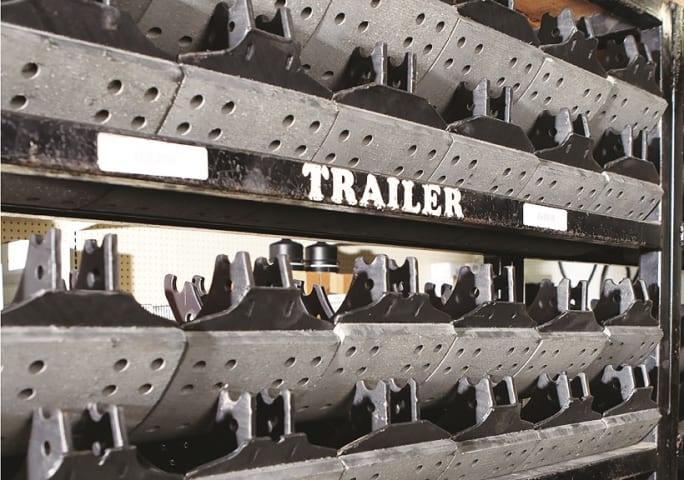
The parts room needs to look like a supermarket, says Darry Stuart, with everything organized and easy to find.
Photo: Paul Hartley
Inventory plays its part
The parts department is critical to the efficient functioning of a shop, according to Haug. “You have to make sure you have the fast-turning items on your shelves, and make sure to remove old parts that are no longer in use and are just taking up space that could be used for needed parts.”
If you don’t have a part in inventory, you need a plan of how you are going to get it quickly. “Shop efficiency is a combination of everything working together, from the time the truck hits the yard, comes into the shop, gets checked in and written up and work begins,” Haug explains. “A part of that is making sure you have parts on hand or are able to get them in an expedient manner so the repair is not delayed.”
Morrow says Ploger keeps common wear items on hand, but also will stock parts when it discovers a specific issue. “For example, at one time there was a problem with a leveling valve on Volvo trucks, so we kept those in stock because it allowed us to be more efficient knowing we were going to be seeing that type of repair.”
She says the fleet also works closely with its local dealer. While diagnosing a vehicle, if the technician gets a fault code that could be caused by one of three things, “we will go ahead and bring in those three parts so we don’t have to place a special order part later. Once we fix the problem we will return the other parts to the dealer.” Of course this strategy only works if the dealer allows parts to be returned.
Stuart says the parts room is the heart of a maintenance operation and that 50% of the cost of maintenance is the cost of the parts. As a result, he believes the parts room needs to look like a supermarket. “If you go to a supermarket and you are looking for bread, you will find all the bread in one place, lined up perfectly. The same is true for beans or salad dressing. It should be no different in the parts room.”
For a shop to be truly efficient, everyone needs to understand the role it plays, Haug says. “Sometimes the shop is misunderstood. We have to understand how much of an integral part of our transportation company it really is. It is the first line of defense and the first place to meet and greet drivers when there is an issue.”
More Maintenance

Truck Drivers Need More Than Another Alert
Fleets have more visibility into truck health, safety events, and driver activity than ever. The next challenge is turning all that information into useful guidance for the person who has to decide what to do next.
Read More →
The Maintenance Checks Trucking Fleets Should Prioritize Before Fall Freight Picks Up
Making it through August isn’t the same as being ready for the next several months of operation. Find out what systems may have suffered from summer heat and need to be checked out before fall.
Read More →
What Three Fleets Are Doing Differently When Buying Truck Parts in 2026
With freight improving but costs still climbing, fleet maintenance executives explain how they're balancing price, quality, and supplier relationships.
Read More →
Paccar Recalls 2027 Trucks Built This Summer for Possible Electrical Problem
The nearly 6,000 Kenworth and Peterbilt trucks in the recall could potentially lose engine power, among other things.
Read More →
Will API PC-12 Oil Change Trucking Fleet Maintenance?
The new API PC-12 heavy-duty engine oil category reflects the changing demands of modern diesel engines. But fleets like Foodliner are looking to getting their own data before making decisions on adopting the new oils and questions such as extending oil drain intervals.
Read More →
Brake Safety Week to Focus on Drums and Rotors
Commercial vehicle inspectors are focusing on truck brakes during CVSA's Brake Safety Week, August 23-29.
Read More →
Possible Battery-Cable Fires Prompt Recall of 15,000+ International MV and HV Trucks
On the recalled vehicles, manufacturing variations can cause the battery interconnect cable to contact the auxiliary stud and hold down the bracket.
Read More →
Rush, MCT Team Up to Grow Refrigeration Service Network
The joint venture will operate MCT's network of Carrier Transicold dealerships and mobile service locations, with the companies promising greater service capacity and uptime for refrigerated fleets.
Read More →
ConMet Expands Aftermarket Brake Drum Lineup With TruCast
A new heavy-duty truck brake drum option in the aftermarket gives customers more flexibility within the ConMet product family.
Read More →
Mack Expands Premium Service Contract Coverage to Medium-Duty MD
With a service contract, inspections, preventive maintenance and repairs can be handled in a single visit instead of multiple ones.
Read More →