The Art of Team Driving to Create an Unbreakable Cold Chain
Learn how Wisconsin's Krueger Wholesale Florist uses team drivers to ensure weekly nonstop routes get fresh flowers and plants distributed around the clock.
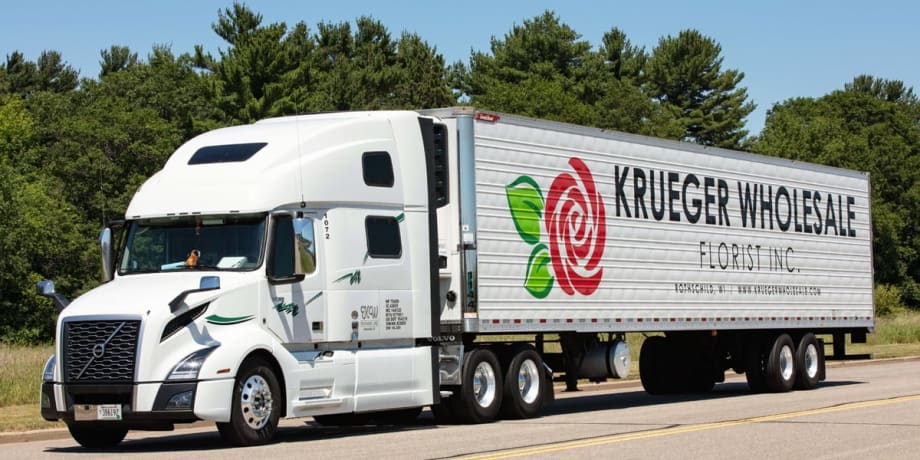
Krueger Wholesale Florist's logistics division, KW Transit, employs teams of drivers who make weekly runs from Wisconsin to either Florida or California.
Photo: Krueger Wholesale Florist
3 min to read
When importing flowers from Colombia, Ecuador, and other areas in South America to distribute to customers across the country, it’s essential to maintain a constant cold chain. In this world, timing is everything.
Ad Loading...
To ensure quality and an extended shelf life of its cut flowers and plants, Krueger Wholesale Florist owns and operates a private fleet of trucks to ensure multiple weekly nonstop routes get the product distributed without a hitch.
Krueger Wholesale’s logistics division, KW Transit, employs 18 drivers, who predominantly make six to nine weekly runs from Wisconsin to Miami and back and two weekly runs to California and back.
Ad Loading...
The best way they’ve found to keep their cold chain tight and their flowers and potted plants fresh? Team runs.
Fleet Snapshot
Who:Krueger Wholesale Florist
Where: Rothschild, Wisconsin
Fleet: 12 trucks, 16 trailers
Operations: Private fleet, floral and plant distribution
Fun Fact: Family-owned and operated since 1963
Challenge: Operating nonstop routes to maintain a constant cold chain
Teams not only allow nonstop movement and a continual renewal of product for their 24/7 business operations, but also allow drivers an abundance of home time. For example, a team of two drivers will leave Wisconsin on Monday to pick up a load in Miami; by Wednesday, they're both home. Pairing a predictable route with five days of time off provides enough of a benefit that KW Transit is able to attract and keep drivers.
In the current environment, where many fleets are pulling out all the stops to recruit and retain drivers, team versus solo runs is an added barrier to hiring. So Krueger Wholesale relies on its reliable business model, new equipment, and thoughtful hiring process to sweeten the deal.
“Teams are harder to come by now than they used to be,” KW Transit Logistics Manager Sherry Klem said. “Normally the drivers I hire come in solo and I marry them up based on their personalities.”
After they’ve made it into a routine and seen Krueger Wholesale’s operations first-hand, drivers rarely want to go back to solo driving. Once you have the driver’s trust, Klemm says, and drivers know you can take care of them, they’re fully onboard with team driving.
Ad Loading...
Krueger Wholesale Florist provide customers with fresh cut flowers, greens and botanicals.
Photo: Krueger Wholesale Florist
“This affords them a life where you can stay on the road, but have time at home,” she says. “Many have said they don't even feel like they need to take their paid time off because they have enough time already. It’s wonderful. Their life is so much better. They have actual rest when they get home.”
It can be a big ask to convince a driver to pair up initially. But KW Transit has found success in doing so, thanks to Klemm’s innate ability to pair drivers together. Although, sorry, even she says she doesn’t know exactly what her secret is. Through her 20 years at Krueger Wholesale, she has cultivated a long interview process that gives her a feel for preferences (such as day or night driving), personality and ability.
But one best practice she swears by is keeping trucks on the road new and spec’d with all the driver comforts offered on the market, including investing in quality mattresses. KW Transit specs 12 Volvo Trucks VNL 860 sleeper trucks, a brand requested by the drivers over the years. The trucks are traded in once they reach 500,000 miles. That means three trucks are typically traded in each year, ensuring drivers don’t have to worry about breakdowns and have the most comfortable truck available to them.
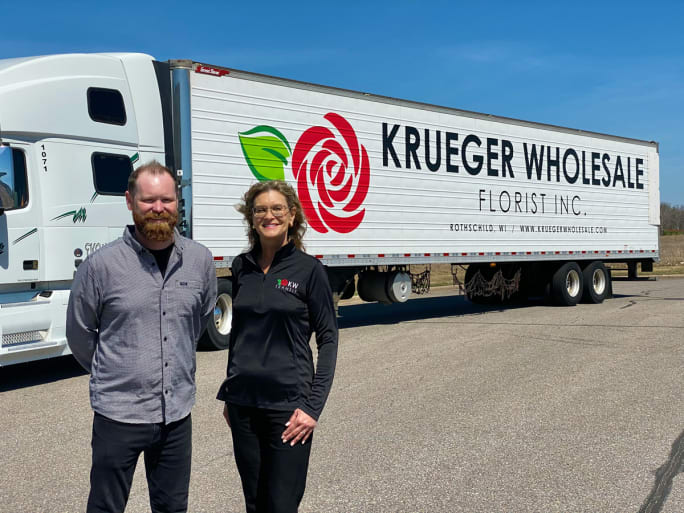
Left to right: Jacob Fochs, Krueger Wholesale Florist's director of business developement, and Sherry Klem, KW Transit's logistics manager.
Photo: Krueger Wholesale Florist
KW Transit’s drivers run a lot of dedicated routes, and Klemm says they never run empty. Krueger Wholesale has been in business since the 1960s, and it has cultivated a chain of importers and vendors that know the drill.
“We have vendors where we can come loaded and can be turned within an hour,” she says. “We’ve been very fortunate that there’s been no downtime when that team leaves our yard with that tractor and that tractor never gets shut off.”
Ad Loading...
Kreuger Wholesale operates out of a 150,000-sq.-ft. corporate headquarters and distribution center in Rothschild, Wisconsin, which is supplemented by an additional satellite facility. KW Transit also operates its own maintenance bay.
For fleet managers and collision repair professionals keeping heavy-duty trucks on the road, getting the color right the first time isn't just about appearance — it's about efficiency, turnaround time, and bottom-line results. Discover how today's digital color tools are transforming the repair process from guesswork to precision.
Carriers whose updates were due on or after June 1 have more time, while FMCSA works to stabilize its new registration system and warns of phishing sites impersonating its new carrier registration system, Motus.
Cargo theft is no longer just the cost of doing business. It's a multi-billion-dollar criminal enterprise exploiting vulnerabilities across your fleet, drivers, and supply chain.
Explore how telematics help refrigerated fleets improve visibility, uptime, efficiency, compliance, and cargo protection across connected cold chain operations.
Escalating U.S.-Canada tariffs could disrupt cross-border freight, reduce truck volumes, raise costs, and create new uncertainty for carriers on both sides of the border.
The American Transportation Research Institute wants to know what's worrying trucking fleet managers, drivers, and other stakeholders in its annual Industry Issues survey.
HDT Truck Fleet Innovator Adam Buttgenbach helped PepsiCo build one of North America’s largest EV fleets by focusing on where electric trucks make operational sense.