Test Drive: There's Much to Like About Volvo's New VNL
There’s much to like about Volvo’s new VNL lineup. Drivers will like the solid handling and comfortable environment, while fleet owners will be happy with the fuel efficiency.
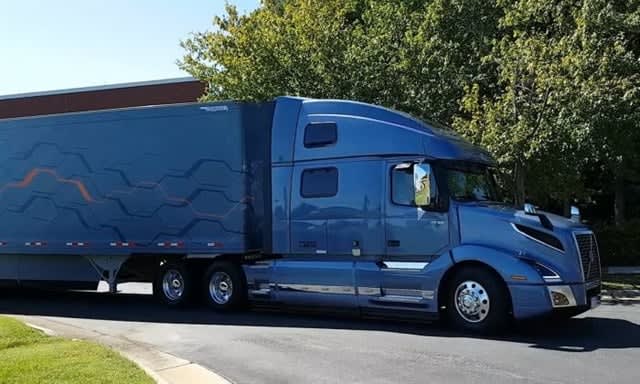
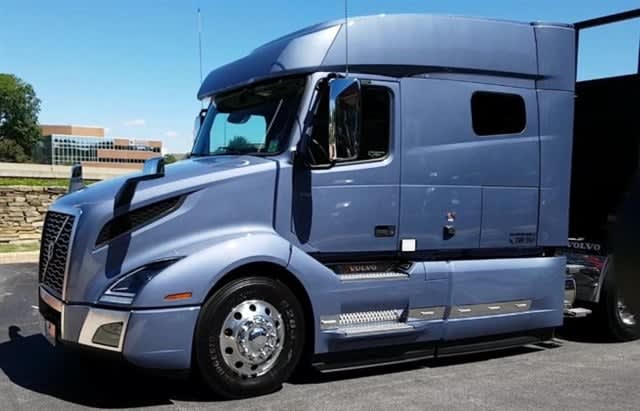
Volvo’s flagship VNL 860 sports a 77-inch high-roof sleeper and a 455-hp, 1850/1550 lb-ft D13 turbo-compound engine with the XE Economy downsped driveline.Photos: Jim Park
8 min to read
Volvo’s flagship VNL 860 sports a 77-inch high-roof sleeper and a 455-hp, 1850/1550 lb-ft D13 turbo-compound engine with the XE Economy downsped driveline.Photos: Jim Park
Many suspected when Volvo took the wraps off its SuperTruck that it would be the shape of Volvo trucks to come. Volvo’s VNR regional trucks, introduced in April, and the flagship VNL series, launched in July, both feature the signature headlight design, the swept fenders and a generally rounder and less textured shape than their predecessors.
Ad Loading...
Volvo has much to crow about with the new VNL lineup. The shape and the sculpting they’ve done to the side fairings, the hood and the bumper have netted a full percentage point gain in aero efficiency. That’s quite an achievement today, when we are used to hearing about fractions of a percent of improvement.
According to Volvo, the aero improvements, coupled with some powertrain enhancements like turbo-compounding for the GHG17-compliant D13 engine and a downsped driveline that likes to cruise at 1,100 rpm, deliver a stunning 7.5% gain in fuel efficiency compared to the latest models of the previous-generation VN tractors. Only time will tell if that’s realistic, but if it is, we’re a significant step closer to the elusive 10-mpg mark.
Ad Loading...
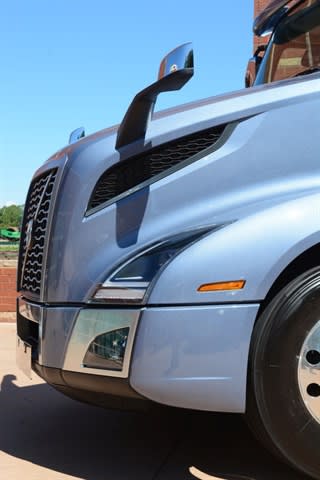
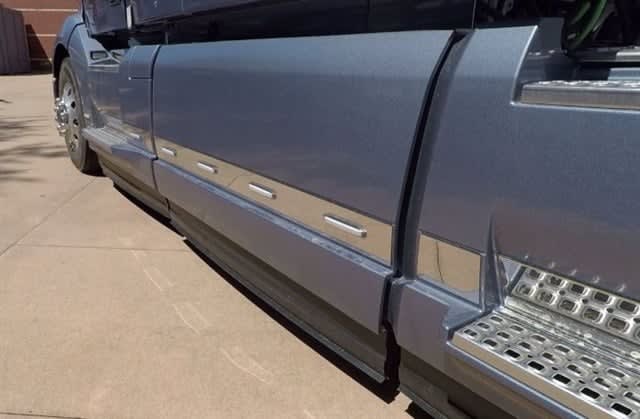
The changes to the exterior of the truck include a narrower hood with a lower crown and more rounded leading edges, more rounded fenders with the integrated headlights, and smoother chassis fairings with a flexible extender that reaches even closer to the ground for improved crosswind performance. There’s no longer an opening in the chassis fairing for the DEF tank fill; it’s now covered with an automotive-style sprung door. The changes to the chassis fairings did not, however, mean changes to the full-sized and deeply serrated access steps. Safety is still a very important consideration for Volvo.
The front of the truck is much rounder than the previous VNL, and is styled very closely to the company’s SuperTruck.
The bumper has been pushed forward by 1.4 inches at the centerline and pulled back by 4 inches at the wheel well. This gives the front of the truck a rounded profile that presumably cuts into the wind a little more easily.
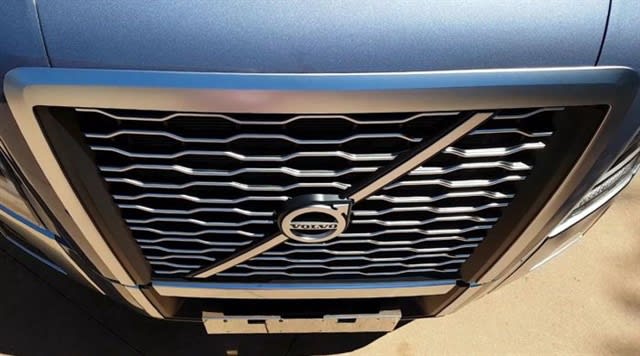
The bumper has removable panels hiding the tow hooks. They are still there, but they don’t interfere with the aerodynamics. Like the VNR, the VNL has the new signature grille styling with a new Volvo iron mark. It’s the third revision to the grille facia since 1996. The cooling system behind the grille hasn’t changed, but the packaging has been tightened up, allowing for the narrower, lower hood.
The cab itself is new, with new body sculpting on the side walls and a pair of good-sized windows that really open up the sleeper. A bold sculpted line extends from the rear edge of the hood, across the door and all the way to the back of the sleeper. It adds a nice visual accent, but also helps to stiffen that big side panel, which I’m sure helps lower the wind noise and low-frequency resonance inside the truck.
New to the VNL lineup is the 70-inch sleeper. Previously, the Volvo VNL sleeper was 61 inches, putting the company at a slight disadvantage in sleeper length compared to the rest of the industry. The 70-inch sleeper is available on the VNL 740 and 760 models in mid- and high-roof configurations. The premium VNL 860 boasts a 77-inch high-roof sleeper.
Ad Loading...
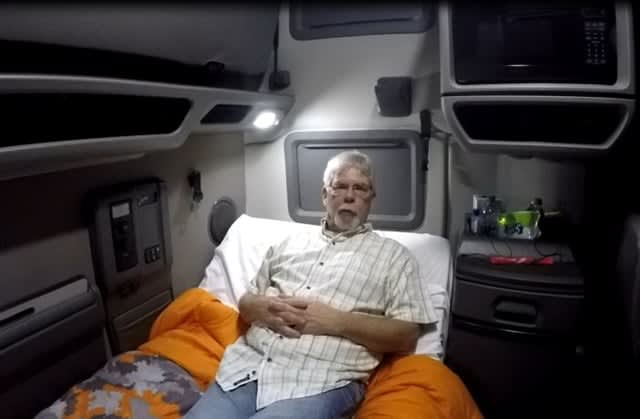
The recliner mattress is a nice feature for after-hours relaxation. Interior tweaks to the sleeper give it a more spacious look.
Inside the cab
Much of what we see inside the new VNL is the same as the VNR model, but with slightly different trim options. It has the same new A and B dash panels with reconfigured switch layouts and crisp new white-lit gauges. It also has the new 5-inch color information display, tied to the new 21-button array on the steering wheel where drivers can scroll through menus and personalize a number of display settings. This is a significant step up from the previous monochromatic display and the stalk-controlled options menu.
There are three trim levels: Fleet, with Heron vinyl fabric; Touring, with Heron cloth headliner and Longspur cloth back wall and metallic accents; and Limited, with Heron cloth headliner and Longspur cloth back wall with orange accents. The basic color scheme is beige, tan and gray.
“We used lighter colors in the higher parts of the sleeper to give it a more spacious feel,” says the VNL’s lead graphic designer, Adriana Perez-Cross. Certain design elements, such as not having cabinets go all the way from floor to ceiling, also add to the openness of the cab and sleeper compartment.
One very positive move is the ability to unbundle all the interior options. So you can get, for example, the premium seat with the lowest level interior, and any combination in between.
The bumper is pushed forward by 1.4 inches at the centerline and pulled back by 4 inches at the wheel well, giving the truck a rounded frontal profile.
Volvo changed the window control buttons so they will now go all the way up or down with just one touch of the button. You can stop the window mid-way as well. The buttons are large enough to manipulate easily. The mirror position controls, however, are set rather far forward on the door sill and are not quite so easy to reach. A minor irritant.
Ad Loading...
A more significant irritant was the position of the seat-mounted shifter. For some reason, it’s set out from the side of the seat, which isn’t a problem itself, but it makes for precious little space between the shifter knob and the fancy new cup-holder system under the dash. With the seat set fairly far forward, as I like to drive, I could not swing my leg between the cup holder and the shifter. I had to lift my leg over it, or slide the seat back to make room for my size-10 shoes.
The latest addition to the sleeper is the reclining bed that props you up a little for reading or watching TV. It gets you into a comfortable position for that activity. I had some problems getting it to go back to flat when I was ready to go to sleep, but Volvo assured me that it’s designed to easily be raised and lowered with a handle on the side. The problem was either a glitch in the pre-production truck, or a problem with the oversized hotel sheets being used for the test obscuring or obstructing the works.
I also discovered that the power ports on the dashboard switch off with the key. I plugged my phone in there when I hit the sack and it was not charged in the morning. Apparently I should have used the ones in the sleeper, which do remain on, Volvo told us later.
The VNL 740 with the mid-roof sleeper is targeted toward bulk haulers and flatdeck haulers that don’t pull tall loads.
On the road
I drove two trucks on the course Volvo had set out for us. The first was a high-roof VNL 760 (see Spec Sheet on page 45), followed in the afternoon by a mid-roof VNL 740 (Spec Sheet on page 48). The latter was actually spec’d for a tank fleet customer of Volvo’s. The 760 had the high-torque D13 engine with turbo-compounding rated at 455 hp/1,850 lb-ft.
Volvo says the turbo-compounding mechanism adds up to 50 hp to the drivetrain through a gear train with a viscous clutch of sorts. It won’t make your 455-hp D13 into a 505-hp D13. Rather, it lets the D13 run at 405 hp while contributing its 50 hp or so the drivetrain, thus requiring less fuel for the same power output. I can’t say that I noticed any direct impact on performance because of the turbo-compounding (not available until next year), but there were several occasions where the engine/transmission and the XE downsped driveline got down to 930 rpm and actually held there while pulling up slight grades. There’s fuel savings to be had at those low revs. And remarkably, the engine felt solid and confident pulling at the low speed – much improved over the very early days of downspeeding.
Ad Loading...
The VNL 740 had a different powertrain spec’d for a different purpose, so I didn’t see the really low engine speeds. 1,050 rpm was as low as I remember going, but the truck was equipped with the adaptive gearing technology (see box on previous page).
Despite the different powertrains and the different sleeper configurations, the two trucks had a few things in common. Both were extremely quiet. I checked the noise level on my iPhone app and it showed 61 dB (A-weighted) at highway cruise. By comparison, my Volvo D50 personal car had a reading of 57 dB at highway speed. And because the truck is so quiet, I couldn’t help notice a wind whistle in both trucks coming from somewhere around the passenger door. I don’t think it was the aero mirrors because the VNR 740 didn’t have them. The noise was exactly the same in both trucks.
Both trucks were equipped with an optional stabilizer bar on the front suspension. If you’re planning on buying one of these trucks, order the stabilizer bar. It improves the truck’s handling so dramatically, it should be standard equipment.
The chassis fairings are smoother and have flexible extenders to go very close to the ground for better aero performance in crosswinds.
Final observations
Ease of maintenance is a big consideration in a truck spec, but it’s difficult in a time-compressed test drive to come to any firm conclusions on how well this truck is designed for technician access. I do know that Volvo has designed the bumper end caps to be removable to allow techs to get up closer to the engine. There’s not a lot of room under the hood or between the frame rails, so I suspect this truck will produce its share of skinned knuckles. The floor mats in the cab are removable, allowing easier access to the engine cover under the dash.
Drivers won’t have a difficult time doing their pre-trip checks, as the engine is mounted low between splayed frame rails. I confess I could not easily locate the air tank drains, but I believe they are behind the chassis fairing under the driver’s door, which is fairly easy to remove for inspections.
Ad Loading...
The entire VNL lineup is available with a Volvo powertrain, obviously, but Cummins’ X15 and the X12 G natural gas engine are also available. These trucks can be ordered with Eaton 10-, 13- and 18-speed manual and automated manual transmissions as well as an Allison 6-speed automatic.
Volvo says drivers were consulted extensively during the design process for the new VNL lineup, and that shows in the product. It’s an immensely comfortable truck that’s smooth, spacious and quiet. Aside from the minor irritations mentioned above, there’s very little here to which I wouldn’t award very high marks.
Specifications
VNL 760 6x4 70-inch tall-roof sleeper
Wheelbase:
233 in.; Dry weight: 19,405 lbs
Powertrain:
Volvo D13 TC; GHG 17, XE High-torque
455 HP/1850 lb-ft
Volvo I-Shift ATO2612F 0.78:1 OD
Front end:
Volvo; VF14; 13,200 lbs
59-in. parabolic leaf spring
Michelin-X line Energy Z, 275/80R22.5H
Rear end:
Meritor; MT40-14X*C; 40K lbs 2.47:1 ratio
Volvo Optimized Air Suspension
Michelin-X Line Energy D, 275/80R22.5G
Cab/Sleeper Options
Rain-sensing wipers
Automatic lighting
Active safety: VEST, VADA
Position Perfect steering wheel
Trim level: Limited, upper & lower bunk
Seating: National leather w/heat, ventilation, back-cycler
Jim Park holds a CDL and was a driver and owner-operator for 20 years. He not only does test drives, but also writes about equipment, driver issues, and other topics.
Can trucking’s standard seven-way connector handle more cameras and trailer data? Grote’s Adam Slade shows HDT how the company is using new technology with its 4See trailer system, not only to add a new backup camera but also to expand other capabilities — without adding another connection.
The next-generation 4See rear-view backup camera from Grote uses the standard seven-way connector and supports additional cameras and other trailer data.
From rigs decked out in patriotic America's 250 paint schemes to autonomous trucks and more, check out these photos from ATA's 2026 Management Conference & Exhibition.
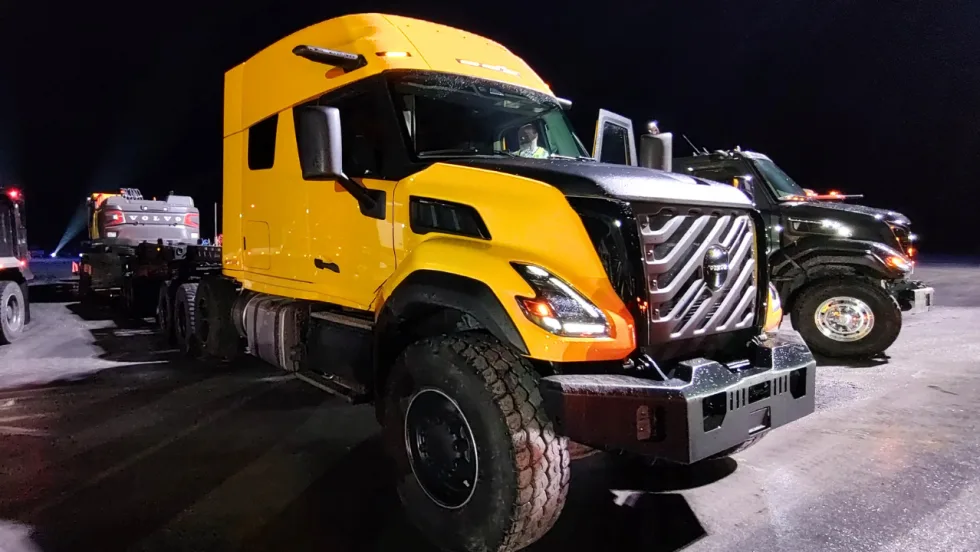
Volvo Trucks has launched the VNX, a new vocational truck also available as a tractor in day cab and two sleeper configurations, with one heavy-haul model. The Volvo VNX is powered by Volvo's D13 platform, which delivers up to 540 horsepower and 1,950 pound-feet of torque and is EPA 2027-compliant.
What’s another tenth of a mile per gallon worth? GP Transco shares how equipment upgrades and driver coaching turn small gains into meaningful fuel savings.
Operating-cost savings have overtaken sustainability goals as the leading reason surveyed fleets are adopting battery-electric terminal tractors, according to new NACFE research.
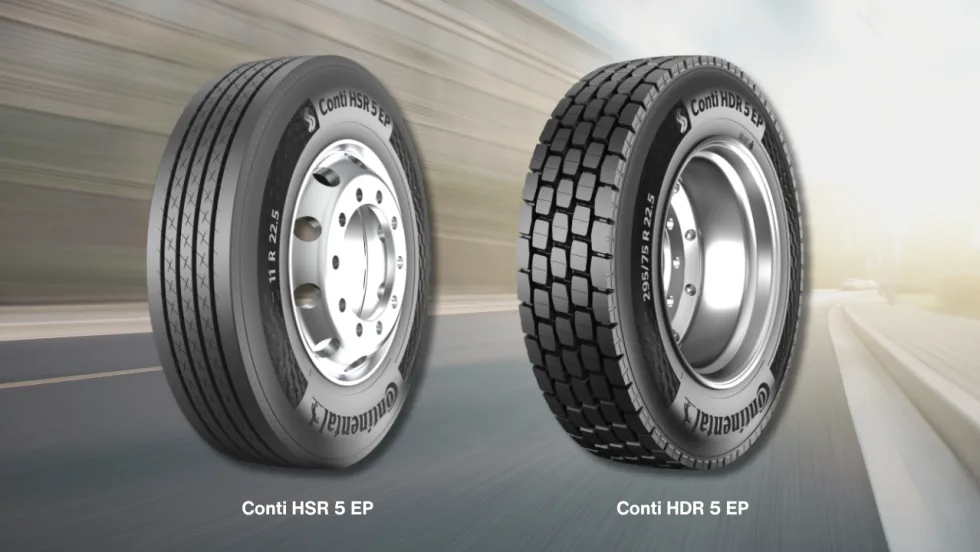
Continental says its new Generation 5 steer and drive tires for regional operations offer longer tread life, with estimated mileage gains of 22% and 19%, respectively.