




Streetwise Tires: Avoiding Urban Damage
Unlike their relatively pampered long-haul cousins that run all day long on flat, straight Interstates, tires that earn their keep on city streets get up close and very personal with all manner of road hazards, including curbs, potholes, piercing grave

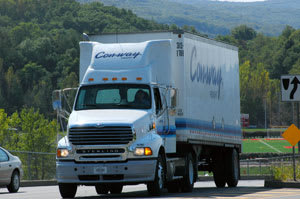
Tires for regional and P&D applications face greater stress due to tight turns and constant stop-and-start cycles.
Unlike their relatively pampered long-haul cousins that run all day long on flat, straight Interstates, tires that earn their keep on city streets get up close and very personal with all manner of road hazards, including curbs, potholes, piercing gravel
, and more. Add several hundred starts, stops, and tight, scrubbing turns every day, and you can see why simply running out old highway tires on the pickup-and-delivery fleet might not be a good choice.
To achieve optimum life and efficiency from a P&D tire, fleets should consider tread and sidewall design as well as the rubber compounds used in its construction. Both tend to be thicker than those on a highway tire in order to protect the casing from damage. The additional 32nds of tread provide better resistance to stone drilling and punctures, tolerance to scrubbing, and ultimately longer time to removal and better retreadability. The thicker sidewalls protect the casing from curb damage.
"On these tires, it's about withstanding the turning forces and shoulder wear," says Roger Stansbie, director of Continental's radial truck tire technologies for the NAFTA market. "There's less of a concern about drive traction, as these tend to be all-position tires, which is probably driven by convenience, too."
The stress placed on the tread face by the constant turns and start-and-stop city environment conspires to chew away the tread pretty quickly, so balancing tread life with impact and puncture resistance takes a steady hand from an engineering point of view.
Michelin, for example, uses its Matrix Siping Technology in several regional tires to resist wear and increase tire life.
"To enable the tire to last as long as possible, we use application-specific rubber compounds that resist aggression and irregular wear," explains Chris Tolbert, business segment manager, Michelin Americas Truck Tires. "Tread design is also important to consider. Through siping and groove design, tires can provide increased traction and protection against premature or irregular wear."
Fuel economy still matters
In over-the-road applications, aerodynamics usually account for approximately 40 percent of a vehicle's fuel use, and tire rolling resistance accounts for about 35 percent. While the aerodynamic influence in a P&D application is negligible, rolling resistance remains a contributing factor to fuel economy. It's rather difficult to measure because of the frequent starts, stops, and turns, but that doesn't mean it can be ignored, especially in some types of operations.
"I don't believe mpg improvement can be measured in a pure urban P&D fleet," says Goodyear's national fleet manager, Matt D'Arienzo. "Most urban fleets have longer idle time coupled with frequent braking and accelerating. But some segments in the P&D fleet may have longer highway runs where fuel economy could be considered a controllable."
One of Goodyear's latest offerings, the G662 RSA with Fuel Max Technology, is targeted toward regional and local haul applications where rolling resistance on highway portions of runs could be a factor.
Likewise, Michelin's X One XDN2 and XZUS tires are gaining traction in the same markets because of their fuel-saving characteristics.
"We see this tire used heavily on sanitation vehicles in the urban application," says Tolbert. "Because the wide single tire replaces the duals and their four sidewalls with just two, the amount of wasted energy through sidewall flexing is reduced, saving fuel over traditional dual tires."
Stansbie says Continental is considering a move toward natural rubber or synthetic/natural blended compounds on its 17.5-inch tires in order to improve fuel economy through reduced rolling resistance.
"The low hysteresis effect of those compounds gives you the best bang for the buck in terms of rolling resistance," he says. "We're now looking at using more of the compounds we see in highway tires."
The primary cause of rolling resistance is hysteresis. As the tire rotates under the weight of the vehicle, it experiences repeated cycles of deformation and recovery, and it dissipates this hysteresis energy loss as heat. Hysteresis is the main cause of energy loss associated with rolling resistance and is attributed to the characteristics of the rubber.
Life cycle costs
While a P&D tire might see only 50,000 to 60,000 miles total tread life, there is plenty of opportunity for retreading. A successful retreading program, of course, depends on quality casings.
And casings in a P&D environment take a beating. This is where puncture resistance and sidewall protection become factors. The number of potential retreads is limited by casing condition, and with a higher tendency for casings to be damaged due to sidewall impacts or punctures, you may expect fewer retreads than with a highway casing. If you want exceptional life out of the casing, you'll have to buy the proper protection up front.
"Retreading presents a significant cost reduction over replacing a tire with a new one," says Michelin's Tolbert. "Because of the rigors of the high-scrub application, fleets should spec high-quality tires, whose casing durability would be better able to withstand the retreading process, provided the tires are properly maintained throughout their first life."
Continental has been working with a fleet customer to optimize inflation pressure in the P&D environment, with an eye toward improving fuel economy and tread life. Stansbie says the results of the field tests show that 90-95 psi is a good range for most applications, but pressures up to 105 psi started to affect tread wear.
"The thinking was, upping inflation pressure might have a positive impact on fuel economy, but we saw excessive wear in the center of the tread before we saw any real gains in fuel economy," Stansbie explains. "I think the main move to achieve lower rolling resistance is to compound the tread accordingly."
Priorities
In terms of overall spec'ing parameters, different fleets will have different priorities. Durability would take precedence over fuel economy in many cases, though economy is becoming more of a consideration as fuel costs rise. Retreadability is certainly a concern, and fleets that can capitalize on a retreading program can realize substantial returns.
Goodyear's D'Arienzo notes that the choice may come down to the availability of a reliable local service provider. "Uptime is crucial," he says. "OE availability will get you going, and local supply and service availability will keep you running."
The old axiom "you get what you pay for" also applies here. Some tires may fit in a regional and urban setting, but fleets should look to spec tires specifically designed for such applications, with features that allow the tire and vehicle to perform at a high level of efficiency.
"A tire capable of being used in, but not specifically engineered for, these applications, could succumb to the rigors of the environment more easily," Tolbert cautions. "If all other parameters are equal, the fleet should consider the tire with better casing durability to provide the lowest total cost over the life of the tire."
From the August 2009 issue of Heavy Duty Trucking.
More Equipment

How Volvo Updated Its D13 for EPA 2027 [Watch]
Volvo’s updated D13 promises lower emissions without sacrificing performance or fuel economy. Take a closer look at what changed inside the engine in this HDT Spotlight video.
Read More →
Michelin Tire Improves Efficiency and Durability for Regional Fleets
The Michelin X Multi Energy D2 is a regional haul drive tire engineered to help fleets improve fuel efficiency, durability and traction in demanding stop-and-go operations.
Read More →
ZF Expands Commercial Vehicle Push in North America
ZF is expanding its North American commercial-vehicle presence with new transmission applications, electrification, trailer technology and autonomous-driving systems.
Read More →
Tesla Wants a Self-Driving Semi. Are Cameras Enough?
Could Tesla’s camera-only autonomous driving technology work on an 80,000-pound Semi? In this commentary, HDT's Deborah Lockridge takes a look at Tesla, Cybercab, and how autonomous trucks see the road.
Read More →
Kodiak: Driverless Long-Haul Truck Launch on Track for 2026
Kodiak AI says its driverless long-haul safety case is 93% complete and it remains on track to begin commercial operations by year-end 2026.
Read More →
What DOT’s Automated Vehicle Strategy Means for Trucking
The U.S. Department of Transportation issued a new automated-vehicle strategy that outlines plans for driverless-truck regulations, cross-state freight corridors, and federal safety standards.
Read More →
East Coast Port Launches $45M Electric Truck Push
The Port Authority of New York and New Jersey announced millions in incentives for zero-emission drayage trucks, yard tractors, and new charging hubs near the port.
Read More →
PlusAI Going Public to Fund Autonomous Truck Launch
A SPAC deal could provide PlusAI with up to $300 million as it works toward a 2027 commercial launch of factory-built autonomous trucks.
Read More →
NHTSA Moves to Rewrite Truck Fuel-Economy Rules
The National Highway Traffic Safety Administration says it lacks authority to regulate medium- and heavy-duty truck engines separately from complete vehicles, but the existing standards have not yet been eliminated.
Read More →
Detroit Opens Orders for EPA 2027 Engines
Detroit isn’t starting from scratch to meet EPA 2027 diesel emissions standards. Its Gen 6 DD13 and DD15 engines keep much of today’s platform while updating the fuel and aftertreatment systems.
Read More →