




What Safety Strategies and Technologies are Trucking Fleets Using in 2024?
What strategies and technologies are trucking fleets using in their safety and compliance efforts? Heavy Duty Trucking and Work Truck posed that question to fleet managers of medium- and heavy-duty trucks in our third Safety Survey.


Heavy Duty Trucking and Work Truck teamed up for their third fleet safety survey.
Image: HDT Graphic
What strategies and technologies are trucking fleets using in their safety and compliance efforts? Heavy Duty Trucking and sister brand Work Truck posed that question to fleet managers of medium- and heavy-duty trucks in our third Safety Survey.
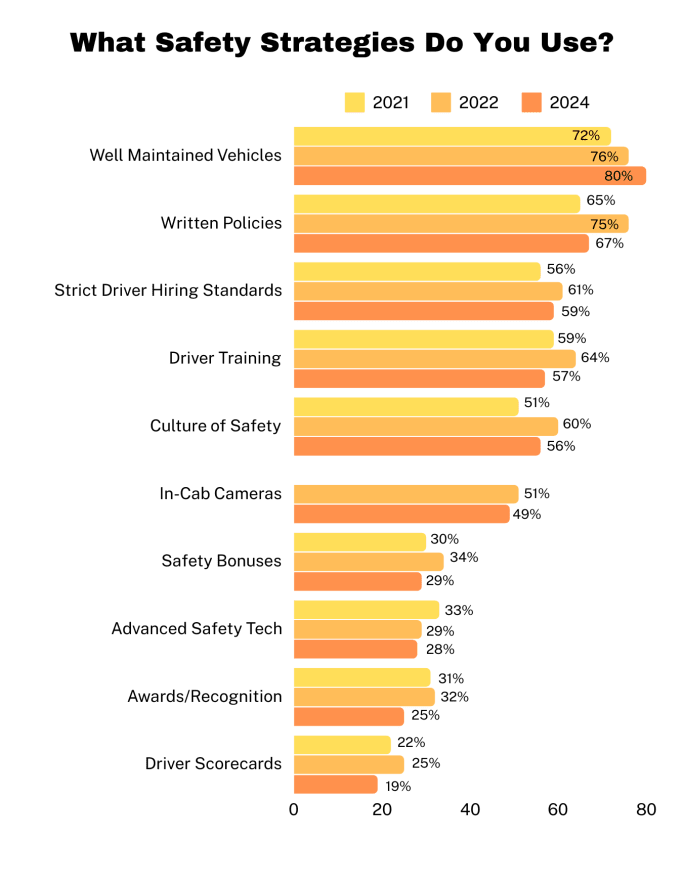
Asked what safety strategies they use, the top reply, as it has been all three years we’ve done this survey, is well-maintained vehicles.
Written policies and procedures was the second most common at 67%, followed by strict driver hiring standards (59%), driver training (57%), and creating a culture of safety (56%) rounding out the top five.
Top 10 Safety Technologies
The most popular safety technologies among the survey respondents were:
Speed limiters 51%
Air disc brakes 48%
Forward-facing in-cab cameras 39%
Lane departure warning 38%
Forward collision warning 35%
Adaptive cruise control 32%
Backup cameras 32%
Electronic stability control 31%
Collision mitigation with automatic emergency braking 30%
Side blindspot monitoring 26%
Some safety technologies were more prevalent among larger fleets than smaller ones. For instance, more than twice the percentage of over-100-truck fleets are using speed limiters compared to fleets under 25 trucks.
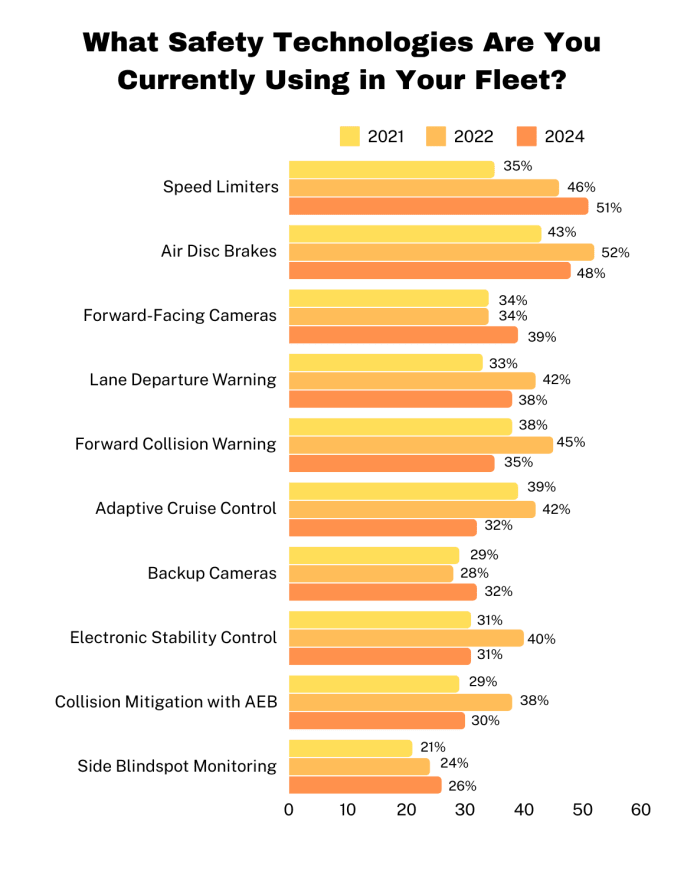
More fleets are deploying dash cams, which came in third in this year's survey, all the way up from eighth in 2022 and fifth in 2021.
Source: HDT/Work Truck 2024 Safety Survey
On the other hand, forward-facing cameras look to have fairly similar adoption across fleet sizes. 39% of the responding fleets said they currently are using them. Of those using them, among fleets of fewer than 100 trucks, 30% were using them. It was 40% for fleets of more than 100.
When asked which safety technologies respondents plan to implement in the next year, the top 10 were:
Air disc brakes 18%
Backup cameras 16%
Speed limiters 15%
Side blindspot monitoring 12%
Dual-facing in cab cameras 11%
Forward collision warning 9%
Collision mitigation with automatic emergency braking 9%
Collision mitigation 8%
Lane departure warning 9%
The federal government is considering mandating automated emergency braking for heavy trucks, but only 30% of respondents said they are currently using the technology. That’s actually down a bit from 2022’s 38%.
But that varies considerable by fleet size. Among fleets between 25 and 99 trucks, nearly half — 48% — said they are currently using it, and 43% of those with fleets of 100 and over. Only 9% of small fleets less than 25 trucks said they are using AEB.
More on Safety Tech: Keep ADAS Working Right
Should Truck Speed Limiters Be Mandatory?
Even as the government mulls a possible mandate on speed limiters for heavy trucks, many trucking fleets are already using them, both as a safety tactic and a fuel-efficiency strategy.
After a decade-long push by trucking and safety advocates to require speed limiters in heavy trucks, in 2016, the Federal Motor Carrier Safety Administration and the National Highway Traffic Safety Administration floated a proposal to do just that.
2022 Survey: What Safety Technologies Appeal to Different Types of Fleets?
In 2022, FMCSA tried to put the stalled rulemaking back into gear with supplemental notice of proposed rulemaking to gather information from fleets that use speed limiters voluntarily.
It made no mention of maximum speed.
More than 4,000 comments were received on this “prerule.” A proposed rule was widely expected by the end of 2023, but we’re still waiting.
The latest projection from the FMCSA for a proposed rule to require heavy-truck speed limiters is May of 2025.
But retired FMCSA official Jack Van Steenburg told attendees at Heavy Duty Trucking Exchange, “It’s not going anywhere. It’s dead on arrival.”
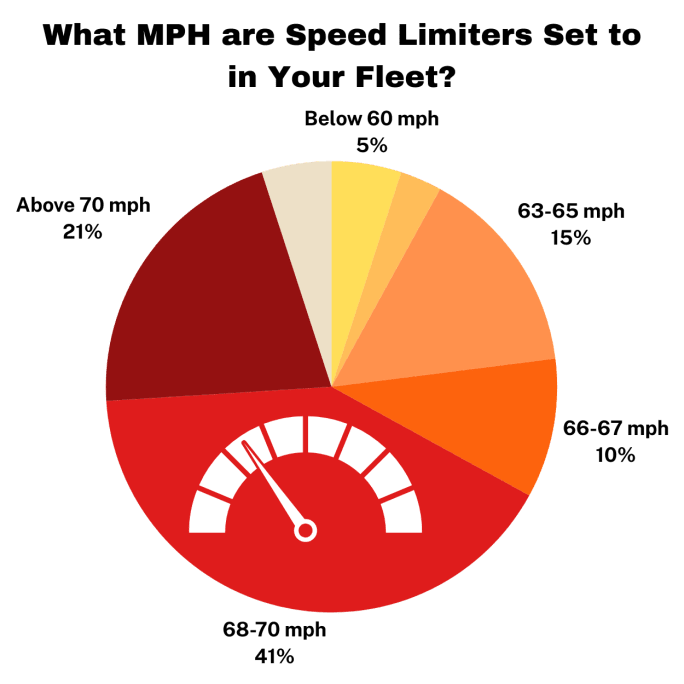
The most common top speed set in respondents' speed limiters was 68-70 mph.
Source: HDT/Work Truck 2024 Safety Survey
Trucking Fleets Using Speed Limiters Weigh In
Nevertheless, as noted, many trucking fleets already use speed limiters voluntarily. 51% of respondents to the survey said this was one of the safety technologies they were currently using in their fleets. In fact, it was the most common cited, followed closely by air disc brakes at 48%.
We asked those who are using speed limiters about the speed they are set to, and under which conditions.
The most common speed limiter top setting was between 68 and 70 mph.
Below 60 mph 5%
60-62 mph 3%
63-65 mph 15%
66-67 mph 10%
68-70 mph 41%
Above 70 mph 21%
It’s not uncommon for fleets to incentivize drivers to use the more fuel-efficient cruise control by setting the speed limiter to allow a higher top speed under cruise control. And indeed, a slightly higher percentage of respondents, 26%, said they set the top speed to above 70 mph when the driver was using cruise control.
The American Trucking Associations' position on mandatory speed limiters is that higher speeds should be allowed if trucks are equipped with adaptive cruise control and automatic braking.
41% of respondents that use speed limiters said this did not apply to their fleet or they did not know. 21% said they set limiters to 68-70 under these conditions and 18% set them to above 70 mph.
Maintenance departments are a key part of fleet safety strategy.
Source: HDT/Work Truck 2024 Safety Survey
We also asked what respondents believed a mandatory speed limiter maximum speed should be set at. A little over one-third said 68-70 mph and another nearly one-third said about 70 mph. 23% felt speeds below 68 mph should be mandated.
In addition, 15% of respondents said they plan to implement speed limiters within the next year – nearly doubling the percentage planning to implement speed limiters compared to the 8% in our 2022 survey.
Are You Missing Opportunities to Get Crashes Off Your CSA Score?
Only 20% of respondents said they have taken advantage of FMCSA’s Crash Preventability Determination Program.
The majority of respondents, 68%, said they had not taken advantage of the program, and 12% didn’t know or weren’t sure.
That’s even less than our last survey in 2022, when 23% of respondents said they had, 54% said no, and 23% said they didn’t know or weren’t sure.
This program was developed to address industry concerns about all crashes being used in the FMCSA’s Safety Measurement System (SMS), even those that were clearly not preventable.
One of the major complaints about the SMS system when the Compliance, Safety, Accountability (CSA) program rolled out in 2010 was that all crashes counted against a motor carrier's scores. Why, people asked, should carriers be penalized for a crash caused by someone else who ran a red light, was traveling the wrong direction, committing suicide by leaping from an overpass into the path of an oncoming truck, or numerous other scenarios?
The Crash Preventability Determination Program has been in operation since May 2020. Currently it reviews 16 specific crash types and modifies information in the SMS to distinguish not-preventable crashes. The existing program was an expansion of the agency’s previous demonstration program that reviewed eight crash types. Last year, FMCSA proposed to broaden the program further.
About the 2024 Fleet Safety Survey
An email invitation to participate in an online survey was sent to those in the Work Truck and Heavy Duty Trucking fleet databases meeting specific criteria.
82% of respondents operate Class 8 trucks. About a third of respondents operate medium-duty vehicles.
50% categorized their organization as for-hire fleets; 32% as private fleets, and 15% as government fleets.
General freight was the most common at about one-third, followed by construction/mining, manufacturing, and oil/gas.
36% operated small fleets of fewer than 25 vehicles. 29% had fleets of 25-99, and 27% fleets of 100-499. Only 8% operated 500 or more vehicles.
More Safety & Compliance

FMCSA Pauses Biennial-Update Enforcement Amid Motus Transition
Carriers whose updates were due on or after June 1 have more time, while FMCSA works to stabilize its new registration system and warns of phishing sites impersonating its new carrier registration system, Motus.
Read More →
ZF Expands Commercial Vehicle Push in North America
ZF is expanding its North American commercial-vehicle presence with new transmission applications, electrification, trailer technology and autonomous-driving systems.
Read More →
Truck Drivers Need More Than Another Alert
Fleets have more visibility into truck health, safety events, and driver activity than ever. The next challenge is turning all that information into useful guidance for the person who has to decide what to do next.
Read More →
Tesla Wants a Self-Driving Semi. Are Cameras Enough?
Could Tesla’s camera-only autonomous driving technology work on an 80,000-pound Semi? In this commentary, HDT's Deborah Lockridge takes a look at Tesla, Cybercab, and how autonomous trucks see the road.
Read More →
What DOT’s Automated Vehicle Strategy Means for Trucking
The U.S. Department of Transportation issued a new automated-vehicle strategy that outlines plans for driverless-truck regulations, cross-state freight corridors, and federal safety standards.
Read More →
NYC Expands Speed, Pedestrian Safety Tech Across Fleet
New York City is expanding intelligent speed assistance and pedestrian-alert systems across its municipal fleet, moving the technologies from pilot programs into vehicle procurement and retrofit requirements.
Read More →
FMCSA Removes 110 Truck Driver Training Schools from Certified ELDT List
Federal regulators also are targeting more than 160 additional training providers and launching a nationwide audit of third-party CDL skills testers as part of a broader crackdown on trucking fraud.
Read More →
Beyond DOT Compliance: What Makes a Trucking Fleet Truly Safe?
A trucking fleet can follow every rule and still make unsafe decisions. The real test comes when safety conflicts with freight, productivity, or cost.
Read More →
Hours of Service Pilot Programs: FMCSA Readies for 2027 Rollout
Two pilot programs could eventually reshape hours-of-service rules, giving truck drivers options to pause their 14-hour clock or use longer split sleeper rest periods.
Read More →
New Guide Offers Pet Safety Tips for Truck Drivers
Hundreds of thousands of pets travel in truck cabs. A new safety guide from Volvo Trucks and the Center for Pet Safety offers practical advice for truck drivers who bring dogs and cats along for the ride.
Read More →