




Q&A: Bill Chamblee, Trucking Defense Attorney
Earlier this year, attorney Bill Chamblee successfully defended FFE Transportation in a $3.5 million lawsuit after an accident between a company truck and a police car. We spoke with him about trends he's seeing in the realm of legal issues affecting motor carriers.



Dallas-based Chamblee, Ryan, Kershaw & Anderson is a legal firm defending trucking companies against lawsuit stemming from traffic accidents. Earlier this year, Bill Chamblee successfully defended FFE Transportation in a $3.5 million lawsuit after an accident between a company truck and a police car. He's been doing transportation litigation defense work for 26 years. We spoke with him about trends he's seeing in the realm of legal issues affecting motor carriers.
HDT: Tell me about some of your recent success stories defending trucking clients.
Chamblee:The most recent victory I had was a case for FFE that involved a tractor-trailer rig that was approaching an intersection at night and was crossing under a flashing yellow light. There was an emergency police vehicle responding to a call and running sirens and lights that ran through a red light and into our truck. The police officer was significantly injured and the lawsuit involved an issue of whether or not the police officer running under lights has right of way to enter that intersection or whether we were negligent in failing to yield. We were successful; the jury found no negligence on the part of our driver.
HDT: Do you see any trends in legal cases against trucking firms?
Chamblee: The truth of it is, trucking litigation hasn't changed that much in 25 years. For the most part you see the same cases, the same claims and the same issues.
There are now federal agencies that monitor and grade trucking companies, and you can find that information now online. Plaintiffs' lawyers are starting to use that online information in their cases. That's probably the most recent change.
The hours of service regulations have been altered and changed. Probably the biggest issue in transportation litigation that comes up over and over again is the issue of logbook violations, as well as the download information you can get off these trucks.
If you were to make a list of the things that plaintiffs' attorneys will immediately go look for in litigation that involves truck crashes, they look at log books. And they will get all the download information that you can obtain now, which used to you couldn't obtain. They'll look at hard braking, at the speed of the vehicles, and they are comparing that download information to the actual logbook to determine whether the logbook accurately represents the driver's actions.
For instance, I had in a case two trials ago, where the download information you can get off Qualcomm and ECM data showed the truck was in fact on the road, in motion and moving in a city different than the driver's log book recorded at that time where the truck was at – 400 miles from that spot. They tried to use that data to say you cannot rely on the logbook at all to determination ether the driver was "fatigued" at the time of the accident – they claimed the accident was the result of fatigue and failure to respond to something in the road. What I did was tell the jury, 'Let's just look at the data off the truck,' and he wasn't violating HOS in terms of driving time.
HDT: How do you think the expanding use and even mandate of electronic logs will affect this?
Chamblee: Right now electronic log books still require the driver to input some data into the system. If the truck's stopped you can't tell whether the driver is actually on duty or in the sleeper berth. So even on electronic logbooks you still have the question of whether the driver takes the time to correctly input the data. But ELDs will clear up some of the issue of logbook discrepancies vs. the data on the truck.
HDT: Speaking of technology, what about various types of safety technologies such as collision avoidance, lane departure warning, etc.?
Chamblee: That's a really good point that has come up in lawsuits recently. For instance, backup cameras is something that comes up – they're not standard in the industry at all and not mandated by the federal government, but plaintiffs' lawyers in backing incidents will ask the question.
You used to not hear that question a few years ago. Devices have been mandated on new cars so the question becomes, why are they not standard in trucking? The way you deal with that in litigation at the present moment is you file motions with the court asking that the plaintiffs be prohibited from inquiring of any witness as to whether or not such safety devices were used by the trucking company. The argument is they're not industry standard, they're not federally regulated or mandated, and that information only serves to prejudice the jury. And I've been successful in keeping it out.
HDT: As what point does something become considered an industry standard?
Chamblee:One way is it's mandated by federal government or by state governments. The other way is that enough trucking companies in the industry start utilizing it that anyone looks at anyone who's not doing it and says, it's wrong that you're not doing it. If the majority of the industry has seen the benefit of it and is utilizing it, that makes it an industry standard.
Every time someone talks about implementing some new safety measure, all those matters over the last 50 years that have been instituted in the trucking industry have not curbed the amount or volume of litigation. It simply creates new and different arguments for plaintiffs' lawyers to make. The issue will become maintenance of the device, or why did the truck not respond to it – there will always be an issue.
Lawsuits do not set the standard; they determine whether you deviated from the standard already set. The jury doesn't set the standard.
HDT: What are some of the most common things you see in truck suits?
Chamblee: I've found the vast, vast majority of all cases against a transportation company for a personal injury really do not involved the negligence of the company or the driver, and if correctly handled, the driver and co should be successful in 90% of them. They are brought simply because there is an injured person on the other side and because a trucking company is an attractive target in litigation.
HDT: What advice do you have for trucking companies?
Chamblee:The first thing you do to avoid a lawsuit to the extent possible: you must have a good safety program. The safer your program, the more conscientious your drivers and safety directors and risk managers, the less incidences and accidents you have, the less litigation, plain and simple. It sounds rhetorical but it's abundantly true.
Secondly, if the accident is one of any significance -- and the difficult thing about saying that is you might think it's of no significance until a plaintiff's lawyer files a lawsuit a year and a half later -- I would argue that in almost any accident that involves any potential injury at all, you should:
1. Preserve all data. Do not discard logbooks after six months for a driver that's been involved in an accident, even though federal motor carrier regulationss only require six months. I promise you if you do not have those logbooks, someone's going to claim that you destroyed them on purpose.
2. Download all available data you can get off the truck and retain it.
3. Contact your lawyer immediately upon the occurrence of an accident so that you and your attorney can decide the best way to go about preserving evidence and investigating the accident.
4. If the accident is significant to any degree, take the time and effort to have a reconstructionist go to the scene early on to preserve the evidence at the scene.
5. Even if you've had an accident where you determine that your driver may be at fault, there is always still an honorable and truthful way to defend a potential lawsuit. It may be that you only aggressively defend it from a damage standpoint because the plaintiffs will want more money.
Everybody at the scene is going to claim some degree of injury or damage. Start collecting information – how much damage was there actually? Have a biomechanical engineer get involved early on to talk about the transference of force so you can establish that the amount of force is not enough to cause the degree of injury they may claim. The key to being a good lawyer in defending a transportation company is that every case has a truth in it. It may be no liability, may be no causation (you caused the wreck but not the damage).
HDT: What mistakes do you see trucking firms make during legal proceedings?
Chamblee: One, as I mentioned earlier, they have not retained the logbooks. This comes up all the time, they get rid of them after six months.
Two, determining the preventability or nonpreventability of accidents. Trucking companies are so quick to rule an accident as preventable, when it fact it was not as it applies to the driver. Preventable in the industry is not the same as liability, but in a jurors' mind it is. So I tell people, be more cautious about determining preventability.
The handful of companies that I work really closely with, they have an approach to that, fully in keeping with the spirit of federal regulations, that is much more fine tuned and accurate than it was years ago.
HDT: What's the key to winning a trucking case?
Chamblee: I represent many different industries, and there are certain industries where I start off with a jury pool that has a psychological outlook about my defendant which is positive, like a doctor. But in the transportation world, that psychological bent works against the transportation company. You've got to help the jury understand that [that prejudice] exists in their mind, and the reason for that existence is not real or legitimate as it applies to this case.
Once you level that playing field psychologically with the jury, they are in the mindset to decide the case without prejudice. And that's how you win transportation cases.
Dallas trial lawyer Bill Chamblee has had more than 130 court victories on behalf of his clients during his 28-year legal career. The managing partner of Dallas-based Chamblee, Ryan, Kershaw & Anderson, he handles a wide variety of complex commercial litigation, including defending transportation firms and medical professionals.
More Fleet Management

What the U.S.-Canada Trade War Means for Trucking
Escalating U.S.-Canada tariffs could disrupt cross-border freight, reduce truck volumes, raise costs, and create new uncertainty for carriers on both sides of the border.
Read More →
What Are Trucking’s Top Concerns for 2026?
The American Transportation Research Institute wants to know what's worrying trucking fleet managers, drivers, and other stakeholders in its annual Industry Issues survey.
Read More →
American Trucking Associations Looks for a New Leader
ATA President and CEO Chris Spear abruptly left his job at the association on August 21, at a pivotal time for the trucking industry.
Read More →
Public Wi-Fi Cybersecurity Risks: How Truck Drivers and Fleets Can Protect Their Data
Public Wi-Fi can expose truck drivers and fleets to credential theft, malware, and other cyber threats. Here’s how to reduce the risk on the road.
Read More →
For Nicky Cupp, Fleet Innovation Starts With Frustration
HDT Truck Fleet Innovator Nicky Cupp turns everyday pain points at Fraley & Schilling into opportunities for better technology and smarter processes.
Read More →
Adam Buttgenbach’s Approach to Electric Trucks: Start With Where They Fit
HDT Truck Fleet Innovator Adam Buttgenbach helped PepsiCo build one of North America’s largest EV fleets by focusing on where electric trucks make operational sense.
Read More →
Deen Albert: Let Automation Do the Math, People Make the Decisions
HDT Truck Fleet Innovator Deen Albert makes sure people are still at the heart of operations at Grand Island Express, even while adopting artificial intelligence tools. AI-assisted dispatch helped boost revenue 25% with the same number of trucks.
Read More →
Trimble’s New AI Agent Takes Aim at Fleet Back-Office Busywork
Arc Agent works across Trimble TMS products to automate repetitive tasks such as freight orders, maintenance, invoices, fuel costs and more.
Read More →
How HDT’s 2026 Truck Fleet Innovators Are Rethinking Fleet Operations
Meet five trucking leaders who are challenging assumptions, solving operational problems, and putting innovative ideas to work.
Read More →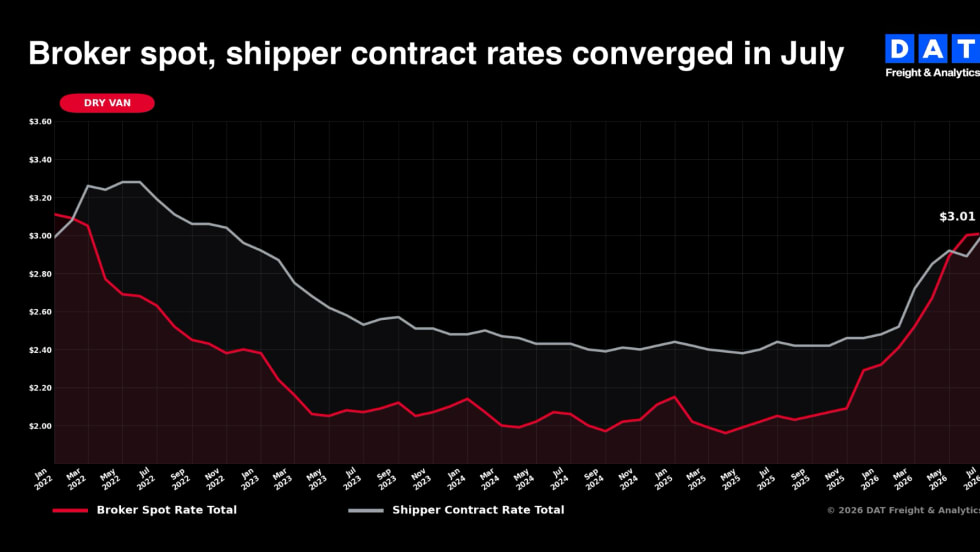
Tight Trucking Capacity Pushes Rates Higher Even as Freight Volumes Fall
“Spot rates moving ahead of contract rates have historically signaled a tightening market, but we haven’t seen a capacity-driven market quite like this one,” said DAT's Dean Croke.
Read More →