




Knowing Isn't Fixing
Safety technology on trucks is one reason crash rates, injury rates and fatalities have fallen over the past two decades. Yet insurance rates and the costs of settlements they represent have gone up. Why?
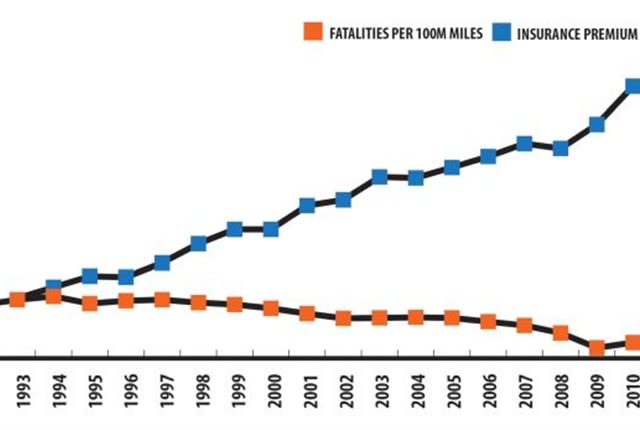
Over the years, accident rates are down but insurance premiums are up.
Safety technology on trucks is one reason crash rates, injury rates and fatalities have fallen over the past two decades. Yet insurance rates (and the costs of settlements they represent) have gone up. Why? Because adding safety technology increases your fleet’s liability if you don’t do anything with the data it generates.
True story: A safety manager at a Top 100 fleet found his best million-mile driver in the company lounge and asked how he was doing. The driver said, “Well, I’m all right. But I had a little issue with my truck, so my manager OK’d a trip to the shop.”
“What’s the problem?” asked the safety manager.
“I have this high-pitched beep come out of my dash whenever I follow another vehicle. And now it’s not working. I’m hoping they get it fixed today so I can still pick up a load.”
After the conversation, the safety manager scratched his head, wondering what the beeping sound might be. The company had recently upgraded the fleet with collision-mitigation technology. “But that couldn’t be what the sound is,” he told himself. “This is a million-mile guy.”
He ran a query in the system, and sure enough, there was a report showing the driver routinely left less than 2 seconds following distance. The collision mitigation system must have been driving him crazy with beeping for more than a month! Did he literally wear out the buzzer?
The worst part? No one but the driver knew. No alerts were sent to the safety manager, the regional safety director, or the vice president of safety. Instead, the company was watching its “worst 50” drivers for incidents. It never occurred to him (or apparently anyone) that million-mile drivers might make mistakes like routinely following too closely.
The safety manager called the shop and learned the truck was fixed. But he realized that while the truck was operationally safe to drive, his star driver might not be. He returned to the lounge to have a sit-down talk with the driver. As he walked, he wondered about the best thing to say. “We have a plan for the usual suspects,” he thought to himself. “But not for someone with a great safety record. How do I fix this without insulting his experience? Who else is having these kinds of issues?”
There are three takeaways from this story:
Train your drivers on new systems, equipment and safety expectations before they are expected to use them.
Inspect what you expect. Do you expect safe performance from your whole fleet? Then you need to inspect the whole fleet for possible issues.
Create corrective action plans for issues that arise. Have you determined what the actionable data is from your system? What is your plan to act on it?
The importance of training
Collision-mitigation, lane-departure warning, rollover prevention, electronic logging devices—all are amazing technologies and systems designed to improve safety. However, drivers still must respond and react correctly. And that takes training.
Fleets cannot assume these technologies are “intuitively obvious.” Many fleets skip formal training in favor of an informal learning curve. The problem with this is three-fold:
Garbage in—garbage out. Don’t assume that if drivers know how to do paper logs, they will easily be able to change duty status and edit logs on a touchscreen.
These systems send visual and audible signals that can be distracting. A driver unaware of where the noise is coming from will take his or her eyes off the road to find the source. Not a good thing.
These systems are designed to encourage proactive, safe behavior. The time to learn about the collision-mitigation system is not when a collision is imminent. Drivers must have the knowledge to react instantly if they hear/see a signal.
A paper manual or YouTube video isn’t going to cut it. Many drivers require hands-on or firsthand experience with technology. More and more fleets are turning to regular, ongoing training to include new technologies. If the fleet has invested hundreds or thousands of dollars per truck in technology, guaranteeing drivers actually use it will be worth a little training each month.
Deluge of data
Vehicle safety systems generate vast amounts of data. The flood of new technologies has some predicting you’ll have double the quantity of data in 14 months.
Deluged with data, how do you distinguish actionable data from noise? Actionable data lets you do something with the feedback, so focus there: hard braking, hard cornering, following distance, etc. The company’s liability is centered between the data that is tracked and ultimately, what the company does with the data.
Good, actionable data should answer not just “what,” but also “where, when, and why.” Context allows you to take the right action. Hard braking suggests one problem in rush-hour traffic, and something totally different at 2 a.m. Giving a driver training to correct the wrong problem leaves the bad habit and annoys the driver.
In summary, negative safety data without an action plan is a plaintiff’s dream case for punitive damages. In the interest of realizing the cost / benefits a safety system can offer, let’s educate our drivers. Let’s focus on data we can actually act upon. And assume nothing about the performance of a driver, whether he or she has 1,000 safe driving miles or 1 million.
Laura McMillan is vice president of training development for Instructional Technologies Inc., which offers Pro-Tread custom and standard training programs. She holds a CDL, a master’s degree in instructional design, and 20-plus years with fleets like Schneider National and Roehl Transport. This article was authored under the guidance and editorial standards of HDT’s editors to provide useful, non-promotional information to our readers.
More Safety & Compliance

From One Generation to the Next: How Mentorship Builds Safer Truck Drivers
After three decades in trucking, Harold Perry shares what he's learned about driver safety, mentorship, and helping the next generation build confidence behind the wheel.
Read More →
FMCSA Pauses Biennial-Update Enforcement Amid Motus Transition
Carriers whose updates were due on or after June 1 have more time, while FMCSA works to stabilize its new registration system and warns of phishing sites impersonating its new carrier registration system, Motus.
Read More →
ZF Expands Commercial Vehicle Push in North America
ZF is expanding its North American commercial-vehicle presence with new transmission applications, electrification, trailer technology and autonomous-driving systems.
Read More →
Truck Drivers Need More Than Another Alert
Fleets have more visibility into truck health, safety events, and driver activity than ever. The next challenge is turning all that information into useful guidance for the person who has to decide what to do next.
Read More →
Tesla Wants a Self-Driving Semi. Are Cameras Enough?
Could Tesla’s camera-only autonomous driving technology work on an 80,000-pound Semi? In this commentary, HDT's Deborah Lockridge takes a look at Tesla, Cybercab, and how autonomous trucks see the road.
Read More →
What DOT’s Automated Vehicle Strategy Means for Trucking
The U.S. Department of Transportation issued a new automated-vehicle strategy that outlines plans for driverless-truck regulations, cross-state freight corridors, and federal safety standards.
Read More →
NYC Expands Speed, Pedestrian Safety Tech Across Fleet
New York City is expanding intelligent speed assistance and pedestrian-alert systems across its municipal fleet, moving the technologies from pilot programs into vehicle procurement and retrofit requirements.
Read More →
FMCSA Removes 110 Truck Driver Training Schools from Certified ELDT List
Federal regulators also are targeting more than 160 additional training providers and launching a nationwide audit of third-party CDL skills testers as part of a broader crackdown on trucking fraud.
Read More →
Beyond DOT Compliance: What Makes a Trucking Fleet Truly Safe?
A trucking fleet can follow every rule and still make unsafe decisions. The real test comes when safety conflicts with freight, productivity, or cost.
Read More →
Hours of Service Pilot Programs: FMCSA Readies for 2027 Rollout
Two pilot programs could eventually reshape hours-of-service rules, giving truck drivers options to pause their 14-hour clock or use longer split sleeper rest periods.
Read More →