




Killer Trucks No More
How the industry is working to better its public image.

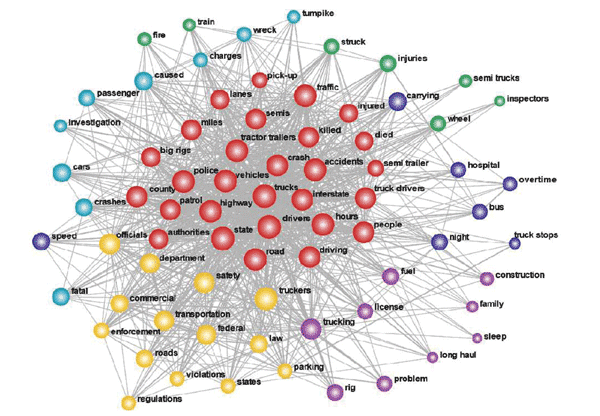
Scan the nation's newspapers and magazines on any given day, looking for references to the trucking industry, and you won't like what you see.
Among the key words that frequently appear in stories about trucking: accidents, crash, police, killed, injured, fatal and died.
This is what the public relations firm Waggener Edstrom Worldwide learned when it analyzed articles about trucking in newspapers, wire services and magazines. There were some favorable stories, to be sure, but "the industry faces a significant challenge in overcoming the pervasive image of unsafe and reckless semi-trucks and semi-truck drivers," the researchers concluded.
They were using a web search technology that has begun to play a significant role in the image business. The Narrative Network technique, as Waggener Edstrom calls it, uses a proprietary Internet text mining program to create a visual map of how the media perceive a brand or a topic. It's a technique much in demand by politicians, who use it to focus and refine the image they present to the public.
"(Waggener Edstrom) told us that in all the research they have done with this product, we have the worst image of anybody that ever used the software," says James O'Neal, president of O&S Trucking, Springfield, Mo., and chairman of the Truckload Carriers Association.
O'Neal says despite some research indicating that trucking's image is not bad, he has long suspected that there is a problem. So he asked the TCA Communications and Image Policy Committee to have Waggener Edstrom do the study. "Why are people scared to be on the road with us, and why do juries feel like they want to punish us?" he wanted to know.
The industry's image is a bigger issue than the portrayal of trucking in the media, he said. But portrayal is a large part of image, and he wanted to get a benchmark for gauging how the industry is portrayed. It turns out that the benchmark is "real low," he says.
The researchers studied the web sites of 75 media outlets, including metropolitan daily newspapers, wire services such as the Associated Press, business magazines such as Forbes and Fortune , and consumer magazines such as Time and People . They also looked at trade magazines (such as HDT ), which cover the industry in more detail and in a more positive light than the other publications.
The analysis produced a "map" that displays the key words, issues and concepts included in the coverage. Among the issues referenced in the analysis are familiar items such as the parking shortage, speed governors, illegal loads and the impact of government regulations.
What the researchers found is that coverage of the industry, particularly at the local and metropolitan level, perpetuates and reinforces a negative image. "Currently, the most common type of trucking industry-related story reaching the average consumer involves an accident or tragedy of some sort," they said in their report.
The researchers also found that TCA, specifically, has a relatively low profile. The association does not provide an industry voice in the most negative coverage, but when it does show up in coverage it projects a positive voice, indicating it has an opportunity to act as an industry leader.
WHAT TO DO
It adds up to a big problem, according to O'Neal. "Public image shapes public opinion, which shapes public policy," he says, echoing the mantra of another industry leader, Steve Williams, chairman of Maverick Transportation and former chairman of the American Trucking Associations.
Trucking is more vulnerable to public policy than most industries. Tick off a half-dozen of the top national issues - safety, security, mobility, the environment, taxation, international trade - and you'll find compelling interests for the trucking industry. And, O'Neal adds, a poor industry image can be an invisible thumb on the scales of justice.
"Anybody that's been in an at-fault fatality accident knows that the deck is stacked against them if you do have to go to court," he says. "No matter how good your safety program, how good your risk management practices, the people you've got in place ... if you get in a court of law and you are at fault in an accident, you're really not on a level playing field at all. The terrible emotions of the case are going to be on the plaintiff's side.
"So it is important for us to promote a better image, if for no other reason than to create a better jury pool. It's not the only reason, but it is a compelling reason, because we are a safe industry, we are a humanitarian industry, we are a good Samaritan industry, we are a philanthropic industry - but nobody thinks about those things once an accident happens."
O'Neal had hoped for something positive in the research, but it is hard to find. "It is what it is ... a continual drumbeat of bad press because of the sensational nature of any truck accident."
The researchers offered a number of recommendations for ways to counteract the way the industry is portrayed. Among them: Reach out to metropolitan publications with programs to give reporters a sense of a truck driver's daily life, and of the essentiality of trucking; and launch a campaign to inform reporters of statistics that show the industry's dedication to safety and to improving the environment.
They also suggested that there is an opportunity for the long-haul industry to address the matter of driver pay.
"We learned from the research that one of the challenges facing the industry is how we recruit new drivers," says Deborah Sparks, TCA vice president of development. The driver recruitment ads on the backs of trailers point out that the industry pays by the mile, which sends an unfortunate message to the public: Those who drive the fastest and longest earn the most.
But, in fact, most TCA members have a "livable wage" program in place, she says. "Unfortunately we're not telling that to the public when we put those posters up. They are not complimentary of what we are actually doing."
O'Neal explains that his company's livable wage program, which he copied from Pottles Transport, amounts to a guarantee: "It's measured by the mile but paid as a salary. It's got the floor in it that as long as you're ready and available to work, if through no fault of your own you don't get enough miles to make a reasonable, livable wage, we're going to make sure that you do."
Fleet managers, safety directors and payroll clerks get paid whether freight is up or down - and drivers should as well, O'Neal says.
This subject has been assigned to one of four subcommittees the TCA Communications & Image Policy Committee has created in response to the research. The subcommittees are charged with presenting recommendations for action at the TCA annual meeting in March.
Another subcommittee will address the idea of drafting an industry Code of Conduct. A third will look at coming up with a brand that can be used to identify the industry and communicate with journalists - "We do not have one word that we use to describe ourselves," Sparks says. "We don't have one brand image." And a fourth subcommittee has been tasked with figuring out how to get the word out about what trucking is doing to improve the environment.
Sparks says they want to be sure not to bypass programs that the industry already has under way. "We don't want to barrel through and ignore stuff that's already been done."
TCA is a stand-alone organization, but also is a member of the ATA federation of trucking interest groups. ATA already has a host of image-building programs that target the issues and audiences listed by the researchers.
For example, America's Road Team, sponsored by Volvo Trucks, selects and trains drivers to take a message of safety and essentiality to a variety of audiences, including newspapers and other media.
ATA also runs the "Good Stuff, Trucks Bring It" branding program; the "Be Ready, Be Buckled" seatbelt program; the "Share the Road Safety Tour," sponsored by Mack Trucks and Michelin; National Truck Driver Appreciation Week; the "Get Trucking" program for aspiring drivers; and the "American Supports You" trailer wrap program.
There is the possibility of overlapping image efforts as TCA goes forward with its plans, but the organizations appear to have addressed that risk.
For this research project, the liaison between TCA and ATA is Virginia Parker, director of marketing for Flying J and chairman of the ATA Communications and Image Policy Committee.
The subcommittees tackling the issues raised by the research are staffed by members of both TCA and ATA, Parker says. "(They) have a passion for improving the industry's image ... (and) are anxiously engaged in working together for the benefit of industry associations."
O'Neal describes this effort as a marathon rather than a sprint. The industry's image has been built up over a long period of time, he says. "It will take years to make the progress we need to make."
What he wants to do is counteract the image of trucking as anti-safety and in it only for the money. "This industry is so far removed from that and the story is not getting out."
In a couple of years he hopes to run the Narrative Network analysis again and come back with a different result.
More Fleet Management

Color Match Smarter: Tools That Restore & Perform
For fleet managers and collision repair professionals keeping heavy-duty trucks on the road, getting the color right the first time isn't just about appearance — it's about efficiency, turnaround time, and bottom-line results. Discover how today's digital color tools are transforming the repair process from guesswork to precision.
Read More →
FMCSA Pauses Biennial-Update Enforcement Amid Motus Transition
Carriers whose updates were due on or after June 1 have more time, while FMCSA works to stabilize its new registration system and warns of phishing sites impersonating its new carrier registration system, Motus.
Read More →
2026 Blueprint for Countering Smarter Supply Chain Theft
Cargo theft is no longer just the cost of doing business. It's a multi-billion-dollar criminal enterprise exploiting vulnerabilities across your fleet, drivers, and supply chain.
Read More →


How Telematics Improves Visibility, Control, and Performance in Refrigerated Fleets
Explore how telematics help refrigerated fleets improve visibility, uptime, efficiency, compliance, and cargo protection across connected cold chain operations.
Read More →
What the U.S.-Canada Trade War Means for Trucking
Escalating U.S.-Canada tariffs could disrupt cross-border freight, reduce truck volumes, raise costs, and create new uncertainty for carriers on both sides of the border.
Read More →
What Are Trucking’s Top Concerns for 2026?
The American Transportation Research Institute wants to know what's worrying trucking fleet managers, drivers, and other stakeholders in its annual Industry Issues survey.
Read More →
American Trucking Associations Looks for a New Leader
ATA President and CEO Chris Spear abruptly left his job at the association on August 21, at a pivotal time for the trucking industry.
Read More →
Public Wi-Fi Cybersecurity Risks: How Truck Drivers and Fleets Can Protect Their Data
Public Wi-Fi can expose truck drivers and fleets to credential theft, malware, and other cyber threats. Here’s how to reduce the risk on the road.
Read More →
For Nicky Cupp, Fleet Innovation Starts With Frustration
HDT Truck Fleet Innovator Nicky Cupp turns everyday pain points at Fraley & Schilling into opportunities for better technology and smarter processes.
Read More →
Adam Buttgenbach’s Approach to Electric Trucks: Start With Where They Fit
HDT Truck Fleet Innovator Adam Buttgenbach helped PepsiCo build one of North America’s largest EV fleets by focusing on where electric trucks make operational sense.
Read More →