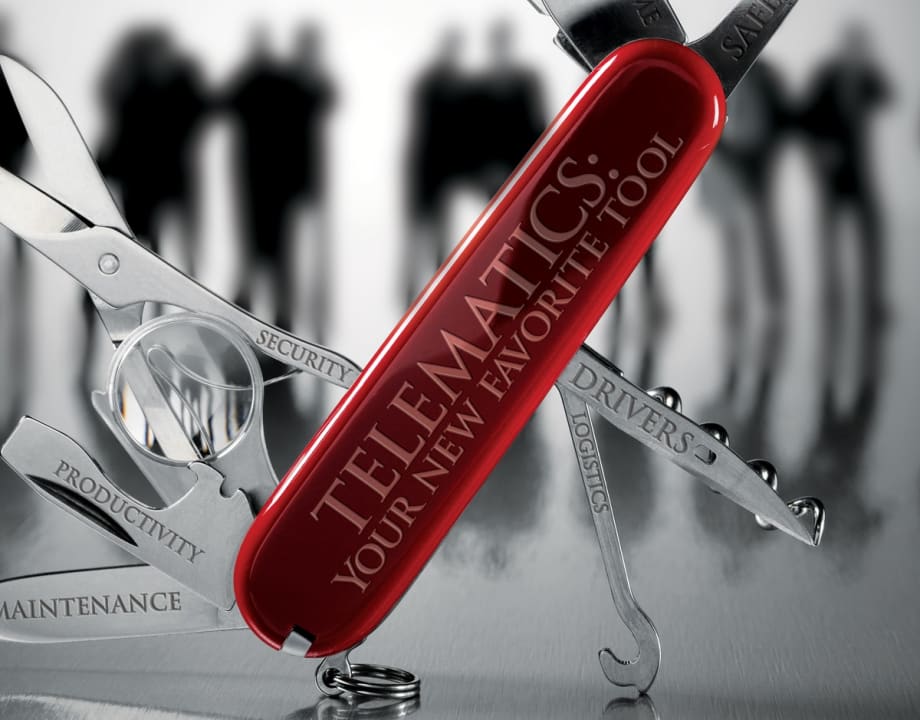
Integration and data analytics are turning telematics into a valuable, customizable tool that can improve every part of a fleet’s operations.
Credit:
Getty Images
11 min to read
Drivers love to loathe electronic logging devices. But these onboard data collection and transmission devices, recently mandated by the federal government for commercial drivers, aren’t going anywhere.
Ad Loading...
And ELDs have opened up a whole new frontier in vehicle telematics, because now — in theory, anyway — the vast majority of commercial trucks are now connected trucks, collecting data about virtually every aspect of their working day.
The timing of the mandate could not be better for the burgeoning science and technology of telematics, which essentially uses sensors on vehicles to monitor and record various component life and performance, and relay information about those connected systems back to fleets and OEMs.
Ad Loading...
The Evolution of Trucking Telematics
In 2014, Navistar announced what it said was the first telematics system available from a truck maker.
“Like an electronic umbilical cord, International telematics moves wireless data from each vehicle into the office or workstation of fleet and maintenance managers,” we reported at the time.
“An in-vehicle device transmits telemetry and location information via cellular wireless technology. International telematics software then organizes and packages the information, displaying it through a secure website that provides real-time data reporting and administration on each vehicle in customers’ fleets.”
Early telematics were essentially reactive systems. In addition to amber or red warning lights flashing on a dashboard, these systems sent an electronic warning to fleet executives and OEMs, alerting them of problems on the vehicle in real time.
As they got more sophisticated, they were integrated into systems that could set up a sequence of events confirming parts availability and scheduling a repair.
Ad Loading...
Telematics expanded rapidly into other operational areas beyond basic downtime and maintenance warnings. Today, telematics touch every aspect of fleet operations and are being used to monitor and improve the performance of both humans and machines in fascinating new ways. And this is just the beginning.
In addition to taking much of the guesswork out of repairs, telematics systems are generating data about every aspect of a truck’s working day that can help fleets take efficiency to the next level.
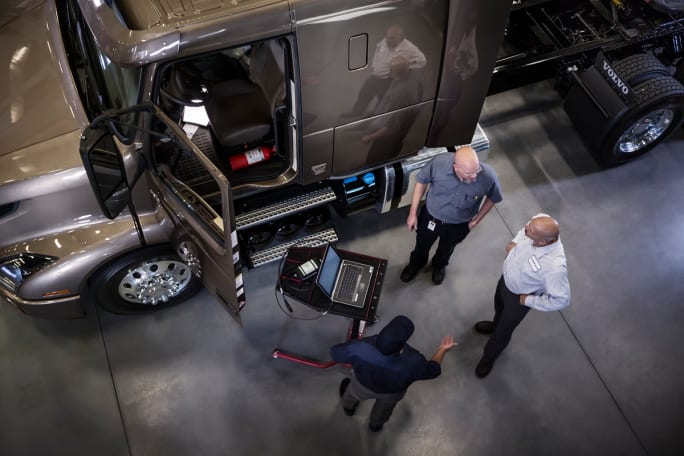
Photo: Volvo Trucks North America
Uptime and beyond
The power of telematics as an uptime enhancer was obvious to Rush Truck Centers, the nation’s largest network of commercial vehicle dealers, which started putting together its own telematics network several years ago.
Today, Rush maintains a state-of-the-art response center outside its San Antonio, Texas, headquarters. The company is looking to expand its telematics offerings extensively as systems become more powerful and customers become more comfortable with them.
“I’ve been in telematics for 10 years now,” says Cindy Hunter, technology sales director for Rush Truck Centers. “In the beginning, the majority of our customers didn’t have a clue what we were talking about.
"Now, I think the adoption rate among Rush customers for telematics systems is between 65% and 70%. And the ELD mandate is really driving that trend.
Ad Loading...
"So we feel that this is a technology that is going to continue to grow and expand as more fleets begin to start using telematics systems and applying the information they provide. And I still don’t think we all really see what’s possible yet with this technology.”
Most fleets operating now have some type of telematics solution deployed, many of which are stand-alone ELDs and not true telematics systems, says Glenn Williams, vice president of product management for Trimble’s transportation division.
But, he adds, as fleets see the data ELDs now make available on a daily basis, adoption rates are likely to increase throughout the remainder of 2019 and beyond.
“Fleets that are adopting telematics solutions solely for ELD compliance will likely see that they can use this technology to go beyond hours-of-service applications to improve route effectiveness, dispatch efficiency, and the overall performance of their drivers and vehicles,” Williams says.
“Fleets that currently have more robust telematics solutions in place can utilize the data collected within actionable dashboards and advanced analytics to make business decisions.
Ad Loading...
"Fleets are focusing on retaining drivers, improving utilization, optimizing routes and available hours of service, improving safety and compliance, and reducing vehicle downtime.”
Fleet executives are a lot more open to telematics now than they were just two or three years ago, says Adam Bruttell, vice president, sales and marketing, Mix Telematics.
“Back then, we were hearing a lot of concerns about Big Brother watching over our every move. And you just don’t hear that anymore. The idea that telematics are somehow punitive for drivers or a micromanagement system has largely gone by the wayside.
"Now, the prevalent understanding is that these systems are about making employees more productive, drivers safer, and fleets more profitable.”
Mix Telematics is a company that is using data generated by telematics systems on vehicles to focus on driver safety and fuel efficiency — just two of the ways this technology is moving out of the maintenance realm.
Ad Loading...
“ELDs have — by far — been the biggest factor in super-powering both the amount and type of data coming into fleets now,” Bruttell says. “All arrows now point to the vehicle. The vehicle is at the epicenter of everything a fleet is doing. And telematics is the tool that connects the vehicle to the worker, and the worker to the work.”
Sanjiv Khurana, general manager, digital vehicle solutions, Daimler Trucks North America, says the global truck manufacturer is thinking about telematics in three ways.
First, he says, in terms of providing insights about the truck itself. Second, gaining new insights about the driver, and, third, insights about the load and the fleet operations.
“Our customers want more information back from the truck,” Khurana says. “Many of the hardware features are provided by third-party telematics providers. Our customers are requesting those features from us so that the complete connectivity solution works directly from the truck as a single source of information and insights.
"We will evolve our telematics services to use what’s already on the truck to provide data and insights to our customers and to third parties who can use that information to drive fleet solutions or other telematics solutions.”
Ad Loading...
At the same time, Khurana says, Daimler sees the truck and its architecture evolving to allow for additional information and data elements that help fleets run their business.
“As an example, when we look at cameras on a vehicle, we can use the video connectivity already built into the truck to provide some of those solutions. Our customers want to avoid the hassle of installing additional equipment on the truck and really want the truck at its fullest potential directly from the factory. Those are the vehicle design changes telematics are driving today.”
The real inhibitor for telematics currently is not so much a technical piece of getting the data from the truck as it is a challenge for the consumer to use data in more parts of their operation, says Conal Deedy, director of connected vehicle services, Volvo Trucks North America.
“Each company has to figure out where telematics data can help improve efficiencies. On the other end of the spectrum, Volvo Trucks works with a number of companies that are closely tracking fuel economy and then pairing it with other information, such as driver performance characteristics and how the truck is tuned, to evaluate how they can achieve the best fuel efficiency from their Volvo truck.
"This information could lead to a training or bonus program that incentivizes drivers for great performance and helps the company hit efficiency goals, or identifying a truck that could be reprogrammed to achieve maximum fuel for its duty cycle.”
Ad Loading...
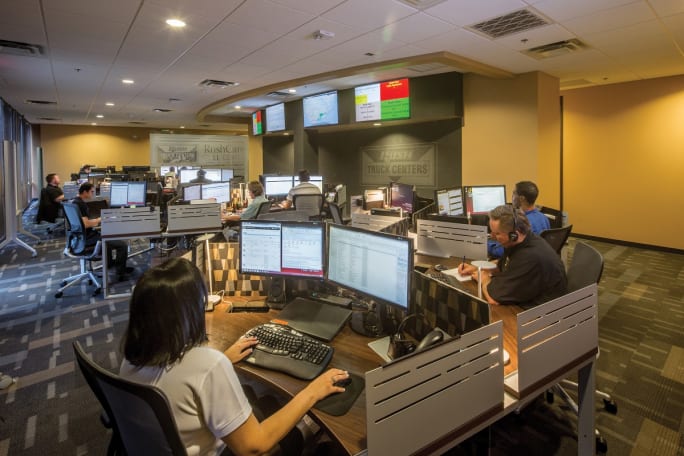
Rush Truck Center’s modern call center uses a host of products, services, systems and dealerships all over the country to troubleshoot problems on the road.
Photo: Rush Truck Center
A more integrated, customized approach
As the power of telematics grows, so does the need to make the various systems that support the technology more user-friendly.
In the early days, getting actionable intelligence from the deluge of data coming in from vehicles was often compared to drinking from a firehose for many fleet managers. So a primary goal over the past couple of years has been to make information more accessible for users.
This means customizing the way it is presented and developing a more integrated and user-friendly way of accessing information coming in from different providers.
“Making the data actionable has been a major priority for us,” says Rush’s Hunter. “Any ping that comes off a truck has tons of data in it. So it’s important for us to create some sort of filter that allows fleets to set up what issues they want alerts for.
"Because the safety office doesn’t care about idle time — but the maintenance department will care not only about that, but also about hard braking and fuel economy numbers as well. But all of this information will be prioritized differently for each of those fleet departments.”
Ad Loading...
To help, Hunter says Rush has developed its own, customizable dashboard that allows customers to set up the inflow of data in a way that helps them be most effective at responding to issues.
Robb Nixon, Rush Care vice president, aftermarket sales, says this is where telematics has brought new efficiencies to fleets.
“Thanks to telematics, once there’s a problem with a vehicle, we work that problem in a way that’s never been possible before,” he says. “This includes routing a vehicle into our own shop or a repair facility outside of our network. We can search e-commerce sites across the web to find parts if one is unavailable, and track the repair process from start to finish.
"These processes have been so efficient that we’ve seen dwell time in dealerships cut in half and uptime double for some of our fleet customers.”
Another adoption inhibitor Deedy points to is the fragmentation of telematics services and the expense of paying subscription fees for multiple modems on the truck, which creates challenges when multiple interfaces don’t work together or cascading expenses.
Ad Loading...
Volvo Trucks uses one embedded telematics system for the whole truck and customers see the value of a system that is streamlined and integrated.
As more and more data is being exchanged across different telematics providers to different offices inside fleets, OEMs and dealers, the need for some sort of basic level of connection and integration is obvious. And this, experts say, will likely be the next advance in telematics technology.
“As we move beyond ELDs and fleets start to fine-tune their data, we’re going to see a whole host of providers in the telematics field,” Bruttell explains.
“Like with anything else, you’re not going to have one provider be the best at everything. The OEMs and dealers will have the best maintenance information and powertrain upgrades. Fleets will have a favorite provider for asset tracking, route optimization, back office documentation… safety and driver modification. And the need to be able to integrate all the information from these experts in their respective fields will be vital for fleets.”
Trimble’s Williams adds, “We are already seeing the evolution of telematics systems, with advanced telematics solutions integrating with multiple third-party in-cab and back-office systems, including downloadable apps, consumer-grade hardware and others.
Ad Loading...
"Advanced telematics systems not only integrate third-party applications, but they also provide a means for a streamlined flow of data, improving load visibility for multiple individuals, including drivers, fleets, shippers and consignees.”
This supports the broader industry trend around data democratization, Williams says: Customers want easier access to data and the tools that make data more consumable.
The future of telematics will likely include giving fleets actionable data through customized reports and dashboards, as well as other business intelligence tools, to help them make more informed decisions about their drivers and equipment, he says.
“I think we will likely see a continued adoption of machine learning and artificial intelligence (AI) in telematics solutions,” Williams adds.
“Today, Trimble utilizes machine learning and AI in its Driver Retention Analytics and Video Intelligence solutions, taking large amounts of data to identify trends and prescribe actions, allowing fleets to make proactive decisions, whether it is around driver retention or coaching, to improve the overall safety and performance of their operations.”
Ad Loading...
That’s a goal the OEMs are onboard with, too.
“I think the first point of interconnectivity will be between the truck and the cloud and between our cloud and our partners’ clouds,” DTNA’s Khurana says.
“There are a variety of different sensors and different telematics providers of different services, and as we start to develop what we call Detroit Connect Direct and cloud connectivity, that will drive some standardization in how those APIs are structured.
"That becomes the first point of interconnectivity and standardization between the truck OEM, third-party service provider and a fleet customer. It won’t happen overnight, but that’s where it’s going.”
More data, faster data
“I think 5G will be a complete game-changer for telematics in the future,” Bruttell says. “As fast as telematics are becoming accepted, we still can’t get all the information coming off a truck downloaded efficiently in our current broadcast format. That’s why I think expanded network capabilities will really drive this whole thing to a whole new level of efficiency.”
Ad Loading...
Migration to a 5G network is already underway, Bruttell adds, and the new spectrum should be in widespread in the next three to five years.
“When you start to consider how much more integrated and customized the customer interfaces will be, combined with the exponential increase in data availability, I think we’re looking at major disruptive forces in how fleets conduct their business.
"Something like 30% of Fortune 500 companies in the 1980s are not in business today. And telematics will be as big a game-changer for the trucking industry. I can’t even begin to describe how these systems will work 10 years from now. They will allow fleets to track assets, safety and uptime in ways that seem impossible to us now — even with all the new technology we’re talking about.”
For fleet managers and collision repair professionals keeping heavy-duty trucks on the road, getting the color right the first time isn't just about appearance — it's about efficiency, turnaround time, and bottom-line results. Discover how today's digital color tools are transforming the repair process from guesswork to precision.
Carriers whose updates were due on or after June 1 have more time, while FMCSA works to stabilize its new registration system and warns of phishing sites impersonating its new carrier registration system, Motus.
Cargo theft is no longer just the cost of doing business. It's a multi-billion-dollar criminal enterprise exploiting vulnerabilities across your fleet, drivers, and supply chain.
Explore how telematics help refrigerated fleets improve visibility, uptime, efficiency, compliance, and cargo protection across connected cold chain operations.
Escalating U.S.-Canada tariffs could disrupt cross-border freight, reduce truck volumes, raise costs, and create new uncertainty for carriers on both sides of the border.
The American Transportation Research Institute wants to know what's worrying trucking fleet managers, drivers, and other stakeholders in its annual Industry Issues survey.
HDT Truck Fleet Innovator Adam Buttgenbach helped PepsiCo build one of North America’s largest EV fleets by focusing on where electric trucks make operational sense.