




How Trucking Fleets Can Be Proactive With Tire Safety
Drivers are required to physically inspect their tires at the beginning and the end of a driving shift, and fleets have some obligation to look after these expensive assets — but somehow tires continue to come apart out on the highway.

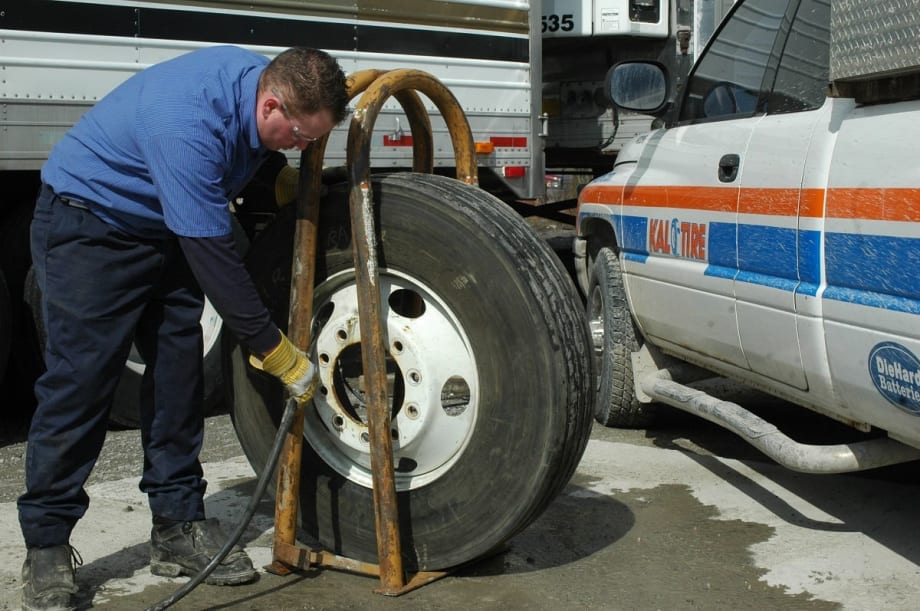
Truck tires don't run on wishes and prayers and proper tire managment can save fleets a lot of headaches.
Photo: Jim Park
Commercial vehicle drivers are required to physically inspect their tires at the beginning and the end of a driving shift, and fleets have some obligation to look after these expensive assets — but somehow tires continue to come apart out on the highway.
Blowouts cause not only mayhem when they pop, but now you have a dangerous chunk of debris blocking the roadway. The fleet is out about a thousand bucks for a new tire and a service call, and the driver loses two to three hours of precious productivity. Preventing all that calamity must be worth 15 or 20 minutes in the morning, right?
It has been reported that about 80% of roadside tire failures are a direct result of creeping air loss. In other words, undetected under-inflation.
The chief cause of under-inflated tires is lack of basic maintenance. Tire pressures need to be checked at a minimum on a weekly basis. While acknowledging that's almost impossible for fleets that have trailers hidden in drop-yards, some inexpensive technology can alert drivers to under-inflated tires before driving away with one. Or better still, automatic inflation systems can re-inflate tires before they leave the drop yard.
Barring that, drivers could check the pressure — but they seldom do. While whacking the tire with a pipe won't give any indication how much air pressure is in the tire, at the very least the driver knows there's some air in the thing. That's better than nothing, but just barely.
Inspecting Your Truck Tires The Right Way
"Pressure checks with a calibrated tire pressure gauge is the only reliable way of ensuring tires are properly inflated," says Kyle Chen, the truck and bus radial tires brand manager at Bridgestone. "Drivers and maintenance staff should also be briefed on the correct inflation pressure for various tires and wheel positions."
Chen says basic tire checks should be performed every day by drivers, and more thorough inspections should be done by the maintenance staff whenever the truck comes in for a PM.
"The basic tire casing inspection includes checking the sidewall for bulges that may indicate internal damage such as a belt separation," says Chen. "Also, watch for cuts in the sidewall that are deep enough to see the body ply. Check for objects penetrating the tire, such as nails and screws that can be pick up in yards."
The tread must be at least 2/32 of an inch deep on drive and trailer tires, and 4/32 on steer tires. But Chen warns that any point on the tread that is worn below those depths, so as flet spots resulting from a skid, will put a tire out of service.
"DOT inspectors will look for the lowest point on the tire and measure that," he says. "Also be sure there is no exposed belts showing on the tread face. That's an out-of-service violation as well."
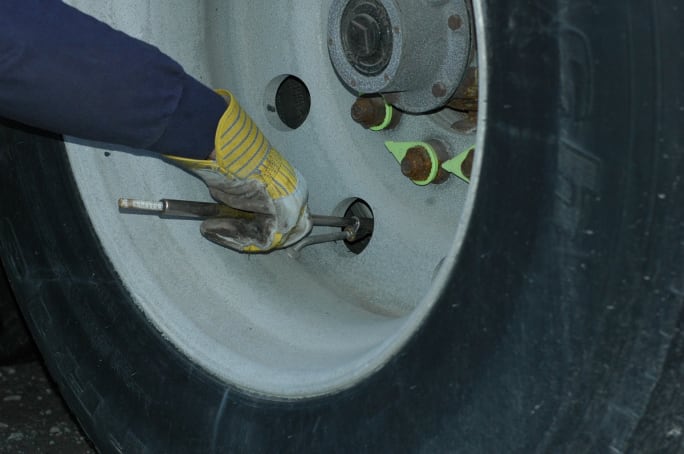
It may help to remind drivers that investing 30 minutes once a week to closely inspect their tires could help prevent an on-road failure that could cost them several hours of downtime.
Photo: Jim Park
Getting Drivers On Board
Drivers are critical to the success of a tire care program, but getting buy-in and support for the plan can be an uphill battle. Drivers usually view tires as a maintenance problem and can be reluctant to devote any time to inspecting them and keeping them properly inflated. Today, with pressure from mandatory electronic logging rules, drivers are less likely give up driving time to a probably unpaid task.
It may help to remind drivers that investing 30 minutes once a week to closely inspect their tires could help prevent an on-road failure that could cost them several hours of downtime (and cut into their pay).
Some fleets report moderate success in getting drivers involved with tire maintenance by teaching them about tires and the importance of regular inspections and pressure checks.
Tire-Care Training Begins at Orientation
For one fleet, indoctrination begins at orientation. Drivers are taken through tire inspection procedures and told they are expected to do regular pressure checks and top-offs when necessary. The training session includes a reminder that downtime hurts them, too. If they are stuck on the side of the road for several hours waiting on a service call because they didn’t check their tires, eating up their on-duty time and paid miles, they have nobody but themselves to blame in most cases.
The fleet provides tire gauges and stencils the recommended tire pressures right on the vehicle to advise anyone who might take a pressure gauge to the truck what the cold pressure should be.
The maintenance department has also assembled a booklet that illustrates various tire defects, including photos of various types of irregular wear. Drivers don’t need to be experts on what causes irregular wear but being able to recognize it when they see it can help preserve tire life. In many cases, if irregular wear is detected early enough, the tire can be saved.
Tire Care 101
It might seem like an extra load of work, but preparing a Tire Care 101 kit for drivers listing fleet tire pressure, what to look for in a visual inspection, and some images of irregular wear could help enlist drivers in the battle against bad tires. Some drivers will embrace the effort and do their part to report problems, and some will not, but getting even a few on board would be better than none.
"Tire maintenance and regular inspections is thankless work, but you should also consider the hidden costs of ignoring tires," Chen warns. "You have the obvious things like the expense of the roadside repair or replacement and the associated downtime, but you also face possible CSA violations and fines, degraded fuel economy from under inflated tires. If you're not proactively managing your tires, then the problems can multiply and cause even greater difficulties down the road."
More Safety & Compliance

FMCSA Pauses Biennial-Update Enforcement Amid Motus Transition
Carriers whose updates were due on or after June 1 have more time, while FMCSA works to stabilize its new registration system and warns of phishing sites impersonating its new carrier registration system, Motus.
Read More →
ZF Expands Commercial Vehicle Push in North America
ZF is expanding its North American commercial-vehicle presence with new transmission applications, electrification, trailer technology and autonomous-driving systems.
Read More →
Truck Drivers Need More Than Another Alert
Fleets have more visibility into truck health, safety events, and driver activity than ever. The next challenge is turning all that information into useful guidance for the person who has to decide what to do next.
Read More →
Tesla Wants a Self-Driving Semi. Are Cameras Enough?
Could Tesla’s camera-only autonomous driving technology work on an 80,000-pound Semi? In this commentary, HDT's Deborah Lockridge takes a look at Tesla, Cybercab, and how autonomous trucks see the road.
Read More →
What DOT’s Automated Vehicle Strategy Means for Trucking
The U.S. Department of Transportation issued a new automated-vehicle strategy that outlines plans for driverless-truck regulations, cross-state freight corridors, and federal safety standards.
Read More →
NYC Expands Speed, Pedestrian Safety Tech Across Fleet
New York City is expanding intelligent speed assistance and pedestrian-alert systems across its municipal fleet, moving the technologies from pilot programs into vehicle procurement and retrofit requirements.
Read More →
FMCSA Removes 110 Truck Driver Training Schools from Certified ELDT List
Federal regulators also are targeting more than 160 additional training providers and launching a nationwide audit of third-party CDL skills testers as part of a broader crackdown on trucking fraud.
Read More →
Beyond DOT Compliance: What Makes a Trucking Fleet Truly Safe?
A trucking fleet can follow every rule and still make unsafe decisions. The real test comes when safety conflicts with freight, productivity, or cost.
Read More →
Hours of Service Pilot Programs: FMCSA Readies for 2027 Rollout
Two pilot programs could eventually reshape hours-of-service rules, giving truck drivers options to pause their 14-hour clock or use longer split sleeper rest periods.
Read More →
New Guide Offers Pet Safety Tips for Truck Drivers
Hundreds of thousands of pets travel in truck cabs. A new safety guide from Volvo Trucks and the Center for Pet Safety offers practical advice for truck drivers who bring dogs and cats along for the ride.
Read More →