





Related: Tire Maintenance - It’s Not Just Checking Tire Pressure
Taking Tire Pressure Management to the Next Level
Tire pressure monitoring and inflation systems are a proven way for fleets to manage one of their biggest consumable items and ensure safe operation. New technologies will take the capabilities of these systems to the next level.
December 28, 2017
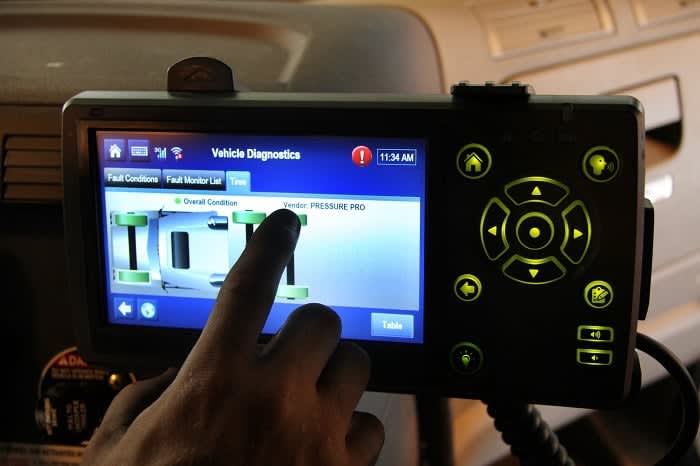
More and more information management options are becoming available today as tire pressure management systems begin to integrate with telematics and connected vehicle systems. Photo: PressurePro
7 min to read
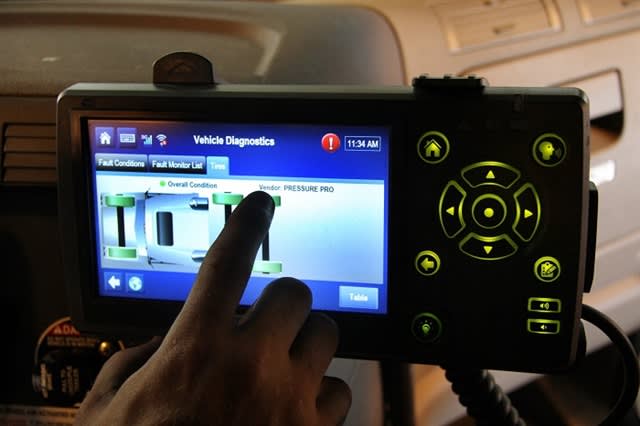
More and more information management options are becoming available today as tire pressure management systems begin to integrate with telematics and connected vehicle systems.Photo: PressurePro
Tire pressure monitoring and inflation systems are accepted as a proven way for fleets to manage one of their biggest consumable items and better ensure safe operation on public roadways. These systems continue to evolve, adding capabilities and functions that increase their effectiveness.
Vanessa Hargrave, chief operating officer for PressurePro, notes that tire pressure monitoring is not new and has been on a steady path of improvement since it appeared over two decades ago. “Over our 26 years in the market, PressurePro has witnessed huge changes in TPMS capabilities, as well as changes in customers’ needs,” she says. “At first, legacy TPMS simply read and reported tire pressures to an in-cab reader. While a revolution in itself, as this capability allowed users to monitor tire performance from the safety and comfort of their cab as well as allowed them to continuously monitor the same performance while on the move, today’s units have greatly expanded on features and capabilities.”
Today, Hargrave says, PressurePro has expanded its TPMS capabilities to meet changing fleet needs, moving beyond providing real-time tire pressure and temperature readings. Expanded alerts and information also include two different levels of low-pressure warnings, a high-pressure alert, an upper temperature alert and a cross-axle alert.
On top of monitoring, automatic tire inflation systems monitor tire pressure in comparison to a preset target pressure and automatically inflate tires whenever the detected pressure is below the target. And today there are systems available for tractor drive axles in addition to the trailer tire systems that have been around for some time.
“Typically, an ATIS uses a status light to alert the driver that the system is delivering air to the tires,” says Tiona Campbell, program manager, controls, for Hendrickson’s trailer commercial vehicle systems. “These systems typically do not report out actual tire pressures, nor can the driver adjust the system target pressure from inside the cab. Most ATIS draw air from vehicle-mounted [air supplies], while some draw air directly from the environment via a self-contained pump. Both styles are only capable of inflating tires found to be below the target pressure. They are unable to relieve air from over-inflated tires.”
To alleviate this problem, Campbell says Hendrickson’s next generation Tiremaax Pro advanced automatic tire pressure control system will not only address under-inflated tires but also over-inflated tires. “It can automatically provide air to a tire found to be below the preset target pressure, and it can respond to changes in ambient temperature by relieving air from a trailer tire found to be above a preset upper threshold,” she says. “Tiremaax Pro can also equalize tire pressures across all wheel positions. All of this is done automatically, with no driver intervention required.”
Even more capabilities are coming.
For instance, Dana intends to introduce an active-inflation component to a TPMS next year. “Similar systems have been in place on trailers for several years now,” explains Steve Slesinski, director of product planning for the commercial-vehicle market. “But with a trailer axle, you’re basically routing the system though a big, hollow, tube. Power unit axles and their gearing are much more complex to design around. But we’ll have a viable solution for tractors and feel that the industry will respond and accept this technology as it did with trailer systems.”
Slesinski says Dana’s research shows that fleets typically experience one unplanned “tire event” a year per truck at a cost of around $700 for service and repairs. “And that’s without factoring in an additional $500 to $1,000 in downtime costs,” he adds. “We expect to price this system so that fleets can get a return on investment in a year to a year and a half, while reducing those costs and downtime in the process.”
Trey Thompson, digital solutions field engineering leader for Continental Tires, says many tire pressure management systems today are stand-alone systems with no ability to aggregate data, see data history, or view the data remotely. But, he adds, connectivity will be more and more common in the future.
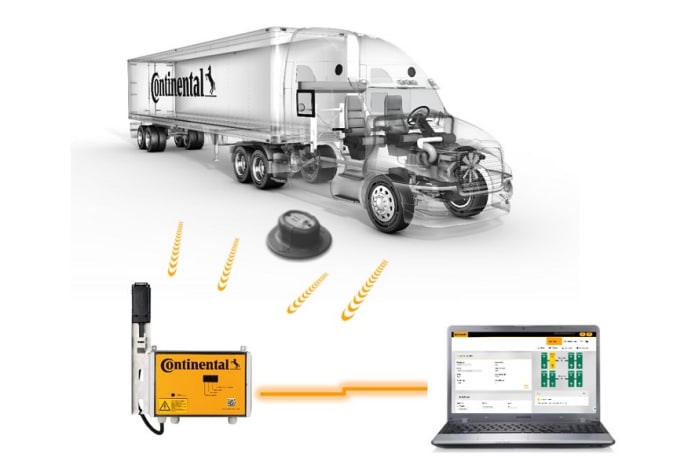
Continental’s new ContiConnect system uses remote sensor readings to collect data and transmit it to any fleet location on the planet for evaluation.Photo: Continental
Managing the data
Of course, if there is a downside to being able to get more real-time data about your tires, it is avoiding being overwhelmed and identifying “actionable” information you can use in the shop.
Peggy Fisher, president of TireStamp, says her company and others are well aware of the need to streamline information coming into fleets.
She says tire pressure monitoring and management systems will integrate further with telematics systems in the future, eventually allowing fleets to have improved visibility and control over developing tire situations. With that in mind, she recommends fleets take into account what kind of data they will be able to access.
“The information you’re getting should be useful and not overwhelming,” she says. “On the other hand, these systems can provide crucial data fleets need to make informed maintenance decisions. And if all you’re getting are alerts, you’re missing out on a great deal of data.”
To help, Fisher says, TireStamp has an app that allows technicians and managers to check on a vehicle on demand. So if a vehicle is driving onto the yard, the technician can pull it up and see all the pressures and temperatures in its tires and address any that may need a little inflation pressure but have not lost enough to generate an alert. They can also use the app to record any tire work done. Managers can use this app to see where the vehicle is, what service it needs, and prioritize the service that is conducted at that location.
“We also provide the fleet with several useful reports that do not overwhelm with too much data,” she adds. For instance, she said, the Active Issues report, run daily around 6 a.m., provides each fleet location with the vehicles at that location that have tires that need attention before they leave the yard.
Likewise, Hargrave says PressurePro has integrated its system with PeopleNet, Omnitracs, Geotab and other telematics providers, as well as RS232 and CANbus (J1939) abilities. “In doing so,” she says, “we’re able to easily integrate our technology and read via tethering or vehicle networks to provide complete and easy to use integration options along with our advanced analyzation tools, including our newly released Automated Data Logger software so users can analyze tire performance data and recognize tire performance trends and patterns.
Continental can integrate its ContiPressureCheck TMPS with PeopleNet or Zonar so users of those telematic platforms can view tire data inside their telematics portal. But it’s gone beyond that with its new ContiConnect remote tire monitoring platform, which allows tire data to be accessed remotely by back office personnel every time trucks return to the fleet yard.
“The yard reader station collects the data and passes it to a web portal, where the data can be viewed from anywhere in the world,” Thompson says. The web portal features audible and visual alerts if a tire experiences low pressure or high temperature, and can also trigger text message and e-mail notifications of the alert.
“This notification capability means that a fleet manager, maintenance personnel, or tire service provider can be alerted to the problem even if they are not constantly monitoring the web portal,” he explains. Many test fleets are using the platform to monitor vehicles as they return to the fleet yard at night so maintenance teams can address any tire issues before the trucks are sent back out the next morning.
“While significantly more data is becoming available across the trucking industry, customers are becoming less interested in having it reported to them,” says Judith Monte, vice president of marketing for Aperia Technologies, which makes the Halo automatic tire inflation system. “The future of tire management is not about reporting data to customers, but transforming data into insights and automatically taking action on them.”
Monte says the most advanced TPMS solutions today provide insights to fleet managers to be able to take action, but the future is enabling fleets to streamline operations by automatically taking that action on the data on their behalf.
“This includes automatically adjusting tires to their optimal pressure, proactively scheduling roadside service and tire repairs, and taking the guesswork out of effective tire management,” she says. “Today, we do not simply report when tire pressure is outside of a set of parameters, but rather we assess a vehicle’s tire condition. We know the severity of a leak, we make blowout predictions, as well as proactive maintenance recommendations.”
It’s all a sign that as telematics and connected vehicles continue to evolve, tire maintenance will become an integrated part of the data stream fleet managers use to keep trucks productive and profitable.
Subscribe to Our Newsletter
More Maintenance

Sponsored•September 16, 2026
Color Match Smarter: Tools That Restore & Perform
For fleet managers and collision repair professionals keeping heavy-duty trucks on the road, getting the color right the first time isn't just about appearance — it's about efficiency, turnaround time, and bottom-line results. Discover how today's digital color tools are transforming the repair process from guesswork to precision.
Read More →
Wrong Repair Prompts Recall of Freightliner, Western Star 4x2 Trucks
DTNA is recalling more than 2,400 trucks that received an incompatible software fix instead of the hardware repair required to address brake valve corrosion.
Read More →
Truck Drivers Need More Than Another Alert
Fleets have more visibility into truck health, safety events, and driver activity than ever. The next challenge is turning all that information into useful guidance for the person who has to decide what to do next.
Read More →

The Maintenance Checks Trucking Fleets Should Prioritize Before Fall Freight Picks Up
Making it through August isn’t the same as being ready for the next several months of operation. Find out what systems may have suffered from summer heat and need to be checked out before fall.
Read More →
What Three Fleets Are Doing Differently When Buying Truck Parts in 2026
With freight improving but costs still climbing, fleet maintenance executives explain how they're balancing price, quality, and supplier relationships.
Read More →
Paccar Recalls 2027 Trucks Built This Summer for Possible Electrical Problem
The nearly 6,000 Kenworth and Peterbilt trucks in the recall could potentially lose engine power, among other things.
Read More →
Will API PC-12 Oil Change Trucking Fleet Maintenance?
The new API PC-12 heavy-duty engine oil category reflects the changing demands of modern diesel engines. But fleets like Foodliner are looking to getting their own data before making decisions on adopting the new oils and questions such as extending oil drain intervals.
Read More →
Brake Safety Week to Focus on Drums and Rotors
Commercial vehicle inspectors are focusing on truck brakes during CVSA's Brake Safety Week, August 23-29.
Read More →Possible Battery-Cable Fires Prompt Recall of 15,000+ International MV and HV Trucks
On the recalled vehicles, manufacturing variations can cause the battery interconnect cable to contact the auxiliary stud and hold down the bracket.
Read More →
Rush, MCT Team Up to Grow Refrigeration Service Network
The joint venture will operate MCT's network of Carrier Transicold dealerships and mobile service locations, with the companies promising greater service capacity and uptime for refrigerated fleets.
Read More →