




How Con Edison Got Creative Making Trailers Safer
New York energy company Consolidated Edison found a easy, efficient solution for its newest aluminum trailers that lacked traction and raised a load securement concern.

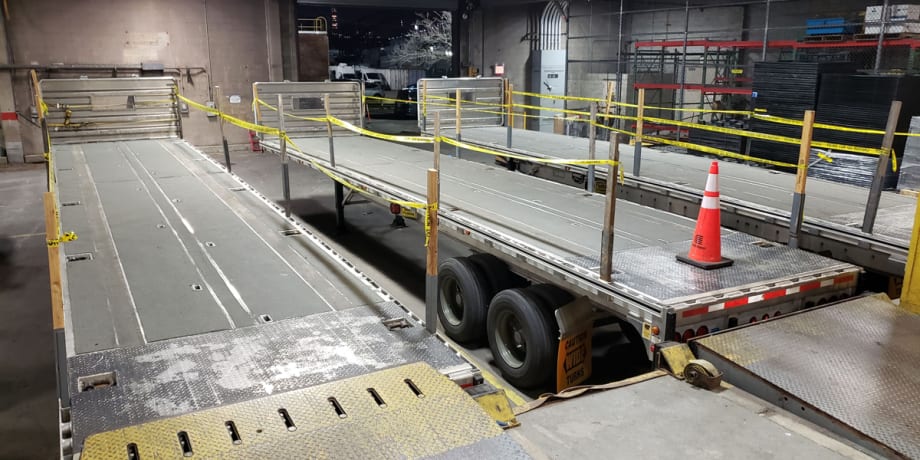
Con Edison uses a specialized epoxy non-slip coating on its 40-foot aluminum trailers to prevent slips and falls and stabilize heavy trailer loads.
Photo: Form-A-Thread
Shortly after New York energy company Consolidated Edison (Con Edison) introduced 10 aluminum trailers to its fleet, a driver raised a safety and load securement concern.
Unlike the fleet’s previous steel trailers, which incorporated wood and a non-slip coating to increase traction, the aluminum trailers only had a narrow band of wood running down each side.
Fleet Snapshot
Who: Consolidated Edison
Where: New York, New York
Fleet: 45 Class 8 trucks in the Astoria Fleet Operations Division
Operations: Energy provider, supply transport
Fun Fact: Plans to deliver emissions-free energy by 2040
Challenge: Trailer load securement
The driver suggested that the large pad-mounted transformers the company hauls, which could weigh many tons, might shift during transport in wet or windy conditions.
As an interim solution, Richard Stewart, a Con Edison environmental health and safety manager, issued an alert stating that, whenever possible, loads should be secured inside in a loading or receiving dock. However, a more permanent long-term solution was required for a non-slip surface to allow safe, reliable load securement of materials and equipment.
The fleet explored several possibilities to improve the traction of the trailer surface, including conventional anti-slip coatings. The company had tried such coatings in the past but found some were costly, difficult to install, required long curing times, or could be applied only to specific substrates, according to Stewart.
And like most things in the fleet world, expediting the application of the coating was important because Con Edison could not afford excess fleet downtime.
“Our fleet [of tractor-trailers] is in high demand because we transport supplies to customers, including during emergencies or outages,” Stewart says. “So, we need the trailers back in service very quickly.”
Stewart considered the possibility of a coating he had successfully used for other applications, including in high-traffic areas at the company’s receiving warehouse in Astoria; stairways in the Bronx; walkway ramps and dock loading ramps in Staten Island; and even plastic bumpers on the company’s utility vans.
He knew this specific epoxy, Form-A-Tread Self Leveling, dried and cured fast. But the coating hadn’t yet been applied to a trailer bed. First, they needed further testing to ensure the coating would withstand the flexing and bowing of the trailer while transporting heavy loads.
Stewart also wanted to ensure the coating could stand up to harsh weather conditions and the wear-and-tear the trailer would endure over many miles. The team decided to perform a trial of three to six months on one trailer.
“The drivers loved it because even on rainy, windy days, the coating improved safety by providing sufficient traction and footing [on the aluminum trailer beds],” Stewart says. “The improved traction also helped ensure large cargo would not shift on the trailer during transport.”
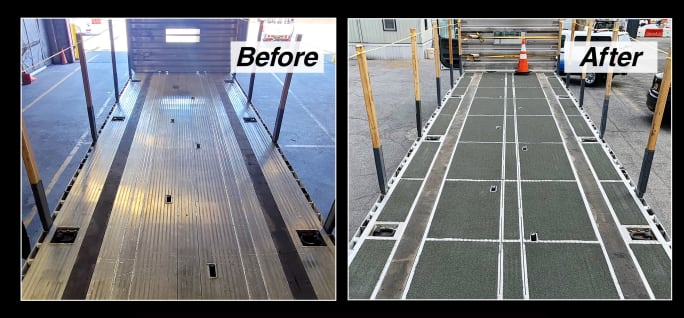
These photos show before (left) and after the Form-A-Thread SL non-slip coating was applied.
Photo: Form-A-Thread
Based on the success of the trial, Con Edison decided to use the coating on the remaining nine trailers.
The innovative use to secure tractor-trailer loads would later win an internal Con Edison team award for environmental health and safety for the Astoria Ops Union Management Safety Team that worked on this initiative.
The award recognized the team’s “extraordinary contribution to ensuring a safe workplace, achieving operational excellence, and improving how tractor-trailer loads are secured.”
“The accomplishment was a great example of not settling for existing conditions but maintaining a high standard and going above and beyond,” Stewart says.
How One Flatbed Carrier Empowers Truck Drivers to Stick Around
More Equipment

How Volvo Updated Its D13 for EPA 2027 [Watch]
Volvo’s updated D13 promises lower emissions without sacrificing performance or fuel economy. Take a closer look at what changed inside the engine in this HDT Spotlight video.
Read More →
Michelin Tire Improves Efficiency and Durability for Regional Fleets
The Michelin X Multi Energy D2 is a regional haul drive tire engineered to help fleets improve fuel efficiency, durability and traction in demanding stop-and-go operations.
Read More →
ZF Expands Commercial Vehicle Push in North America
ZF is expanding its North American commercial-vehicle presence with new transmission applications, electrification, trailer technology and autonomous-driving systems.
Read More →
Tesla Wants a Self-Driving Semi. Are Cameras Enough?
Could Tesla’s camera-only autonomous driving technology work on an 80,000-pound Semi? In this commentary, HDT's Deborah Lockridge takes a look at Tesla, Cybercab, and how autonomous trucks see the road.
Read More →
Kodiak: Driverless Long-Haul Truck Launch on Track for 2026
Kodiak AI says its driverless long-haul safety case is 93% complete and it remains on track to begin commercial operations by year-end 2026.
Read More →
What DOT’s Automated Vehicle Strategy Means for Trucking
The U.S. Department of Transportation issued a new automated-vehicle strategy that outlines plans for driverless-truck regulations, cross-state freight corridors, and federal safety standards.
Read More →
East Coast Port Launches $45M Electric Truck Push
The Port Authority of New York and New Jersey announced millions in incentives for zero-emission drayage trucks, yard tractors, and new charging hubs near the port.
Read More →
PlusAI Going Public to Fund Autonomous Truck Launch
A SPAC deal could provide PlusAI with up to $300 million as it works toward a 2027 commercial launch of factory-built autonomous trucks.
Read More →
NHTSA Moves to Rewrite Truck Fuel-Economy Rules
The National Highway Traffic Safety Administration says it lacks authority to regulate medium- and heavy-duty truck engines separately from complete vehicles, but the existing standards have not yet been eliminated.
Read More →
Detroit Opens Orders for EPA 2027 Engines
Detroit isn’t starting from scratch to meet EPA 2027 diesel emissions standards. Its Gen 6 DD13 and DD15 engines keep much of today’s platform while updating the fuel and aftertreatment systems.
Read More →