





Fact Book 2023: HDT's annual snapshot of where the industry is, where it's been, and long-term trends.
HDT 2023 Fact Book: Driver Pay Reflects Slower Freight Market
Driver turnover, according to reports, has slowed over the past year. However, fleets’ pay focus has shifted away from newer, inexperienced drivers and toward drivers at the higher end of the experience scale. Also, the number of women drivers has increased.
October 30, 2023

Driver turnover costs have increased for fleets, and research found that the more experienced drivers see better pay than newer drivers.
Source: Canva/HDT Illustration
5 min to read
Per-mile pay increases for professional truck drivers at for-hire motor carriers slowed in late 2022 and into 2023 as the driver hiring binge that began in late 2020 and persisted into early 2022 eased. Driver pay, retention, and turnover are all explored in the HDT Fact Book 2023, HDT's annual snapshot of where the trucking industry is, where it's been, and what its current long-term trends are.
Slower hiring needs halted the breakneck pace of driver wage gains seen in the same time frame, late 2020 and into 2022, when hourly and per-mile wages for drivers climbed at historically high rates. Base mileage and hourly pay grew more than 10% in 2021 from the year prior, according to The National Transportation Institute’s National Driver Wage Index, a composite look at pay momentum for drivers across trucking segments.
However, 2022 was a tale of two halves. Driver pay climbed by nearly 5% last year, according to NTI’s Driver Wage Index. Those gains were concentrated in the first half of the year, with pay momentum stalling in the back half, particularly the fourth quarter.
Muted changes continued into 2023’s first quarter, but wages showed signs of life in the spring months, particularly for more experienced drivers — what NTI calls cap earners.
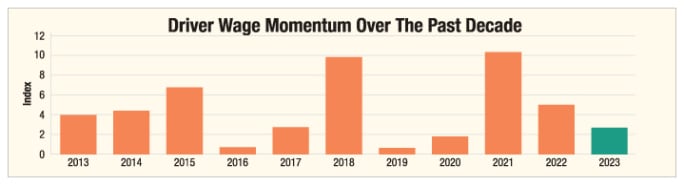
After the longer economic recovery period following the Great Recession, driver pay momentum has been in a yo-yo cycle, with large upward momentum in 2018 and 2021 followed by years with muted changes to driver wages.
Source: NTI
Data from The National Transportation Institute’s National Survey of Driver Wages, a quarterly survey of hundreds of for-hire motor carriers of nearly 200 attributes that make up a driver’s total compensation, shows that fleets’ pay focus has shifted away from newer, inexperienced drivers and toward drivers at the higher end of the experience scale.
NTI surveys fleets on mileage and hourly pay by experience — one year, three years, and cap earners, aligned with typical pay models at for-hire motor carriers. Drivers with one year of experience had been seeing the largest percentage pay gains throughout the pandemic recovery period during the frenzied hiring environment. Drivers with three years of experience saw the next highest pay gains, while drivers with the most experience saw the smallest percentage gains year over year and quarter to quarter.
In 2023, however, drivers with the most experience are seeing the largest percentage gains on a quarter-to-quarter basis, with the rolling annual percentages tilting closer to their favor, too. Turnover remains persistent at the fleet level and industrywide (churn of drivers entering and exiting the industry), so the concentration on pay for experienced drivers is likely meant to promote tenure.
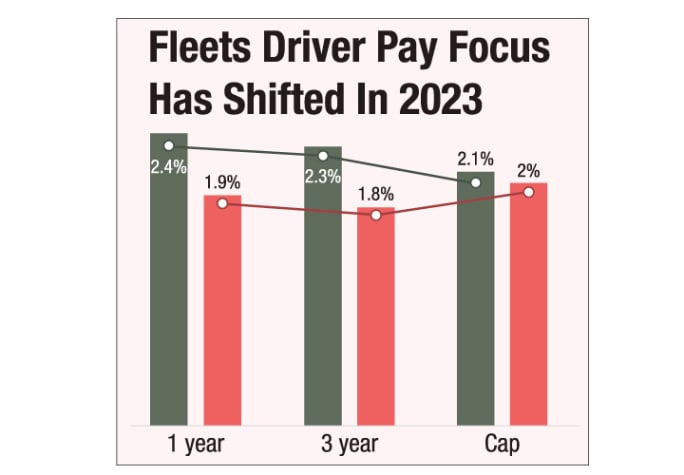
Drivers with one year of experience were seeing the biggest quarter-to-quarter and annualized percentage pay gains throughout 2021 and into 2022. Yet drivers with the most experience saw the smallest percentage gains year over year and quarter to quarter. By the middle of 2023, gains for less-experienced drivers had slowed, and drivers with the most experience and tenure (aka cap earners) saw their rolling annualized pay gains catch up to their less-experienced counterparts.
Source: NTI Driver Wage Index
One prominent driver pay issue fleets are contending with in 2023 is a drop in productivity, which eats into drivers’ take-home earnings. That means while drivers may be earning more per mile, their paychecks in recent quarters often have not reflected those higher wages as fleets struggle to keep drivers’ miles up on the downside of the freight cycle.
Supplements such as fuel and safety bonuses have seen attention this year, too, as fleets use those incentives to combat productivity-related pay drops and to promote overall cost savings.
While for-hire carriers’ wage programs have been responsive to market conditions, private and dedicated fleets have remained active in adjusting their compensation, according to data from NTI’s National Private Fleet Survey and National Dedicated Fleet Survey.
Private fleet pay gains are still hovering near the 5% mark year over year, compared to the 2.3% forecasted gain for drivers at for-hire fleets. Some private fleets, seeing an opportunity to be aggressive for drivers in the lull in the for-hire segment, have increased pay by as much as 20% on a year-over-year basis.
Driver Turnover Slowed in 2022
Truck driver turnover rates fell in almost every sector and fleet size category in 2022 compared to the prior year, according to the American Transportation Research Institute’s annual cost of operations survey. Smaller fleets generally have lower turnover regardless of sector, while larger fleets generally have turnover rates that exceed 50%.
According to ATRI, less-than-truckload carriers had a turnover rate of 20.6%, slightly higher than the 2021 rate of 18.6%.
Meanwhile, among private fleets, driver turnover returned to more normal, if elevated, levels in this year’s National Private Truck Council’s Benchmarking Survey Report, reflecting 2022 statistics — after eclipsing the 20% threshold for the first time in the history of the survey last year.
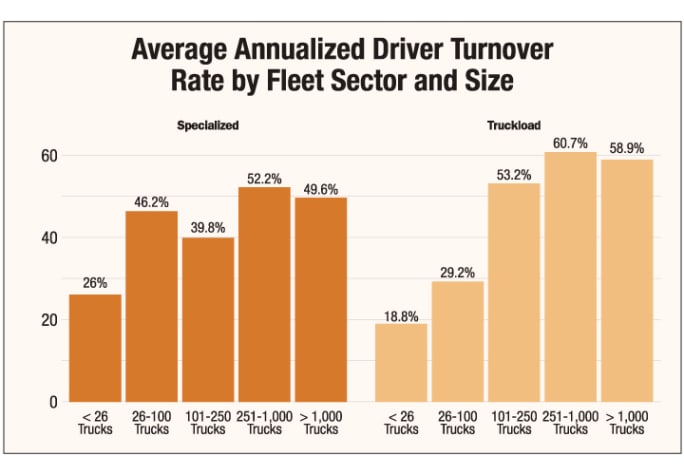
Truckload carriers experienced higher turnover in 2022 than other sectors, except in fleets with fewer than 100 trucks. Specialized carriers had less variation in turnover rates across fleet sizes.
Source: ATRI
This level of turnover is consistent with the aging workforce and the increased number of drivers opting for retirement, according to NPTC. As business conditions returned to a more normal pace, the demand for drivers decreased.
Driver turnover carries a cost for fleets — this year’s survey estimates $9,748, according to NPTC. Last year, the cost averaged $7,866, which was up from the $7,500 reported in the previous year.
Drilling into these onboarding costs, heavy-duty operations spend on average $9,700 (compared to $8,450 last year) to onboard a driver, while medium-duty fleets report a cost of $3,780 (compared to $6,300 last year).
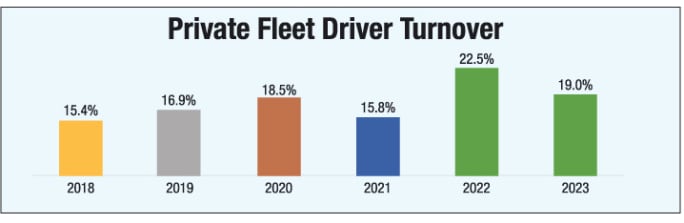
Respondents to the NPTC annual benchmarking survey report driver turnover of 19%, down from last year’s historical level of 22.5%. To keep things in perspective, turnover has averaged 14.25% over the 15-year history of the survey.
Source: NPTC
Driver Demographics
Trucking employed 8.4 million people in industry-related jobs in 2022, up 405,000 from the previous year, including 3.54 million professional truck drivers, according to American Trucking Associations’ American Trucking Trends 2023.
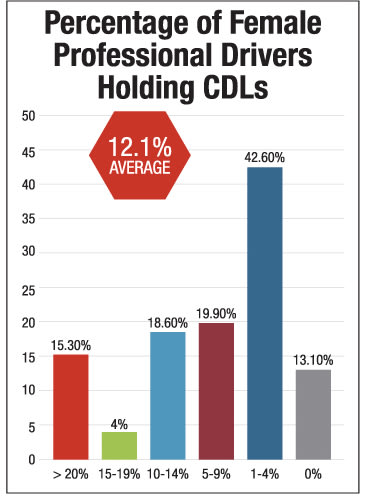
More than half of fleet respondents to the WIT Index had 4% or fewer women CDL drivers. About 15% had more than 20%.
Source: Women in Trucking WIT Index
Looking at the racial/ethnic background of drivers, with 18.3% of drivers identifying as Black, 4% as Asian, and 23.3% as Hispanic or Latino, for a total of 45.6%. In 2021, minorities accounted for 46.1% of truck drivers.
Women made up 8.1% of the nation’s drivers in 2022, according to ATA — an all-time high and the seventh straight annual increase. In 2021, ATA reported that 7.9% of the nation's drivers were women, which also was an all-time high.
The 2023 WIT Index released by the Women In Trucking Association found a higher rate of women drivers among its survey respondents. It reported that 12.1% of professional drivers who hold commercial driver’s licenses and drive heavy-duty trucks are female — down from last year’s 13.7%. However, that's still up from the 2019 report, where it was about 10%.
Subscribe to Our Newsletter
More Drivers

Truck Drivers Need More Than Another Alert
Fleets have more visibility into truck health, safety events, and driver activity than ever. The next challenge is turning all that information into useful guidance for the person who has to decide what to do next.
Read More →
FMCSA Removes 110 Truck Driver Training Schools from Certified ELDT List
Federal regulators also are targeting more than 160 additional training providers and launching a nationwide audit of third-party CDL skills testers as part of a broader crackdown on trucking fraud.
Read More →
Hours of Service Pilot Programs: FMCSA Readies for 2027 Rollout
Two pilot programs could eventually reshape hours-of-service rules, giving truck drivers options to pause their 14-hour clock or use longer split sleeper rest periods.
Read More →
Medical Cards, English Proficiency Reshape Roadcheck Violations
Medical-card violations jumped to the top of the driver out-of-service list during CVSA’s 2026 International Roadcheck, while English-language proficiency violations appeared among the leading violations for the first time.
Read More →
Driver Trust Can Make or Break the Success of Fleet Safety Technology
New Teletrac Navman research suggests that onboarding, transparency about driver data, and positive feedback can play a significant role in how commercial drivers respond to safety and coaching technology.
Read More →
EEOC Sues KLLM Over Alleged Sex Discrimination in Driver Training
KLLM is facing a federal sex-discrimination lawsuit over policies the EEOC alleges put female truck driver trainees at a disadvantage.
Read More →
FMCSA Moves to Codify English Language Requirements for Commercial Drivers
By changing regulations on English-language proficiency requirements for commercial drivers, rather than relying on a guidance memo, the FMCSA said future administrations won't be able to walk back the Trump administration's stricter enforcement with just a memo.
Read More →
Drivers Put Western Star Trucks to the Test at Star Nation Experience
Watch to get an inside look at the Western Star trucks, technology, and community behind the Star Nation Experience 2026!
Read More →
Trump Administration Looks to Put More Veterans Behind the Wheel
The Freedom Haulers program pulls together existing and expanded programs at several federal agencies to recruit veterans to drive commercial heavy-duty trucks and cut the red tape for them to get a CDL, training, and employment.
Read More →
Putting Mack’s Command Steer to the Test
A test drive of Mack’s Command Steer active steering system evaluates how it can make truck driving easier and less tiring.
Read More →