





Related: How Veritable Vegetable Cares for Employees, Clients, Community During COVID-19 Pandemic
Going Green is More than Just a Slogan for Veritable Vegetable
There isn’t anything much greener than vegetables, so if that’s part of your company name, you better make sure you are, too. For Veritable Vegetable, an organic supplier and transporter based in San Francisco, it is part of how it meets its customers’ — and its community’s — needs.
July 7, 2020
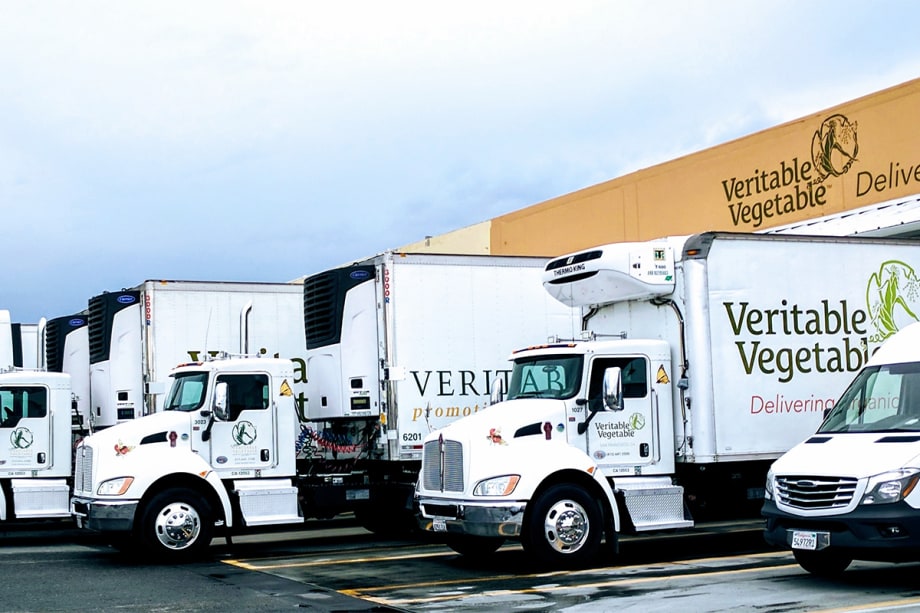
Photo: Veritable Vegetable
3 min to read
There isn’t anything much greener than vegetables, so if that’s part of your company name, you better make sure you are, too. For Veritable Vegetable, an organic supplier and transporter based in San Francisco, it is part of how it meets its customers’ — and its community’s — needs.
“Sustainability is a deeply ingrained value at VV; we consider the environment, social, and economic impact of every decision we make at every level of the company,” says CEO Mary Jane Evans. “As a certified California Green Business and a certified B Corp, we believe in putting our business to work for the greater good.”
(Certified B Corporations must meet high standards of verified social and environmental performance, public transparency, and legal accountability to balance profit and purpose.)
The women-owned and -led company runs its trucks 365 days of the year on more than 40 routes every week in California, Arizona, Colorado, Hawaii, Nevada, and New Mexico. VV’s near-zero-emissions fleet includes equipment for both local and regional routes.
And sustainability efforts don’t stop with its fleet. The facilities are equipped with a 560-panel solar array, offsetting more than 25% of its energy use. Evans and her team also recently signed up for CleanPowerSF, San Francisco’s renewable energy program, which means all the company’s power comes from 100% renewable sources.
“We utilize state-of-the-art, high-efficiency refrigeration equipment and refrigeration management technology to control our storage rooms and docks,” says Evans. High-speed roll-up doors ensure food stays fresh while reducing energy usage. “We also invest in energy-efficient ballasts, fixtures and bulbs, as well as motion- and lumen-sensors that detect movement and natural daylight, cutting down on energy use whenever possible.”
Veritable Vegetable is also one of the few businesses in San Francisco that diverts 99% of its waste from landfills by recycling, re-using and composting nearly all the materials entering the warehouse. The staff uses environmentally friendly cleaning supplies, prints double-sided to reduce paper waste, avoids using plastic water bottles and disposable utensils, and purchases furniture made from renewable resources. Its warehouses feature insulation made from shredded cotton jeans.
For the fleet, Veritable Vegetable specs aerodynamic tractors (Kenworth T660s), hybrid mid-range trucks (Kenworth T3 Hybrids), hybrid refrigeration units (Carrier Vector units), and fully electric NEV light-duty transfer trucks for warehouse use. (Neighborhood Electric Vehicle, or NEV, is a designation for battery-electric vehicles usually built to have a top speed of 25 mph and a maximum loaded weight of 3,000 pounds.)
There are side skirts on all 48-foot trailers, tire pressure monitoring systems on all trailers, and wheel covers on all tractors.
The maintenance crew also reduces consumption by running all tires through a screening, grading, and retread process that ensures they get as much life from each tire casing as possible.
“Making a new tire uses about 23 gallons of oil, much of it in the casing; therefore, to reduce the need for new casings, we have a recap program which significantly reduces overall fuel consumption and minimizes our waste stream,” Evans says. “Our recap program is just one example of our holistic approach to saving fuel.”
Efforts to add electric delivery trucks to the fleet have faced difficulties in putting together an appropriate electric infrastructure.
“Though we’ve made inroads, our efforts to add electric delivery trucks to our fleet have been slowed,” says Evans, saying the company wants to be very thorough in its research to to ensure it doesn’t have a false start.
And research is an important part of being a sustainability leader. “Over the years, we’ve both led by example and learned from others,” she says. “We lean on our community and find resources as they become available. We also are out in front, experimenting with new technologies before they are widely adopted.”
Subscribe to Our Newsletter
More Fuel Smarts

How Volvo Updated Its D13 for EPA 2027 [Watch]
Volvo’s updated D13 promises lower emissions without sacrificing performance or fuel economy. Take a closer look at what changed inside the engine in this HDT Spotlight video.
Read More →
Diesel Price Spike Shortens Payback for Natural Gas Trucks, Report Says
Energy Vision estimates fleets could recover the higher purchase price of an RNG-fueled Class 8 tractor in 1.3 to 2.8 years under current fuel-price scenarios.
Read More →
Calstart Becomes Catalyst Mobility, Reflecting Broader Focus
Calstart is now Catalyst Mobility, reflecting the nonprofit’s growing national role in clean transportation, including zero-emission trucks, infrastructure and incentive programs.
Read More →

Record Diesel Prices Squeeze Trucking Fleets
Average U.S. diesel prices have climbed to nearly $6 a gallon, surpassing the 2022 record as tight refinery capacity and Middle East disruptions keep fuel costs elevated.
Read More →
Sponsored•September 9, 2026
How Fuel Delivery Shapes Engine Performance
Fuel delivery depends on more than what happens at the injector. For fleet, maintenance and technical professionals, looking at the full path from pump to injector can provide useful context for understanding engine performance.
Read More →
East Coast Port Launches $45M Electric Truck Push
The Port Authority of New York and New Jersey announced millions in incentives for zero-emission drayage trucks, yard tractors, and new charging hubs near the port.
Read More →
California Bill Could Shed Light on Electric Truck Prices
Why do battery-electric Class 8 trucks remain so expensive? A California bill headed to Gov. Gavin Newsom would give fleets and state agencies more visibility into what manufacturers charge.
Read More →
Detroit Opens Orders for EPA 2027 Engines
Detroit isn’t starting from scratch to meet EPA 2027 diesel emissions standards. Its Gen 6 DD13 and DD15 engines keep much of today’s platform while updating the fuel and aftertreatment systems.
Read More →
Zero-Emission Truck Corridor Planned for West Coast
California, Oregon, Washington, British Columbia and Baja California are coordinating plans for truck charging and hydrogen fueling from Canada to Mexico.
Read More →
A Closer Look at Kenworth’s Electric T880E Vocational Truck [Video]
Learn more about Kenworth's T880E battery-electric vocational truck at the Paccar Technical Center, including its range, applications, upfitting considerations, and PTO options, in this HDT Spotlight video.
Read More →