




Related: NACFE Updates Tire Pressure Systems Report, Looks to Further Updates
Fuel Efficiency in a Time of Cheap Diesel
Look at fuel economy with an eye to the future. Many factors go into the decision to invest in a technology that will save fuel.
by Mike Roeth, North American Council for Freight Efficiency
June 4, 2020
Photo: Gettyimages.com/herjua
8 min to read
During the COVID-19 pandemic, the national average price of diesel fuel has plummeted. In early May, the price was $2.399 per gallon — 77 cents cheaper than a year ago. This may cause some fleets to take their eyes off their fuel economy efforts.
However, it is important to remember that regardless of the price of diesel, it still represents a significant expense for fleets. According to data from the American Transportation Research Institute, in 2018, fuel cost fleets an average of 43 cents a mile — 24% of a fleet’s average marginal operating costs.
From the North American Council for Freight Efficiency’s work with fleets, it has become clear that savvy fleets look at more than the current price of fuel when considering investing in a fuel-efficiency technology.
Three other factors — future fuel prices, regulations, and sustainability — also play an important role in the decision-making process.
Future Fuel Prices
While there is no consistent period of time that all fleets keep their tractors, most fleets will keep them for between four and 10 years. That makes it important for fleets to be concerned about the future price of fuel. Fuel may be cheap now, but how much will it cost in a few years? Even during times like now with relatively low fuel prices, fleets must understand how decisions today will impact fuel costs for many years in the future.
Historically, diesel fuel prices have been volatile. They are largely dependent on the cost of crude oil and, of course, on supply and demand. Back in 2008, diesel fuel prices soared to more than $4.50 a gallon. By 2016 they had dropped to just above $2 a gallon, before trending back up, and then dropping again to where we are today. The ATRI data shows the impact fuel prices have on a fleet’s operating cost. In 2013, when fuel prices were high, fleets spent on average 65 cents a mile on fuel — more than they were spending on driver wages and benefits. In 2016, when fuel prices were low, fuel was down to 34 cents a mile of a fleet’s operating costs — half of what they were spending on driver wages and benefits.
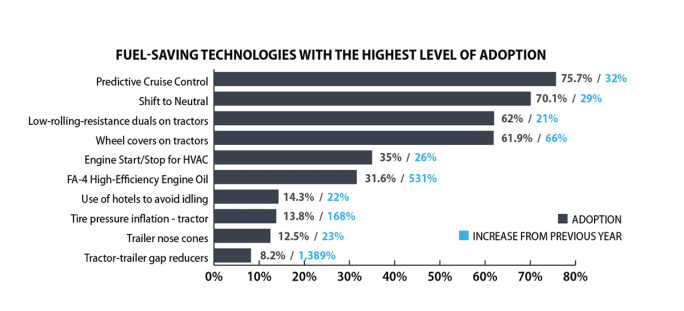
Among the technologies that showed the biggest increases in 2018 in NACFE’s Annual Fleet Fuel Study were tractor gap reducers, high-efficiency engine oil (FA-4), tractor solar panels, predictive cruise control, and tractor wheel covers.
Source: NACFE
No one knows for sure what the price of fuel will be in the future, but fleets should conduct sensitivity analyses with respect to fuel prices and their ownership life expectations.
GHG Regulations
Greenhouse gas emissions regulations, although aimed at vehicle manufacturers, do affect the equipment that fleets purchase. The latest such regulations, GHG Phase 2, were published in August of 2016 and are set to go into effect next January. According to the Environmental Protection Agency, “The final phase two program promotes a new generation of cleaner, more fuel-efficient trucks by encouraging the development and deployment of new and advanced cost-effective technologies.” The regulations cover model years 2021 through 2027 for semi-trucks, large pickup trucks, vans, and all types and sizes of buses and work trucks.
The EPA expects the standards to lower CO2 emissions by approximately 1.2 billon metric tons, save vehicle owners about $170 billion in fuel costs, and reduce oil consumption by up to 2 billion barrels over the lifetime of the vehicles sold under the program.
The onus is on vehicle and engine manufacturers to integrate the right combination of technologies across the entire vehicle. Using EPA’s Greenhouse Gas Emissions Model tool, manufacturers can simulate all the parameters of the powertrain to determine which combinations comply with the regulations. While manufacturers will build the trucks fleets want, they will be encouraging fleets to purchase more fuel-efficient models in order to meet GHG targets.
Sustainability
The increased focus on sustainability by both consumers and the industry is influencing some fleets to look closely at fuel efficiency. Some companies are beginning to recognize that climate change presents a risk to their businesses. A BSR study of 8,000 companies found that 72% of respondents said that climate change presents risks that could significantly impact their operations, revenue, and spending. (BSR is a global nonprofit that works with a network of more than 250 member companies and other partners to “build a just and sustainable world.”)
In a survey by CGS, a global provider of business applications, enterprise learning and outsourcing services, 70% of respondents said sustainability is at least somewhat important to them when making purchasing decisions.
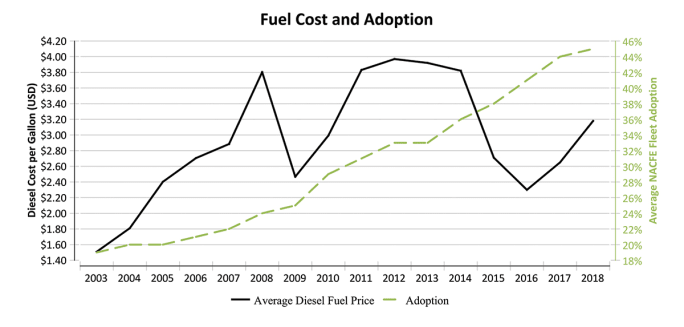
The efficiency-minded fleets in NACFE’s Annual Fleet Fuel Study have steadily increased their adoption of fuel-saving technologies – even as fuel prices have varied widely.
Source: NACFE
It is likely that sustainability will continue to be an important factor, especially as some areas of the country are starting to see cleaner air as a result of decreased activity that has resulted from COVID-19 restrictions.
While it is hard to put a dollar value on investments that make a fleet green, making those investments can help fleets attract (and in some cases retain) business from customers that value sustainability. The focus on sustainability is likely to increase as the next generation enters decision-making positions in corporations; millennials have shown themselves to be committed to implementing sustainable development goals.
Technologies That Matter
NACFE has been collecting data from fleets on adoption rates for 85 fuel-efficiency technologies in its Annual Fleet Fuel Study. In the most recent study, data from 21 fleets was collected covering their adoption practices from 2003 to 2018. The overall adoption rate for the technologies studied in this report has grown from 17% in 2003 to 45% in 2018. (Not all technologies can be applied to a single tractor-trailer, as some are clearly an either/or decision.)
The average fleet-wide fuel economy of the trucks in this study was 7.27 mpg in 2018, a slight increase from the 7.23 mpg in 2017. Compare that to the national average of 5.98 mpg, based on information using International Fuel Tax Reporting data. The fleets in the Fleet Fuel Study are saving $9,912 per year over the national average. If fuel costs had been at the four-year average of $3.89 per gallon (which it was from 2011 through 2014), the savings would have been $12,124.
There is variability in each fleet’s yearly fuel efficiency depending on many factors. For the 16 years of this study, the average rate of improvement in mpg was 2%.
By comparison, during NACFE’s Run on Less demonstration in September 2017, the tractor-trailers equipped with the best of the best currently available technologies attained 10.1 mpg. And in October 2019, the group conducted a second Run on Less, where the average for the more demanding regional-haul duty cycles reached 8.3 mpg.
The fleets in both Run on Less events and those in the Fleet Fuel Study achieve higher than average mpg by investing in a wide variety of fuel efficiency technologies. Those technologies fall into seven broad categories:
Tractor aerodynamics
Powertrain
Chassis
Tires and wheels
Idle reduction
Trailer aerodynamics
Operational practices
Among the technologies that showed the biggest increases in the 2018 study were tractor gap reducers, high-efficiency engine oil (FA-4), tractor solar panels, predictive cruise control, and tractor wheel covers.
Each of the 85 technologies has a unique total cost of ownership and return on investment depending on their applicability to the unique operations of various fleets. Some technologies, like automated manual transmissions and diesel auxiliary power units, cost thousands of dollars, but offer significant benefits, and therefore have acceptable paybacks for many fleets.
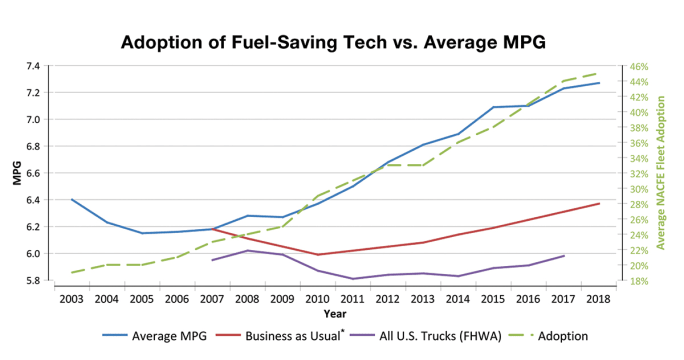
The increasedadoption of fuel-saving technology corresponds withrising average mpg for the fleets in NACFE’s AnnualFleet Fuel Study.
*“Business as Usual” is the NACFE fuel economy prediction for the fleets in the study had they not made the fuel efficiency technology decisions they did and only adopted the mandatory, standard features that truck makers incorporate into their base trucks.
Source: NACFE
Other technologies, such as vented mudflaps or wheel covers, are relatively inexpensive, but it may be more difficult to determine their impact on fuel economy because it is likely to be incremental. And there are even some technologies, like optimizing engine parameters, that cost nothing to implement.
One Key Impediment to Improved Fuel Economy
One of the things fleets participating in NACFE’s Annual Fleet Fuel Study are asked about is setting maximum cruise speed. Many states have increased their speed limits in recent years, and many fleets have also raised the governed speed limit on their trucks by modifying the truck’s programmable engine controls. Increases were in the 2- to 3-mph range, for instance from 62 mph to 65 mph. It is widely believed that increasing speed by 1 mph reduces fuel economy (increases fuel consumption) by about 0.1 mpg. Lower speeds reduce aerodynamic drag and decrease fuel consumption.
Yet in order to attract and retain drivers and to respond to increased freight demand and a loss of productivity due to electronic logging devices, many fleets have raised governed speeds. They have paid the price in increased fuel costs.
To offset this increase in fuel consumption, fleets should consider investing in technologies that improve fuel economy.
The Bottom Line
Regardless of fuel prices, diesel will continue to represent a significant percentage of a fleet’s operating cost. Fuel economy is influenced by a number of factors, from the way the vehicle is spec’d, to how fast it is driven, to how heavy the load is.
Fleets look at a number of factors when determining whether to invest in a technology that will improve fuel efficiency. While specific technology adoption varies by duty cycle, business model, and other factors, fleets are continuing to invest in fuel-efficiency technologies.
In addition, manufacturers are delivering more advanced generations of existing technologies to quicken the payback and mitigate the challenges of adoption of these technologies. Other advancements come from novel technologies that provide the same function in a different way and new technologies that address areas not considered in the past.
While some fleets are enjoying great fuel economy, there is still a significant gap between the best-of-the-best fleets and the average fleet, showing that there is room for improvement. By looking at all four factors — the current price of fuel, the future price of fuel, regulatory requirements and the importance of sustainability — fleets can make smart choices about the fuel-efficiency technologies that make the most sense for them and get them closer to being one of the best-of-the-best fleets.
Mike Roeth is the executive director of the North American Council for Freight Efficiency. An engineer by training, he has worked in the commercial vehicle industry for over 30 years, holding various positions at Navistar and Behr/Cummins. NACFE is a nonprofit organization dedicated to doubling the freight efficiency of North American goods movement, providing independent, unbiased research.
Subscribe to Our Newsletter
More Fuel Smarts

How Volvo Updated Its D13 for EPA 2027 [Watch]
Volvo’s updated D13 promises lower emissions without sacrificing performance or fuel economy. Take a closer look at what changed inside the engine in this HDT Spotlight video.
Read More →
Diesel Price Spike Shortens Payback for Natural Gas Trucks, Report Says
Energy Vision estimates fleets could recover the higher purchase price of an RNG-fueled Class 8 tractor in 1.3 to 2.8 years under current fuel-price scenarios.
Read More →
Calstart Becomes Catalyst Mobility, Reflecting Broader Focus
Calstart is now Catalyst Mobility, reflecting the nonprofit’s growing national role in clean transportation, including zero-emission trucks, infrastructure and incentive programs.
Read More →

Record Diesel Prices Squeeze Trucking Fleets
Average U.S. diesel prices have climbed to nearly $6 a gallon, surpassing the 2022 record as tight refinery capacity and Middle East disruptions keep fuel costs elevated.
Read More →
Sponsored•September 9, 2026
How Fuel Delivery Shapes Engine Performance
Fuel delivery depends on more than what happens at the injector. For fleet, maintenance and technical professionals, looking at the full path from pump to injector can provide useful context for understanding engine performance.
Read More →
East Coast Port Launches $45M Electric Truck Push
The Port Authority of New York and New Jersey announced millions in incentives for zero-emission drayage trucks, yard tractors, and new charging hubs near the port.
Read More →
California Bill Could Shed Light on Electric Truck Prices
Why do battery-electric Class 8 trucks remain so expensive? A California bill headed to Gov. Gavin Newsom would give fleets and state agencies more visibility into what manufacturers charge.
Read More →
Detroit Opens Orders for EPA 2027 Engines
Detroit isn’t starting from scratch to meet EPA 2027 diesel emissions standards. Its Gen 6 DD13 and DD15 engines keep much of today’s platform while updating the fuel and aftertreatment systems.
Read More →
Zero-Emission Truck Corridor Planned for West Coast
California, Oregon, Washington, British Columbia and Baja California are coordinating plans for truck charging and hydrogen fueling from Canada to Mexico.
Read More →
A Closer Look at Kenworth’s Electric T880E Vocational Truck [Video]
Learn more about Kenworth's T880E battery-electric vocational truck at the Paccar Technical Center, including its range, applications, upfitting considerations, and PTO options, in this HDT Spotlight video.
Read More →