




Dual-Fuel Diesel/CNG System Enters Fleet Testing
One company thinks it has the answer for truck operators that want to use natural gas but are concerned about range issues: a dual-fuel system that can be retrofitted to existing diesel engines

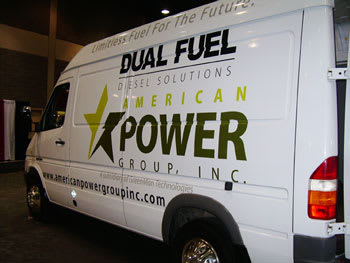
APG is conducting EPA testing of its dual-fuel system on a Sprinter van, nine Class 8 tractors, and a Ford F450 pickup. (Photo by Deborah Lockridge)
One company thinks it has the answer for truck operators that want to use natural gas but are concerned about range issues: a dual-fuel system that can be retrofitted to existing diesel engines.
American Power Group, a subsidiary of Green Man Technologies, has for a decade been converting large onsite diesel backup generators to this dual-fuel system. About two years ago, it started working to adapt the technology for use in vehicles. So far, testing indicates potential fuel savings of 25 to 30 percent per year, according to CEO Lyle Jensen.
The engine starts under diesel power, but under pulling power or acceleration operates in dual-fuel mode, displacing about half the diesel with compressed natural gas. If you run out of CNG, it automatically converts to full-diesel mode.
One of the things that stood out about this technology, Jensen explains, is that it is non-invasive. It doesn't require expensive custom fuel injectors and other heat-sensitive custom componentry, bringing the cost of the system down. Instead, the system introduces CNG through a proprietary air mixer, pre-turbo.
"So we deliver what I would call an enriched-air fuel through the turbo into the air intake manifold." As long as they stay below a level of 70 percent displacement, he says, thermal issues should not be a problem.
This type of technology had been tried elsewhere in the world, Jensen says, but the problem was controlling the safety and reliability of the displacement. So to fine-tune it, the company turned to Robert Natkin, who Jensen calls "one of the smartest powertrain guys I've ever met." Natkin, a former powertrain engineer for Ford, "fell in love with the concept," Jensen says. With his help, they created a third-generation design that converted the analog system to a digital ECU-based system.
The new system can access the diesel engine's electronic control unit and monitor key operating metrics to make sure the dual-fuel system is operating within all the required OEM and emissions parameters. The response is measured in nanoseconds. If temperature or pressure readings exceed the OEM metrics, the control system will automatically shut off the dual-fuel and return the engine to full diesel operation.
In December, APG announced it had received exemptions from the U.S. Environmental Protection Agency that allow it to test and verify its third-generation version in 11 trucks. The testing is to verify that the system does not affect vehicle emissions.
Last month, Casella Waste Systems in Rutland, Vt., agreed to convert one of its refuse trucks to the dual fuel system and begin on-the-road trials. Jensen expects a second and third round of exemptions for fleet testing, with hopes of adding 50 more in the first half of this year.
Once each engine model is approved by the EPA via this testing, the company hopes to start offering the system commercially for those models in the latter half of the year.
More info: www.americanpowergroupinc.com.
From the February 2011 issue of Heavy Duty Trucking magazine.
More Fuel Smarts

Diesel Price Spike Shortens Payback for Natural Gas Trucks, Report Says
Energy Vision estimates fleets could recover the higher purchase price of an RNG-fueled Class 8 tractor in 1.3 to 2.8 years under current fuel-price scenarios.
Read More →
Calstart Becomes Catalyst Mobility, Reflecting Broader Focus
Calstart is now Catalyst Mobility, reflecting the nonprofit’s growing national role in clean transportation, including zero-emission trucks, infrastructure and incentive programs.
Read More →
Record Diesel Prices Squeeze Trucking Fleets
Average U.S. diesel prices have climbed to nearly $6 a gallon, surpassing the 2022 record as tight refinery capacity and Middle East disruptions keep fuel costs elevated.
Read More →

How Fuel Delivery Shapes Engine Performance
Fuel delivery depends on more than what happens at the injector. For fleet, maintenance and technical professionals, looking at the full path from pump to injector can provide useful context for understanding engine performance.
Read More →
East Coast Port Launches $45M Electric Truck Push
The Port Authority of New York and New Jersey announced millions in incentives for zero-emission drayage trucks, yard tractors, and new charging hubs near the port.
Read More →
California Bill Could Shed Light on Electric Truck Prices
Why do battery-electric Class 8 trucks remain so expensive? A California bill headed to Gov. Gavin Newsom would give fleets and state agencies more visibility into what manufacturers charge.
Read More →
Detroit Opens Orders for EPA 2027 Engines
Detroit isn’t starting from scratch to meet EPA 2027 diesel emissions standards. Its Gen 6 DD13 and DD15 engines keep much of today’s platform while updating the fuel and aftertreatment systems.
Read More →
Zero-Emission Truck Corridor Planned for West Coast
California, Oregon, Washington, British Columbia and Baja California are coordinating plans for truck charging and hydrogen fueling from Canada to Mexico.
Read More →
A Closer Look at Kenworth’s Electric T880E Vocational Truck [Video]
Learn more about Kenworth's T880E battery-electric vocational truck at the Paccar Technical Center, including its range, applications, upfitting considerations, and PTO options, in this HDT Spotlight video.
Read More →
Kenworth T880E Brings EV Power to Vocational Trucks
A closer look at the Kenworth T880E’s range, charging, powertrain and upfit options — and where fleets are showing the most interest.
Read More →