





Related: How U.S. Xpress is Using Tech to Train Drivers [Video]
Driver-Training Rule Rolling Out, Wrinkles or Not
Revisions made or sought this year will make it easier for some to get a CDL, but may delay compliance for parts of the rule for training providers and state agencies.
September 6, 2019

Revisions made or sought this year will make it easier for some to get a CDL, but may delay compliance for parts of the rule for training providers and state agencies.
Credit:
Getty Images
5 min to read
A rule to set national minimum-training standards for entry-level applicants seeking to obtain a commercial driver’s license or certain endorsements will take effect on Feb. 7, 2020.
The intent of the final rule on entry-level driver training (which everyone abbreviates as “ELDT,” despite the obvious potential for confusion with the initials “ELD” for electronic logging devices) is to “enhance the safety of commercial motor vehicle operations on our nation’s highways by establishing more extensive ELDT requirements,” according to the Federal Motor Carrier Safety Administration.
The rulemaking has been in the works since the 1980s — before some of today’s CDL holders were even born. Ultimately, completion of the rule was driven by a Congressional mandate imposed under 2012’s Moving Ahead for Progress in the 21st Century Act (MAP-21) highway bill.
Congress pushed it into being, but FMCSA said the rule is based, in part, on recommendations of the agency’s Entry-Level Driver Training Advisory Committee, a negotiated rulemaking committee made up of agency officials and representatives of 25 stakeholder groups that held a series of meetings in 2015. The final ELDT rule was published on Dec. 8, 2016.
Watch for wrinkles
Despite the years of effort poured into making this rule, two wrinkles have emerged this year. The first is an amendment announced in March that the agency says will make complying with the rule less burdensome for certain driver applicants.
While that change is welcome news for some, the other wrinkle, which appeared in July, is a proposal that could have a much wider and potentially negative impact.
The key elements of the final rule are as follows:
Applicants seeking a commercial driver’s license will have to demonstrate proficiency in “theory” (classroom) training and in behind-the-wheel training given on a “driving range” and on a public road.
There are no required minimum number of hours for the knowledge or behind-the-wheel portions of any of the individual training curricula. However, training providers must determine that each CDL applicant demonstrates proficiency in all required elements of the training.
The prescribed program of theory and behind-the-wheel training must be provided by an entity listed on FMCSA’s Training Provider Registry, which must meet qualification standards for their instructional programs as set forth in the rule.
FMCSA said it expects that “many entities currently providing entry-level driver training, including motor carriers, school districts, independent training schools, and individuals, will be eligible to provide training that complies with the new requirements.”
The mandatory training applies to the following individuals:
First-time CDL applicants, both Class A and Class B
Current CDL holders seeking a license upgrade, such as a Class B holder seeking a Class A, or seeking for the first time to secure an additional endorsement to transport hazardous materials, or to operate a motor coach or school bus.
As described by the Commercial Vehicle Training Association, one of the stakeholder groups that helped formulate the rules’ standards, here’s what the rule requires of the providers of entry-level driver training:
Register with FMCSA’s Training Provider Registry and certify that the program meets the standards for classroom and behind-the-wheel training.
Certify students have completed behind-the-wheel training to a proficiency standard.
Certify their program teaches the required classroom subjects (outlined in the final rule), and that students have completed a written assessment covering all subjects with a passing score of 80% or higher.
Certify students have demonstrated proficiency in operating a vehicle before sitting for the CDL exam.
A helpful change
Now, back to that first wrinkle. The rule originally required the same level of classroom training for drivers upgrading from a Class B CDL to a Class A CDL as it did for those getting their CDL for the first time.
But the agency has come to see that because Class B CDL holders have prior training or experience, they should not be required to receive the same level of classroom training as those who have never held a CDL. So, on March 14, FMCSA amended the rule to reflect that new thinking.
This revision applies only to the classroom training for Class B CDL holders. It does not change the rule’s behind-the-wheel training requirements. All driver-trainees, including those who hold a Class B CDL, must demonstrate proficiency in all elements of the behind-the-wheel curriculum in a Class A vehicle.
However, the Commercial Vehicle Training Association pointed out in comments to FMCSA that state-licensed programs will dictate how programs are actually taught. “The reality is that commercial driving schools are more likely to continue to teach a Class A program as filed with their state. Schools are highly unlikely to create a special program for a limited number of people. It is more efficient to subject Class B holders to a full Class A curriculum rather than dedicating resources to developing a new curriculum.”
Ripple effect
The second wrinkle could be more significant, having a serious ripple effect over the next two-plus years. FMCSA issued a Notice of Proposed Rulemaking on July 18 that seeks to extend the compliance date for two key elements of the final rule by two years, from Feb. 7, 2020, to Feb. 7, 2022:
The requirement that training providers upload driver-specific training certification information (i.e., proof of completion of theory and behind-the-wheel training) to the Training Provider Registry.
The requirement that state driver licensing agencies confirm driver applicants are in compliance with ELDT requirements before taking a skills test for a Class A or Class B CDL or a passenger or school bus endorsement, or prior to taking the knowledge test to obtain the hazmat endorsement.
FMCSA says this will give it more time to complete development of the electronic interface that will receive and store ELDT certification information from training providers and transmit that information to the state licensing agencies. It also would give those licensing agencies the time needed to modify their IT systems and procedures as needed.
Reading between the lines, it seems the agency may be suffering from a general IT shortfall or perhaps a batch of glitches that is forcing it to buy a full two years of time to essentially enable training providers and state agencies to comply with the rule.
What is crystal-clear is that FMCSA plans to stick to the schedule for the other compliance elements of this final rule. Beginning Feb. 7, 2020, training providers wishing to provide ELDT must be listed on the Training Provider Registry, and drivers seeking a CDL or endorsement on or after that date must complete the required training as set forth in the ELDT final rule.
Subscribe to Our Newsletter
More Safety & Compliance

FMCSA Pauses Biennial-Update Enforcement Amid Motus Transition
Carriers whose updates were due on or after June 1 have more time, while FMCSA works to stabilize its new registration system and warns of phishing sites impersonating its new carrier registration system, Motus.
Read More →
ZF Expands Commercial Vehicle Push in North America
ZF is expanding its North American commercial-vehicle presence with new transmission applications, electrification, trailer technology and autonomous-driving systems.
Read More →
Truck Drivers Need More Than Another Alert
Fleets have more visibility into truck health, safety events, and driver activity than ever. The next challenge is turning all that information into useful guidance for the person who has to decide what to do next.
Read More →
Tesla Wants a Self-Driving Semi. Are Cameras Enough?
Could Tesla’s camera-only autonomous driving technology work on an 80,000-pound Semi? In this commentary, HDT's Deborah Lockridge takes a look at Tesla, Cybercab, and how autonomous trucks see the road.
Read More →
What DOT’s Automated Vehicle Strategy Means for Trucking
The U.S. Department of Transportation issued a new automated-vehicle strategy that outlines plans for driverless-truck regulations, cross-state freight corridors, and federal safety standards.
Read More →
NYC Expands Speed, Pedestrian Safety Tech Across Fleet
New York City is expanding intelligent speed assistance and pedestrian-alert systems across its municipal fleet, moving the technologies from pilot programs into vehicle procurement and retrofit requirements.
Read More →
FMCSA Removes 110 Truck Driver Training Schools from Certified ELDT List
Federal regulators also are targeting more than 160 additional training providers and launching a nationwide audit of third-party CDL skills testers as part of a broader crackdown on trucking fraud.
Read More →
Beyond DOT Compliance: What Makes a Trucking Fleet Truly Safe?
A trucking fleet can follow every rule and still make unsafe decisions. The real test comes when safety conflicts with freight, productivity, or cost.
Read More →
Hours of Service Pilot Programs: FMCSA Readies for 2027 Rollout
Two pilot programs could eventually reshape hours-of-service rules, giving truck drivers options to pause their 14-hour clock or use longer split sleeper rest periods.
Read More →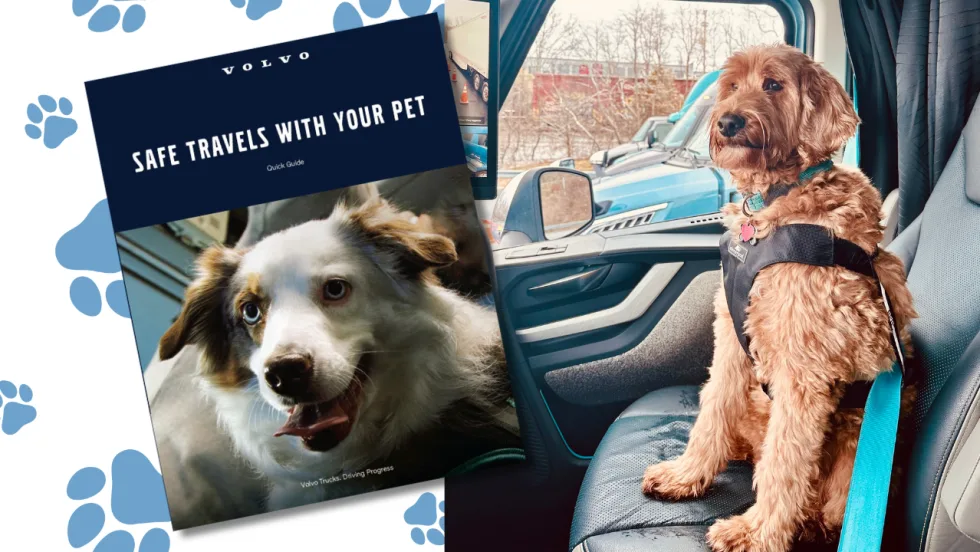
New Guide Offers Pet Safety Tips for Truck Drivers
Hundreds of thousands of pets travel in truck cabs. A new safety guide from Volvo Trucks and the Center for Pet Safety offers practical advice for truck drivers who bring dogs and cats along for the ride.
Read More →