Improving trailer aerodynamics for heavy-duty trucking fleets is an easy and sure-fire way to reduce fuel consumption. Not only are you reducing your carbon footprint, you're putting money back in your pocket at the same time.
Aerodynamic add-ons are evolving and improving. What worked 10 years ago is still good, but the products we see today are even better. It might be time to take a new look at aero.
Photo: Jim Park
7 min to read
In the quest to decarbonize road transport, electric trucks get all the hype these days, but industry has recently concluded that electrification on a scale that matters is still a long way off. Since there is some degree of urgency in dealing with climate change, we can't afford to wait for the perfect solution.
Ad Loading...
The second-best solution now is using less fossil fuel to power the existing fleet.
At the Advanced Clean Truck Expo in Las Vegas in May, Shelley Simpson, the president and incoming CEO at J.B. Hunt Transport raised eyebrows telling the crowd her company was pursuing avenues other than electrification to achieve its carbon-reduction goals, including going all-in on spec'ing more aerodynamic trucks and trailers.
Ad Loading...
"We recently announced an ambitious goal to reduce carbon emission intensity 32% by 2034, starting for a 2019 baseline," she said. "We will get there by focusing in three key areas: alternative powered equipment, budgeting fuel, and improved fuel economy."
The strategy is working. Simpson reported an 18% reduction in greenhouse gas emission intensity since 2019. The company has cut CO2 emissions from 120 tons per million-ton-miles to 94 tons per million ton-miles in five years.
And aero efficiency played a key role in those reductions. Consider that a 1 mpg increase in fuel efficiency (from 7 to 8 mpg) would save almost 1,800 gallons per year. That would reduce CO2 emissions by about 20 tons per year per truck. And at current fuel prices of $3.60 per gallon, savings could be around $5,000 per year.
Faster GHG Reduction Results
Aerodynamic improvements offer immediate reductions in CO2 emissions and immediate reductions in operating cost.
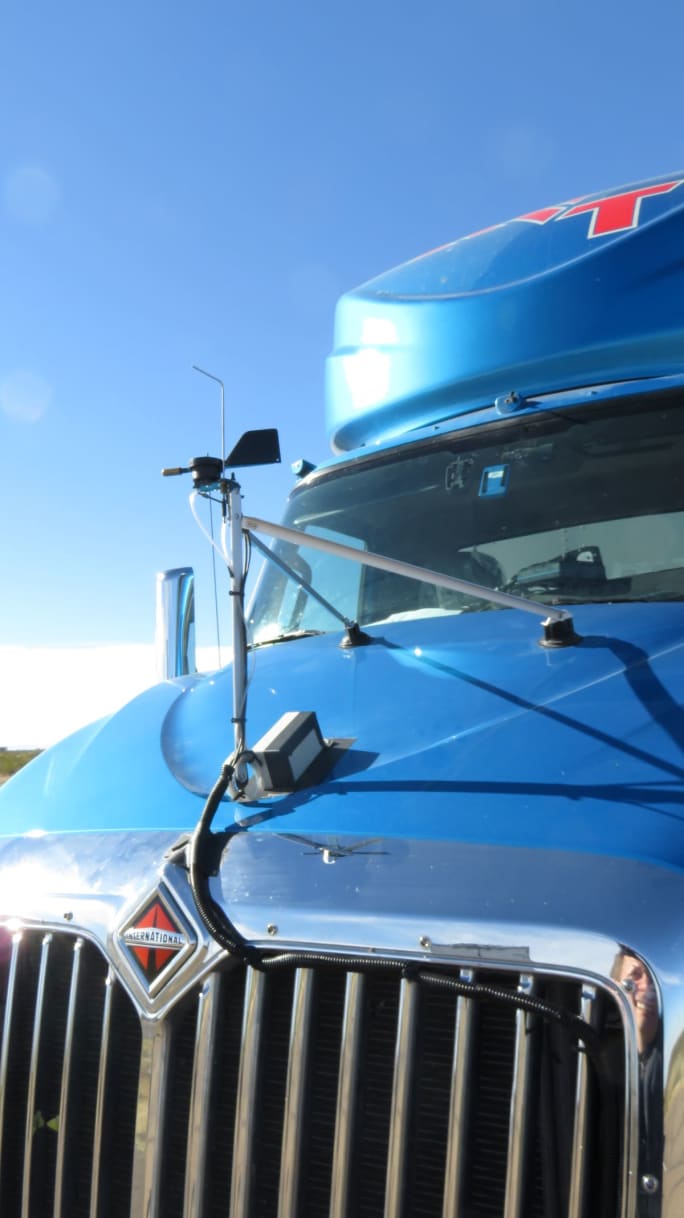
Mesilla Valley Transportation Solutions test aero products on a track in Pecos, Texas. An array or sensors, measuring devices and analytics get very accurate results that can be transposed to match any fleet operating environment in North America.
Photo: Mesilla Valley Transport Solutions
The reductions are smaller in scale than could be achieved by trucks that use no fossil fuel at all, but that out of the question for most fleets at present.
Ad Loading...
What is within reach, on a nationwide scale, is millions of gallons of fuel not burned to move freight. On such a scale, even a few tenths of a mile-per gallon per truck matter.
If you're a 48-state, general commodity dry van fleet you're behind the curve today if you're not at or close to 7 mpg. That's not a particularly tall order in 2024.
Fleet Average Fuel Economy Tops 7 mpg
In its most recent Annual Fleet Fuel Study, published in 2022, the North American Council for Freight Efficiency (NACFE), said the average fleet-wide fuel economy of the trucks in this study was 7.23 mpg in 2021 — a slight increase from the 7.15 in 2017.
Compare that to the national average fleet fuel economy of about 6.2 mpg in the same timeframe (that number was derived from IFTA fuel tax reporting).
That said, many over-the-road fleets now claim 8 mpg as their fleet average. There are plenty of trucks making 10 mpg these days. There are even documented reports of fleet trucks running 12 mpg.
Ad Loading...
Think about that.
That's double the fleet average from 10 or 15 years ago, according to data from the Federal Highway Administration.
Looking at it another way, that's half the CO2 emissions of those older trucks. And a fraction of the NOx emissions and other criteria pollutants as well.
Up Your Fuel Savings Game
So, if you've been considering upping for fuel economy game but thought we had reached peak aero, think again. There are still significant savings to be had.
MVTS Public Aerodynamics Test Results
Mesilla Valley Transport Solutions performs an amazing array of fuel economy testing on Class 8 trator-trailers. And the best part is, they're more than happy to share their finding with the public. Here are a few samples of MTVS test results.
"At highway speeds, there's a mile per gallon almost with just some basic treatment," says Daryl Bear, lead engineer and COO of MVT Solutions. "You can put on a skirt that it gives you a couple percent or skirts that give you seven or eight percent. Those aren't common but they are out there."
Ad Loading...
MVT Solutions, closely associated with Mesilla Valley Transportation -- a fleet renown for fuel efficiency -- does fuel economy testing at track near Las Cruces, New Mexico. Bear equips the test trucks with a variety of data acquisition systems and sensors such as fuel flow meters, aerodynamic sensors, high precision GPS, etc., along with sophisticated analytics that account for weather, duty cycles, driver behavior and more.
But best of all, many of the results of his fuel economy testing are published on the MVTS website and available for public review.
Investing in Aero
Where to start?
There are many aero products on the market, and truthfully, some are better than others. Some provide greater return on your investment, while others that perform well may come with a ton of maintenance issues -- like the trailer tails that were popular some years ago.
They proved very effective when drivers remembered to deploy them.
Ad Loading...
Acquisition costs were considered acceptable, but reliability proved to be the trailer tails' Achillies heel. Maintenance and repair issues quickly overshadowed the fuel saving benefits.
Today, variations on treatments for the back of the trailer are proving equally or nearly as effective as the folding trailer trails, but with few or none of the maintenance headaches.
Even something as basic as trailer skirts can vary widely in effectiveness, and by extension, ROI.
"You need to consider four factors when selecting trailer skirts" says Bear. "Fuel savings, cost, durability and maybe the most critical, the operating environment."
For maximum effectiveness, a trailer skirt would extend from the landing gear to the back bumper, and from the side rail on the trailer to inches above the pavement. Practically speaking, a skirt so close to the pavement wouldn't last a week in real-world service. So, you give up some portion of the aero effectiveness to preserve the life of the skirt and reduce the maintenance liabilities.
Ad Loading...
"Some fleets might want a shorter skirt because of where they operate," says Bear. "That's a trade-off that must be considered."
Treatment for the back of the trailer poses a similar conundrum. The full tails produce the best results, but there come with a bunch of baggage. The more modern tail systems are shorter and less obtrusive and deploy automatically. Like the skirts, the trade-off is slightly less aero performance, but significantly fewer maintenance issues.
Mesilla Valley Transportation were big trailer-tail users," Bear says. "They have switched to the Michelin kit — the whole system: skirts and the rear kit.
"People realize there are savings to be had at the back of the trailer, but there are also operational limitations that boat tails fell short in meeting. These low-profile designs from Michelin and Transtex provide great alternatives. Savings may be lower than with boat-tails, but the newer designs are always deployed and have zero maintenance."
Some Honest Test Results
Mesilla Valley Transportation Solutions is an unbiased, third-party fuel economy testing service that evaluates fuel saving products, including aerodynamic devices. Some reports are commissioned by the suppliers, others are testing independently by MVTS and published openly on the website with the suppliers' consent.
Ad Loading...
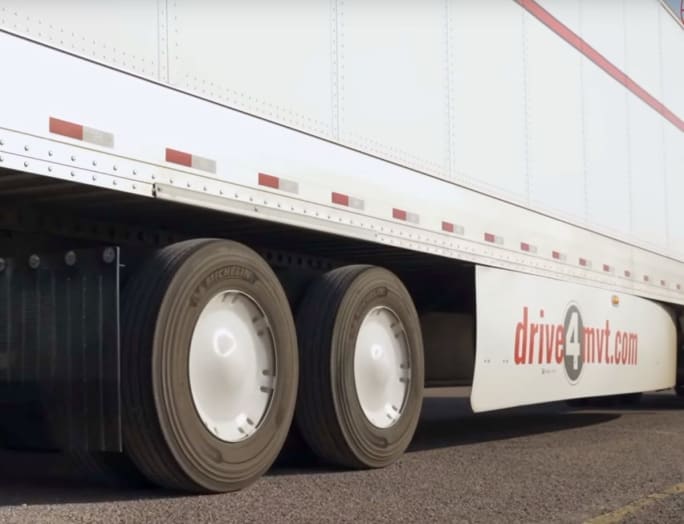
Aerodynamic mudflaps and wheel covers can yield surprising results. Seeming small improvements can add up to big savings when considered as a system.
Photo: Mesilla Valley Transport Solutions
The MVT fleet has relied on this testing program since 2012 to evaluate products with real-world fuel savings.
Note that the test fuel savings are expressed on gallons saved per 1,000 miles as well as a percentage. The gallons-saved metric is useful number, but it may not apply directly to your fleet. It reflects results achieved at the test track at a prescribed speed with weather conditions averaged to a national average standard. But, the numbers provide very realistic baselines from which to compare products.
The best part is, MVTS shares the results, publicly, at no charge. It's an amazing resource for fleets looking to squeeze all the fuel savings possible from their aero investment.
Consider All Your Options
Bear says these are exciting times for aerodynamic technologies, and fleets should be going all-in on building the best possible aero profiles. With so many solid options on the market, grabbing a mile per gallon, maybe two, is easier than it once was.
And it you believe your options are limited to one or two devices, think again.
Ad Loading...
"The old myth is that in aerodynamics 1+1 does not equal 2," Bear says. That's just what it is, a myth.
"When you measure in gallons consumed over a distance rather than a percentage, the savings do stack up. The exception is when one product affects the air flow of another. Consider pairing skirts with aero fenders and gap reducers, for example. The results can be extraordinary."
Volvo’s updated D13 promises lower emissions without sacrificing performance or fuel economy. Take a closer look at what changed inside the engine in this HDT Spotlight video.
Energy Vision estimates fleets could recover the higher purchase price of an RNG-fueled Class 8 tractor in 1.3 to 2.8 years under current fuel-price scenarios.
Calstart is now Catalyst Mobility, reflecting the nonprofit’s growing national role in clean transportation, including zero-emission trucks, infrastructure and incentive programs.
Average U.S. diesel prices have climbed to nearly $6 a gallon, surpassing the 2022 record as tight refinery capacity and Middle East disruptions keep fuel costs elevated.
Fuel delivery depends on more than what happens at the injector. For fleet, maintenance and technical professionals, looking at the full path from pump to injector can provide useful context for understanding engine performance.
The Port Authority of New York and New Jersey announced millions in incentives for zero-emission drayage trucks, yard tractors, and new charging hubs near the port.
Why do battery-electric Class 8 trucks remain so expensive? A California bill headed to Gov. Gavin Newsom would give fleets and state agencies more visibility into what manufacturers charge.
Detroit isn’t starting from scratch to meet EPA 2027 diesel emissions standards. Its Gen 6 DD13 and DD15 engines keep much of today’s platform while updating the fuel and aftertreatment systems.
California, Oregon, Washington, British Columbia and Baja California are coordinating plans for truck charging and hydrogen fueling from Canada to Mexico.
Learn more about Kenworth's T880E battery-electric vocational truck at the Paccar Technical Center, including its range, applications, upfitting considerations, and PTO options, in this HDT Spotlight video.