




Do We Worry Too Much About Inflation Pressure?
Tire pressure monitoring systems have allowed us a peek into the secret life of tires, and revealed some astonishing details.

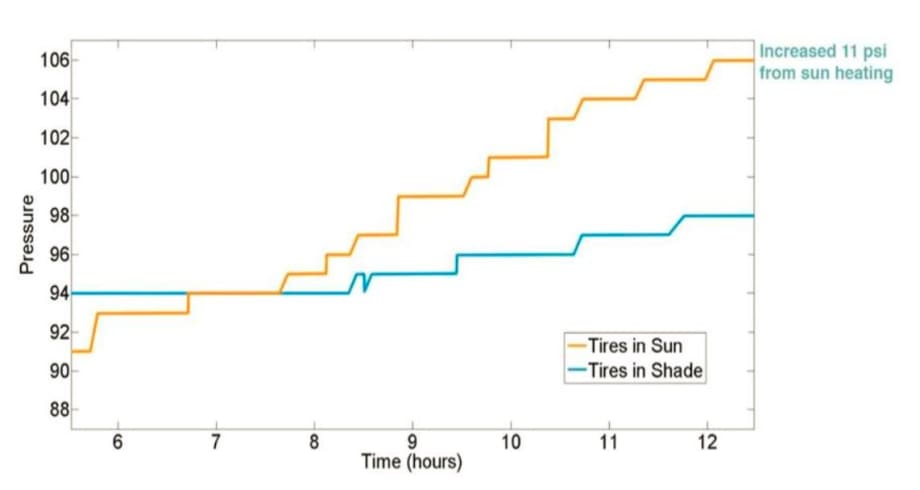
Tires exposed to direct sunlight will hear up, causing pressure differentials between shaded tires, like inside duals. Illustration courtesy of Aperia Technologies
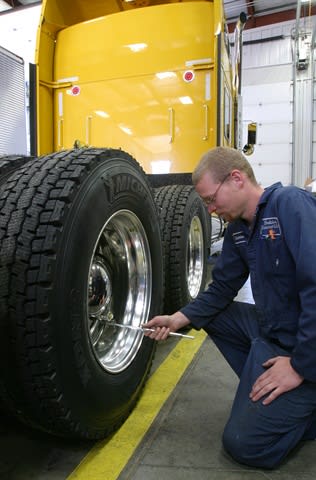
Frequent tire pressure check are useful, but could be counterproductive if tires are hot or ambient temperatures change dramatically from where the tires are checked. Photo courtesy of Michelin.
Tire pressure monitoring systems have allowed us a peek into the secret life of tires, and revealed some astonishing details. Several recent studies have shown, for example, that tire pressure can deviate considerably between two tires, one exposed to direct sunshine, the other on the shady side of the truck. You'd be like a dog chasing its tail if you tried to level out all the tires on that truck. And by evening, the pressures will have all changed again.
Top up a tire inside a warm shop in the winter and then drive outside and everything changes again. Inflate a cold tire outside and then bring it inside and you'll have a whole different set of numbers. It's worse than herding cats.
One of the Task Force sessions from the S.2 Tire and Wheel Study Group at this year's Technology and Maintenance Council meeting in Nashville presented some interesting findings on tire pressure maintenance. Case Studies for Proper Tire Inflation Maintenance, chaired by Al Cohn of Pressure Systems International, has yet to go to balloting, so reporting directly on the discussion would be inappropriate, but the story that emerges from the session is interesting indeed -- and there's plenty of other data that tells a similar story.
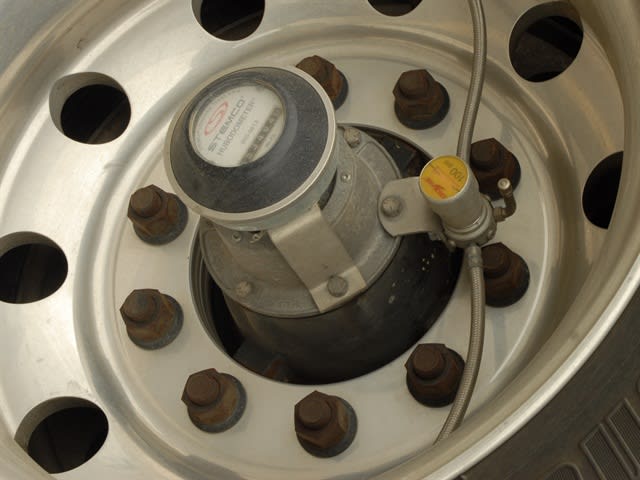
Devices that maintain equal pressure across dual tires preserve tire life and reduce uneven wear. Photo by Jim Park.
Even well-managed tire inflation pressure can be all over the map at different times of the day and in different operating conditions.
"Tires are not going to be perfect all day long," Cohn noted. "You settle for 100 psi Monday morning at 8 am when it’s 70 degrees, but the pressure will change significantly over the course of 24 hours."
Tires are designed to account for these fluctuations, so that’s nothing out of the ordinary. Problems could arise, however, if you are not doing your pressure checks properly, or if you wind up inadvertently compensating for some of the natural changes that are going to occur.
Dramatic variations in pressure
Josh Carter, co-founder and CEO at Aperia Technologies, maker of the new Halo self-powered, all-wheel tire inflation system, did some thorough research on tire inflation pressure while developing the product. He found, not surprisingly, that human error can lead to some dramatic variations in pressure, especially with inside duals.
"We used internal pressure sensors in our testing phase, but we still had fleets do manual pressure checks so we had something to compare," he says. "We found variances of up to 10 psi between the manually indicated pressure and what we saw from the tire pressure monitors."
Carter says it was probably a combination of badly calibrated tire gauges and the technician not getting the gauge to fit snuggly onto the valve stem. He says the variations were more pronounced on inside tires.
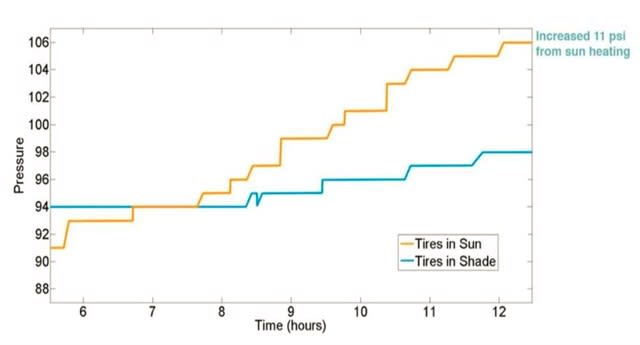
Tires exposed to direct sunlight will hear up, causing pressure differentials between shaded tires, like inside duals. Illustration courtesy of Aperia Technologies
Carter's research also found that tires exposed to bright sunshine will heat up, with the elevated temperature causing a corresponding rise in pressure.
"We saw variations of as much as 11 psi on the sunny tires compared to the tires on the shady side of the truck and on the inside dual on the sunny side," he says. "That's not a huge cause for concern except if a technician is checking tire pressure and lets a sun-exposed tire go with what appears to be a normal reading. It could actually be about 10 psi underinflated."
He also found that some pressure checks were done while the tires were still technically warm, which would show an elevated pressure over a cold tire, possibly leading to a false sense that tires were correctly inflated.
Cohn notes that it takes about 20-30 minutes fully loaded at highway speed to come up to what is considered hot inflation pressure (about 15 psi above cold pressure), while it can take as long as four hours for a tire to cool for an accurate cold pressure check. Cohn also noted 70 degrees is considered the normal ambient temperature for a cold pressure check. Naturally, if it's 40 degrees outside, or 90 degrees, your pressure readings will be up or down about 2 psi for every 10 degrees over or under normal.
That's what we mean when we say maintaining tire pressure is like a dog chasing its tail.
While you will probably never succeed in getting all the tires on a truck at exactly the same pressure for more than a few hours at time, there is cause for concern about letting the pressure slip too far from normal.
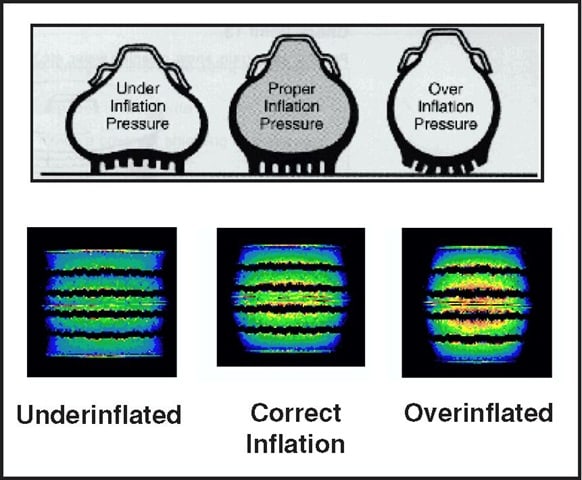
Under or over inflation changes the tire's footprint and may cause accelerated wear on certain parts of the tire. Graphic courtesy of TMC; RP-235A.
TMC's RP 235A notes, for instance, that an inflation mismatch of greater than 5 psi can result in the two tires being significantly different in circumference, and that has real impact on tire wear -- especially on the tire with lower pressure.
RP 235A describes all the pitfalls of unequal pressure in duals, as well as the understood risks of running underinflated tires.
Relief from Worry
Despite the three big concerns stemming from incorrect inflation -- fuel economy, tire wear and blowouts -- fleets can rest easy if they have a few basic checks and balances in place with their tire inflation management process.
Do regular tire pressure checks under similar conditions, i.e., when the tires are cold, when ambient temperature is about the same, and use calibrated tools.
Tools exist or can be easily fabricated to fill several tires from a single manifold linked to a calibrated gauge. Filling all the tires at once will give you accurate and balanced pressure between all tires.
Automatic inflation systems will maintain a preset pressure or dual-tire pressure equalizers can maintain equal pressure between the two tires.
Tire pressure monitoring systems provide fleets and/or drivers with real-time inflation pressure alerts. Temperature compensating systems improve the accuracy of the reading, screening out "normal pressure" readings even when the tire is hot, which could leave it under-inflated when cold.
While tire inflation pressure is worth worrying about, you'll never be able to stay on top of it totally without some outside help. Technology such as automatic tire inflation systems and tire pressure monitoring systems can help even out the swings in pressure, or at least bring them to your attention.
Simply doing more frequent pressure checks can help, but they have to be done under the proper circumstances, such as when tires are cold and when wild swings in ambient temperature won't skew the readings.
More Maintenance

Color Match Smarter: Tools That Restore & Perform
For fleet managers and collision repair professionals keeping heavy-duty trucks on the road, getting the color right the first time isn't just about appearance — it's about efficiency, turnaround time, and bottom-line results. Discover how today's digital color tools are transforming the repair process from guesswork to precision.
Read More →
Wrong Repair Prompts Recall of Freightliner, Western Star 4x2 Trucks
DTNA is recalling more than 2,400 trucks that received an incompatible software fix instead of the hardware repair required to address brake valve corrosion.
Read More →
Truck Drivers Need More Than Another Alert
Fleets have more visibility into truck health, safety events, and driver activity than ever. The next challenge is turning all that information into useful guidance for the person who has to decide what to do next.
Read More →

The Maintenance Checks Trucking Fleets Should Prioritize Before Fall Freight Picks Up
Making it through August isn’t the same as being ready for the next several months of operation. Find out what systems may have suffered from summer heat and need to be checked out before fall.
Read More →
What Three Fleets Are Doing Differently When Buying Truck Parts in 2026
With freight improving but costs still climbing, fleet maintenance executives explain how they're balancing price, quality, and supplier relationships.
Read More →
Paccar Recalls 2027 Trucks Built This Summer for Possible Electrical Problem
The nearly 6,000 Kenworth and Peterbilt trucks in the recall could potentially lose engine power, among other things.
Read More →
Will API PC-12 Oil Change Trucking Fleet Maintenance?
The new API PC-12 heavy-duty engine oil category reflects the changing demands of modern diesel engines. But fleets like Foodliner are looking to getting their own data before making decisions on adopting the new oils and questions such as extending oil drain intervals.
Read More →
Brake Safety Week to Focus on Drums and Rotors
Commercial vehicle inspectors are focusing on truck brakes during CVSA's Brake Safety Week, August 23-29.
Read More →Possible Battery-Cable Fires Prompt Recall of 15,000+ International MV and HV Trucks
On the recalled vehicles, manufacturing variations can cause the battery interconnect cable to contact the auxiliary stud and hold down the bracket.
Read More →
Rush, MCT Team Up to Grow Refrigeration Service Network
The joint venture will operate MCT's network of Carrier Transicold dealerships and mobile service locations, with the companies promising greater service capacity and uptime for refrigerated fleets.
Read More →