





Related: Clean Diesel Trucks Make up 30% of Commercial Vehicles in U.S.
Different Ways to Color Diesel Green
Clean fuels, by one or another name, are not quite the same. But with so many different clean diesels on the market, it can be difficult to distinguish the difference.
September 4, 2018
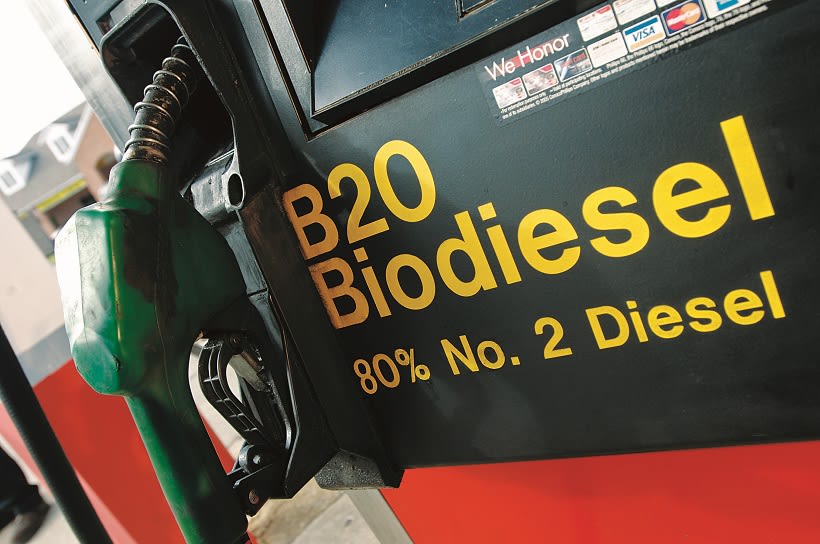
Biodiesel’s physical properties are similar to those of petroleum diesel, but it burns cleaner. Biodiesel meets both the biomass-based diesel and the overall advanced biofuel requirement of the federal Renewable Fuel Standard.
Photo: Renewable Energy Group
6 min to read
Shakespeare’s Juliet asked, “What’s in a name?” She was talking about Romeo, but she may well have been riffing on the different types of green diesel being marketed these days.
Let’s start with “clean diesel.” What does that term even mean? Not so long ago, if a fleet manager spoke of diesel being “clean,” he meant it had been tested and proven to be free of water and other contaminants that could hurt engine performance.
But today, “clean” equates with “green,” and for diesel, that designation is just the starting point for making sense of the marketing terms in play. “Clean diesel fuel – containing 97% less sulfur – is now the standard for both on-highway and off-highway diesel engines nationwide,” explains the advocacy group Diesel Technology Forum. This happened because of the federal emissions regulations that came into play in the 2000s.
DTF says using this ultra-low sulfur diesel (ULSD) in concert with advanced technologies, such as electronic controls, common rail fuel injection, variable injection timing, improved combustion chamber configuration and turbocharging, has “made diesel engines cleaner, quieter, and more powerful than in past vehicles.”
What’s more, according to DTF, the ability of diesel engines to run on a range of renewable fuels and blends enhances the potential for diesel technology to help meet tightening standards for greenhouse gas emissions.
Most new and existing diesel-powered equipment is compatible with diesel blended with biodiesel or renewable diesel (5% to 20% bio/renewable, depending on manufacturer warranties). “Compliance with production quality standards and ASTM fuel standards will be critical to greater acceptance and successful use of these fuels in diesel engines,” DTF points out.
The confusing cousins known as biodiesel and renewable diesel are specific designations for the clean “renewables” noted by DTF. But to be clear, while “bio” and “renewable” when applied to diesel fuel designate them as clean options, they are not interchangeable descriptors.
Of the two broad terms, biodiesel has gotten more attention in the media in recent years than has renewable diesel. Yet by its very name, one might assume that renewable diesel is the greenest of them all. However, the two fuels are produced differently and have distinct properties that affect emission levels and combustion efficiency as well as some performance factors.
Biodiesel basics
So, let’s take them one at a time. A key differentiator of biodiesel is that it is typically served up as a blend. To be sure, it is a renewable fuel in that it is formulated from vegetable oils, animal fats, and recycled restaurant grease.
Biodiesel’s physical properties are similar to those of petroleum diesel, but it burns cleaner. Biodiesel meets both the biomass-based diesel and the overall advanced biofuel requirement of the federal Renewable Fuel Standard, which requires that transportation fuel sold in the U.S. must contain a minimum volume of renewable fuels.
In its pure, unblended form, biodiesel is often referred to as B100 or “neat” (as in “straight up”) biodiesel. Currently, a 20% blend of biodiesel (B20) is approved by most vehicle manufacturers.
A longtime concern with biodiesel is how well it functions in cold weather. That depends on the blend of biodiesel and the characteristics of the petroleum diesel base. Generally, the lower the percentage of biodiesel in the blend, the better the blend performs in cold temperatures.
Regular No. 2 diesel and B5 (a blend of 5% biodiesel) typically perform about the same in cold weather, according to the Department of Energy, with both biodiesel and No. 2 diesel having some compounds that crystallize in very cold temperatures. The DOE notes that in winter weather, fuel blenders and suppliers combat crystallization by adding a cold flow improver. It recommends that for the best cold-weather performance, users should work with fuel providers to ensure an appropriate blend is used.
While biodiesel meets the American Society of Testing and Materials’ D6751 fuel-quality standard, it does not currently meet the separate ASTM D975 standard. Because the production process does not remove oxygen, it has been shown to increase engine-out NOx emissions when compared to clean or renewable diesel. There can also be issues with long-term storage due to its tendency to absorb water, and blending restrictions to prevent engine problems can limit the benefits of biodiesel.

Most new and existing diesel-powered equipment is compatible with diesel blended with biodiesel or renewable diesel (5% to 20% bio/renewable, depending on manufacturer warranties).
Photo: Renewable Energy Group
Renewable remedies
Renewable diesel is fuel derived from biomass that meets requirements established by the Clean Air Act as well as the petroleum clean diesel specs required by both the ASTM D6751 and D975 standards.
A key selling point for renewable diesel is that because it meets those two fuel specs, it can be legally used “as is” — no blending needed – in all modern diesel engines. That also means it’s compatible with existing diesel distribution infrastructure. In addition, it boasts excellent cold weather performance. Its high cetane numbers (75-85) mean renewable diesel combusts efficiently. DOE points out that renewable diesel’s “high combustion quality results in similar or better vehicle performance compared to conventional diesel.”
Neste, which markets MY Renewable Diesel, contends that diesel and biodiesel contain aromatics and impurities that can contaminate oil, foul fuel injectors, and clog diesel particulate filters. Renewable diesel contains nearly zero impurities, it says, and burns much cleaner. This can have an instant positive effect on exhaust aftertreatment systems (less soot produced can mean fewer DPF regenerations) and fuel system components (lack of impurities reduces deposit formation in critical fuel injector parts).
And its green cred is outstanding. Renewable diesel has been shown to cut greenhouse gas emissions by up to 80% when factoring in every step from production through consumption.
While renewable diesel is impressive, Troy Shoen, senior marketing manager for Renewable Energy Group Inc., a producer of biomass-based diesel, says there’s more to picking one clean fuel over another. “Because renewable diesel meets the D975 spec, it can be used the same as conventional diesel,” he says. “The advantage of biodiesel is it’s 100% renewable, but the fact it is a blend helps to reduce its cost and increase its availability.”
Shoen says REGI has taken the blending approach a step further with its new REG Ultra Clean diesel, a patent-pending proprietary blend of renewable diesel and biodiesel. Introduced this spring, Ultra Clean has been approved by the California Air Resources Board for year-round use under the state’s Alternative Diesel Fuel Regulation.
REGI states that the renewable blend is “among the lowest emission diesel fuels on the market. Ultra Clean significantly cuts emissions, blends easily with petroleum diesel, and is one of the lowest carbon-intensity fuels on the market today.”
The new blend combines the best of both fuels’ emission profiles to significantly reduce total hydrocarbon, particulate matter, carbon monoxide and nitrogen oxides (NOx), says Shoen. He says Ultra Clean’s key operational attributes include a higher cetane number for better performance and being easy to use, store, and handle without any changes needed to existing diesel storage/fueling infrastructure.
Lastly, Shoen says that with demand for renewable diesel now outpacing supply, blending in biodiesel as is done with Ultra Clean can “help stretch renewable diesel allocations while still offering the market an extensively renewable product.”
Subscribe to Our Newsletter
More Fuel Smarts

How Volvo Updated Its D13 for EPA 2027 [Watch]
Volvo’s updated D13 promises lower emissions without sacrificing performance or fuel economy. Take a closer look at what changed inside the engine in this HDT Spotlight video.
Read More →
Diesel Price Spike Shortens Payback for Natural Gas Trucks, Report Says
Energy Vision estimates fleets could recover the higher purchase price of an RNG-fueled Class 8 tractor in 1.3 to 2.8 years under current fuel-price scenarios.
Read More →
Calstart Becomes Catalyst Mobility, Reflecting Broader Focus
Calstart is now Catalyst Mobility, reflecting the nonprofit’s growing national role in clean transportation, including zero-emission trucks, infrastructure and incentive programs.
Read More →

Record Diesel Prices Squeeze Trucking Fleets
Average U.S. diesel prices have climbed to nearly $6 a gallon, surpassing the 2022 record as tight refinery capacity and Middle East disruptions keep fuel costs elevated.
Read More →
Sponsored•September 9, 2026
How Fuel Delivery Shapes Engine Performance
Fuel delivery depends on more than what happens at the injector. For fleet, maintenance and technical professionals, looking at the full path from pump to injector can provide useful context for understanding engine performance.
Read More →
East Coast Port Launches $45M Electric Truck Push
The Port Authority of New York and New Jersey announced millions in incentives for zero-emission drayage trucks, yard tractors, and new charging hubs near the port.
Read More →
California Bill Could Shed Light on Electric Truck Prices
Why do battery-electric Class 8 trucks remain so expensive? A California bill headed to Gov. Gavin Newsom would give fleets and state agencies more visibility into what manufacturers charge.
Read More →
Detroit Opens Orders for EPA 2027 Engines
Detroit isn’t starting from scratch to meet EPA 2027 diesel emissions standards. Its Gen 6 DD13 and DD15 engines keep much of today’s platform while updating the fuel and aftertreatment systems.
Read More →
Zero-Emission Truck Corridor Planned for West Coast
California, Oregon, Washington, British Columbia and Baja California are coordinating plans for truck charging and hydrogen fueling from Canada to Mexico.
Read More →
A Closer Look at Kenworth’s Electric T880E Vocational Truck [Video]
Learn more about Kenworth's T880E battery-electric vocational truck at the Paccar Technical Center, including its range, applications, upfitting considerations, and PTO options, in this HDT Spotlight video.
Read More →