





You also might like: Cummins Heritage Gallery [Photos]
Cummins Returns to its Pioneering Roots to Meet Emissions Goals
An early automotive innovator, Cummins advanced the diesel engine and pushed for its use in trucking. Now the company is taking bold — and practical — steps toward a cleaner and greener future.
June 23, 2022
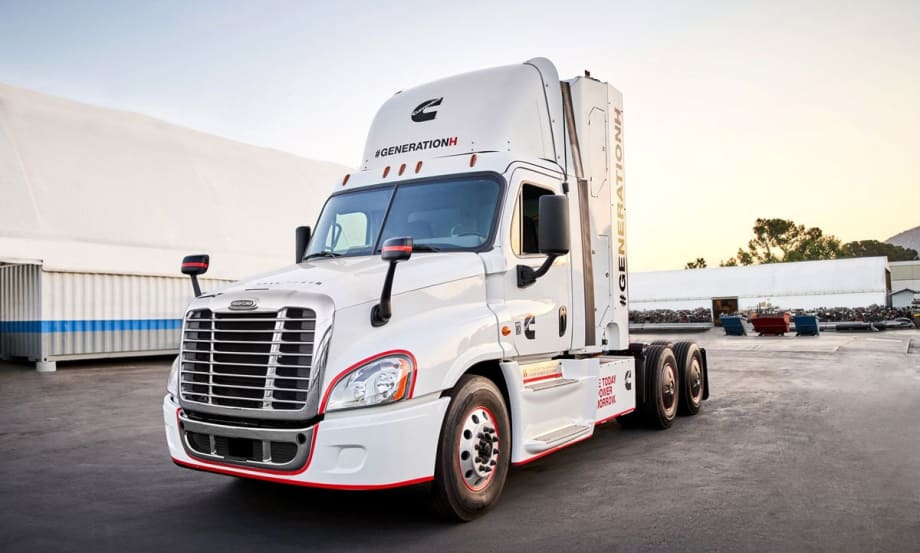
Fuel-cell-electric trucks, like this one pictured in a Cummins-supplied photo from ACT Expo, are just one of many low- and zero-emissions powertrains Cummins is developing.
Photo: Cummins
8 min to read
An early automotive innovator, Cummins advanced the diesel engine and pushed for its use in trucking. Now the company is taking bold – and practical – steps toward a cleaner and greener future.
Columbus, Indiana, is a pretty little town in the American heartland that could come straight out of a Norman Rockwell painting from the 1940s. But Columbus is no mere farming community. A quick drive through its downtown reveals a town with significant architectural and cultural diversity. That’s because over a century ago, Columbus had its very own mad scientist in town — a sort of precursor to Doc Brown from “Back to the Future” — whose endless tinkering and sometimes outlandish projects led to the founding of one of the most important power-generation corporations on the planet today.
Born in 1888, Clessie Cummins was an Indiana farm boy with an eighth-grade education who was at the perfect age to become fascinated by automobile technology at its birth. In particular, Cummins was fascinated by diesel engines. By the early 1900s, diesel, despite being the fuel that launched internal-combustion engine technology, had largely fallen by the wayside as gasoline-powered engines became the dominant form of propulsion for cars and trucks.
But Cummins recognized that diesel had unique strengths that made it the ideal fuel for farm, construction, and highway applications that needed large amounts of engine torque and horsepower. By 1919, he’d perfected his design to the point that he founded Cummins Engine in his hometown and set about changing how freight moved.
Over a century later, Cummins’ name is indelibly intertwined with the story of diesel engines for transportation and power-generation systems all over the world. Today, the company is pushing forward to embrace, research, develop and deploy a host of new power-generation systems in its corporate mission to combat climate change and help save the planet.
A Diversity of Engine Solutions
Cummins invited a select group of transportation journalists to its headquarters in Columbus to discuss the state of a global transportation system on the cusp of great change and how it intends to help its customers through this change.
As a corporation, Cummins intends to take a leadership role in battling climate change globally, and the company has been very vocal recently about this new mission.
CEO Tom Linebarger, for example, gave an impassioned speech at the Advanced Clean Energy Expo (ACT Expo) in May, in which he called climate change the “existential crisis of our lifetime.” He said that he — and Cummins — refuse to sit idly by and then try to explain to future generations why they refused to act while the planet was burning up.
But importantly, both Linebarger and executives in Columbus reaffirmed an extremely important point: Achieving global sustainability goals are pointless if people do not have the means to create a better, more prosperous future for themselves and their children.
In other words, all the advanced, complex, highly technical and expensive powertrain options imaginable won’t do the planet one bit of good if people can’t afford to buy them and get reliable service from them.
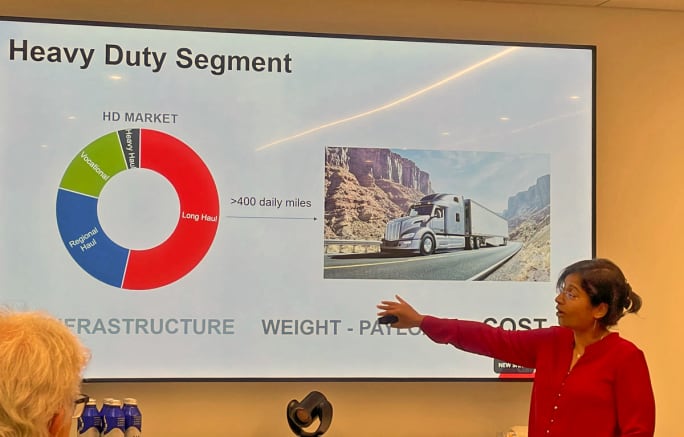
Uma Vajapeyazula, director, engine business on-highway product strategy, Cummins, discusses the OEM’s multi-technology strategy for reaching net zero emissions in trucking by 2050.
Photo: Jack Roberts
Uma Vajapeyazula, director of Cummins’ engine business on-highway product strategy, noted that there is “an unprecedented mix” of new powertrain technologies already on the commercial vehicle market today.
“We believe this foreshadows what Mike Roeth, the executive director of the North American Council of Freight Efficiency, has predicted,” she said. “We are fast approaching a period he calls ‘the messy middle’ — a period where some technologies come to market before others. And in this environment, fleets will experiment with several different alternative-fuel or zero-emissions powertrains in an effort to discover which technology works well for its particular applications. And, moreover, this could very well mean that fleets may have to simultaneously adopt several different powertrain technologies to support different applications in different geographic regions.”
To deal with the coming messy middle, Vajapeyazula said that Cummins has a “unique” advantage in its corner: a broad portfolio of existing power options, as well as powertrain solutions that are in development for both near- and long-term deployment.
Vajapeyazula said Cummins will unveil several vehicle power options on the path to net zero, including a few surprises. These include:
A new, medium-duty gasoline engine.
A new generation of smaller-displacement, heavy-duty diesel engines.
A new generation of “fuel-agnostic” internal combustion engines that can burn natural gas or liquid hydrogen (as well as smaller-displacement models that can run on gasoline or propane).
Battery-electric powertrains.
Hydrogen fuel cell powertrains.
Hybrid powertrains.
“We understand that the messy middle is going to require a diversity of solutions,” Vajapeyazula explained. “And we believe that our portfolio is one big way Cummins can help the trucking industry through this transition to net zero.”
Although the future of zero emissions powertrains looks bright, that future simply is not accessible right now, she said. “It’s basically a question of timing. We want to help our customers bridge this coming gap with power options that make the most sense based on technology that is accessible right now.
“Diesel and gasoline engines will be a mainstay for many fleets for some time to come, until other solutions, such as BEVs or natural gas engines, are fully developed, enter production and achieve sufficient scale to bring pricing down,” Vajapeyazula explained. “So, instead of pushing customers into alternative powertrains that cannot yet meet their application requirements, Cummins will use its expertise and advanced electronic engine control systems to deliver smaller, more efficient gasoline and diesel engines that emit fewer NOX emissions but still deliver performance on par with engines available today.”
Vajapeyazula said that soon, Cummins will have smaller engines — mostly likely in the 10L range — that will perform like never before, while meeting all current NOX regulations.
“This is a great example of how Cummins intends to be real, and practical, with this approach,” she added. “At Cummins, we don’t like to compromise on power. But thanks to Cummins technology and innovation, we no longer have to grow the size of the engine to make that happen." Technologies such as higher compression ratios, variable valve technology, and advanced engine control systems will allow Cummins to develop smaller-displacement diesels with power densities that allow, say, a 10L engine to play a role in the lower rating of mid-bore space and start competing in heavy-duty segment.
Zero-Emissions Performance on Par with Diesel
Cummins made headlines at ACT Expo both with the launch of its new X15 natural gas engine, as well as an announcement that it would soon use the same technology to develop a similar engine that will burn liquid hydrogen as fuel.
This is part of the “fuel-agnostic engine” platform that Cummins announced earlier this year. These engines all use a basic “bottom” structure containing the pistons by simply changing out the specialized heads on the “top” part of the engine to accommodate the appropriate fuel. Using this technology, Cummins said it will soon be able to supply fleets with the same basic engine platforms capable of running natural gas, propane or even hydrogen.
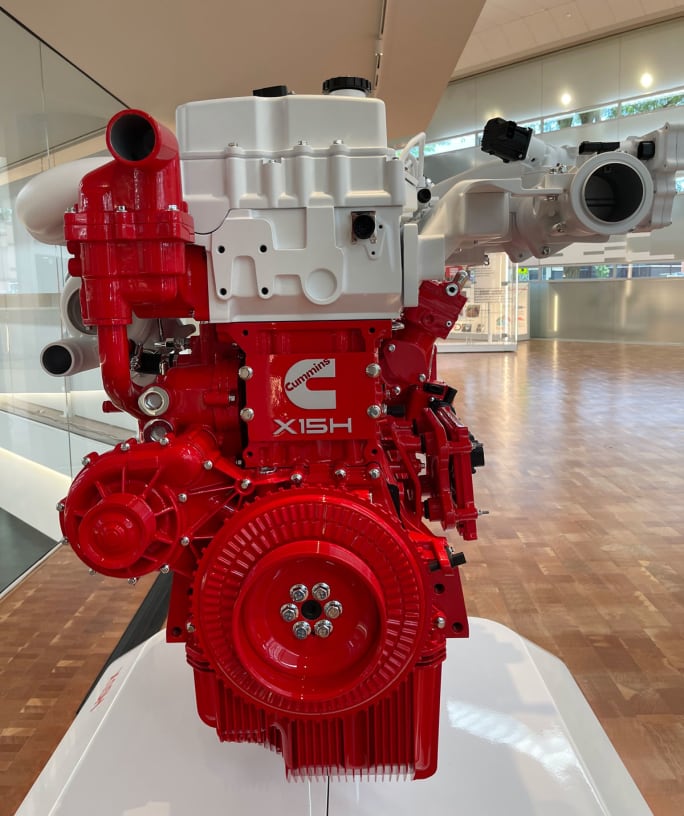
The Cummins X15H hydrogen engine — shown here on display at the company’s headquarters in Columbus, Indiana — could be a game-changer for long-haul truck fleets in a net-zero-emissions future.
Photo: Jack Roberts
“We can make an engine run on any fuel today,” said Jim Nebergall, general manager, hydrogen engines, Cummins. “But hydrogen is simply the lowest-cost zero-emissions fuel out there. And, even better, the maintenance on these engines is similar to that on diesel engines today. There’s not a lot of change, involved. And there’s not a lot of risk. So, for our customers, we think this is going to be an outstanding zero-emission fuels option.”
This breakthrough was made possible by Cummins’ earlier work getting the industry’s first natural-gas heavy-duty engines to market, added David King, North American on-highway product manager for natural and renewable gas engines.
“We learned a lot about how these engines perform, particularly in regard to the different heat signatures these fuels have,” King explained. “The head of the engine really manages its thermal environment. And we’ve learned how to design different engine heads for different fuels to create the proper thermal environment for the optimal combustion of each specific fuel. We can now really control temperatures inside the engine as well as the combustion event itself. In practical terms, we can really push the engine to the point that we get performance that is as close as possible to diesel engines today. That can mean up to 500 hp and 1,850 lb-ft of torque. That’s zero-emissions performance on par with anything available today.”
Cummins hydrogen engines will be clean-burning and require selective catalytic reduction (SCR) exhaust aftertreatment systems as well, Nebergall added. “When you burn hydrogen, you create nitrogen as a byproduct,” he said. “The engines produce much lower NOX than current engines. But SCR will still be necessary.”
The fact that these are spark-ignited engines that share a certain number of components with other Cummins engines will help with scale and reducing costs. The engines also share a common fuel system, as well as sharing a common onboard storage system with Cummins fuel-cell vehicles.
Cummins hydrogen ICE field trials are slated to begin in 2024, with production starting in 2027.
With a bold mission statement and a focus on its customers, Cummins intends to be a major player in trucking’s shift away from fossil fuels toward a net zero future. And, perhaps most importantly, company executives assert that thanks to its unique history, long experience with both diesel engines and trucking, engineering expertise, global reach, international dealer network and on-hand capital available to invest billions of dollars in multiple powertrain and alternative fuel solutions, Cummins is perhaps uniquely suited to meet the demanding goals it has laid out for itself over the coming two decades. No one yet knows how the market will dictate tomorrow’s transportation solutions. But regardless of which technologies win out, Cummins is determined to be a global player in fueling trucking’s future.
Corrected 1/24/2022, 2:30 EDT, to clarify remarks about the role of smaller-displacement engines and a misspelled occurence of Vajapeyazula.
Subscribe to Our Newsletter
More Fuel Smarts

How Volvo Updated Its D13 for EPA 2027 [Watch]
Volvo’s updated D13 promises lower emissions without sacrificing performance or fuel economy. Take a closer look at what changed inside the engine in this HDT Spotlight video.
Read More →
Diesel Price Spike Shortens Payback for Natural Gas Trucks, Report Says
Energy Vision estimates fleets could recover the higher purchase price of an RNG-fueled Class 8 tractor in 1.3 to 2.8 years under current fuel-price scenarios.
Read More →
Calstart Becomes Catalyst Mobility, Reflecting Broader Focus
Calstart is now Catalyst Mobility, reflecting the nonprofit’s growing national role in clean transportation, including zero-emission trucks, infrastructure and incentive programs.
Read More →

Record Diesel Prices Squeeze Trucking Fleets
Average U.S. diesel prices have climbed to nearly $6 a gallon, surpassing the 2022 record as tight refinery capacity and Middle East disruptions keep fuel costs elevated.
Read More →
Sponsored•September 9, 2026
How Fuel Delivery Shapes Engine Performance
Fuel delivery depends on more than what happens at the injector. For fleet, maintenance and technical professionals, looking at the full path from pump to injector can provide useful context for understanding engine performance.
Read More →
East Coast Port Launches $45M Electric Truck Push
The Port Authority of New York and New Jersey announced millions in incentives for zero-emission drayage trucks, yard tractors, and new charging hubs near the port.
Read More →
California Bill Could Shed Light on Electric Truck Prices
Why do battery-electric Class 8 trucks remain so expensive? A California bill headed to Gov. Gavin Newsom would give fleets and state agencies more visibility into what manufacturers charge.
Read More →
Detroit Opens Orders for EPA 2027 Engines
Detroit isn’t starting from scratch to meet EPA 2027 diesel emissions standards. Its Gen 6 DD13 and DD15 engines keep much of today’s platform while updating the fuel and aftertreatment systems.
Read More →
Zero-Emission Truck Corridor Planned for West Coast
California, Oregon, Washington, British Columbia and Baja California are coordinating plans for truck charging and hydrogen fueling from Canada to Mexico.
Read More →
A Closer Look at Kenworth’s Electric T880E Vocational Truck [Video]
Learn more about Kenworth's T880E battery-electric vocational truck at the Paccar Technical Center, including its range, applications, upfitting considerations, and PTO options, in this HDT Spotlight video.
Read More →