




CNG Trucks Offer ROI on Multiple Fronts
Almost a decade ago, Sheehy Mail Contractors looked to save money by switching to CNG-powered trucks. Today, the benefits of that move affect far more than its bottom line.

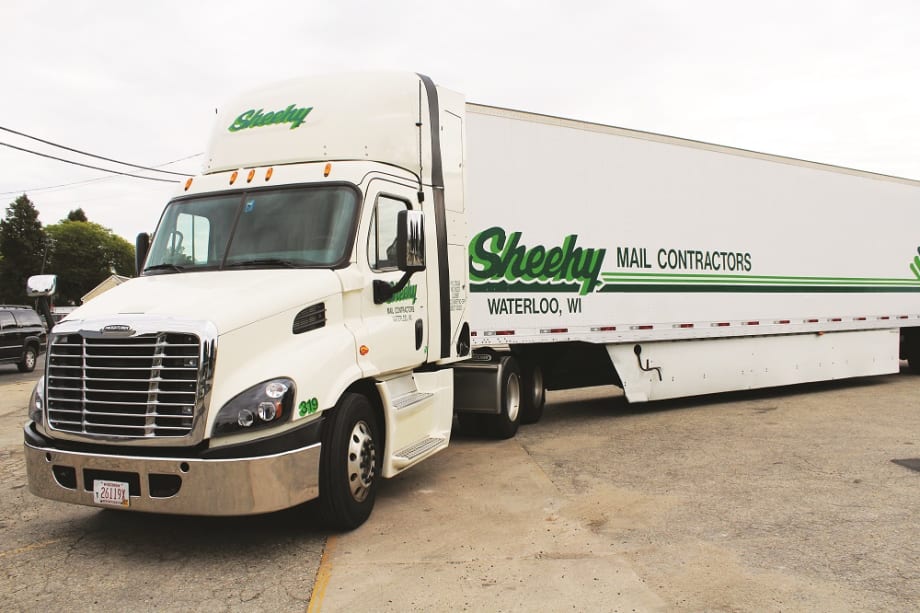
The Sheehy Mail Contractors fleet today is 90% CNG powered, including 15 brand-new CNG Freightliner Cascadias.
Photos courtesy Sheehy
With fuel prices at their highest since 2014, compressed natural gas as an alternative fuel for fleet operations is once again getting attention as a cheap, super-clean alternative to diesel or gasoline. The truth is, many fleets that switched to CNG a number of years ago have been quietly going about their business and never looked back.
Sheehy Mail Contractors, out of Waterloo, Wisconsin, is one such fleet. Founded in 1952, Sheehy operates a fleet of straight trucks and tractors. About 70% of its operations are focused on U.S. Postal Service contracts and the remainder on hauling freight. And it’s a company with a culture of fuel economy deeply embedded in its DNA.
“Our founder, Gerald Sheehy, was putting homemade components on his trucks from the very beginning in an effort to boost fuel economy,” says Nick Myers, communications and brand strategist for the carrier. Around seven years ago, executives at the carrier decided the time was right to seriously look at CNG as an alternative fuel.
Today, less than a decade into its “look” at CNG, it powers 90% of Sheehy’s trucks. “We’ve still got a few diesel trucks in the mix,” Myers says. “But we’ve slowly, but surely, been acquiring CNG-powered units since it became clear the fuel would work well in our applications.”

Sheehy has found that over the past decade an expansive CNG fueling network has sprung up, making it easier for its drivers to find fuel throughout the fleet’s operating area.
Even though the spotlight fell away from CNG after diesel prices stabilized and returned to more “normal” levels a few years ago, CNG technology and infrastructure kept right on evolving and expanding, Myers says, which has made Sheehy’s steady conversion to the new fuel surprisingly painless.
“The national CNG network is extremely stable today,” he says. “This means that we enjoy stable fuel prices as well. They don’t fluctuate much, if at all, and are holding steady around $1.99 a gallon — and we won’t have to deal with the usual Memorial Day price increases other fleets will as refineries switch over from winter- to summer-blended fuel formulations. Even better, over the past decade, we’ve seen an expansive CNG fueling network build up, which has made it easier for our drivers to find fuel, no matter where they are in our area of operations.”
Driver acceptance and training has been a concern for some fleets considering a switch to CNG. But Myers says Sheehy received very little pushback as it began to move to the new fuel in earnest. In fact, today, he says, Sheehy executives consider CNG a secret weapon in the current driver shortage crisis. “We never had any major resistance from our driver force,” he says. “In fact, many of our drivers — most of whom have been with us 20 years or more — prefer CNG over diesel.”
That’s because the trucks are much cleaner to fuel, with no spills, mess or odors, and tend to ride better, he says. “We’ve tweaked our automated manual transmissions to deliver more low-end torque. The trucks still don’t have as much get-up-and-go as diesel-powered units, but our drivers have gotten used to that. New drivers are still a bit hesitant when they first get behind the wheel of a CNG truck. But usually it becomes a non-issue for them as well very quickly.”
CEO John Sheehy notes that while operating costs are “about neutral” compared to diesel, the fleet enjoys a return on investment from CNG that is simply out of reach for fleets running conventional fuels. “We mainly measure our CNG ROI in terms of being good stewards of the environment and the preferential treatment we receive from our customers,” he says.
Myers echoes this sentiment. “Sheehy saves a lot of money on fuel,” he says. “We also routinely win awards for being a green fleet and protecting the environment, receive tremendous good will from our customers and the communities we serve. And we have happier drivers with less turnover. So for us, CNG has been a win on multiple fronts.”
Related: Clean Vehicle Tech Grows in Face of Shifting Regulations
More Fuel Smarts

How Volvo Updated Its D13 for EPA 2027 [Watch]
Volvo’s updated D13 promises lower emissions without sacrificing performance or fuel economy. Take a closer look at what changed inside the engine in this HDT Spotlight video.
Read More →
Diesel Price Spike Shortens Payback for Natural Gas Trucks, Report Says
Energy Vision estimates fleets could recover the higher purchase price of an RNG-fueled Class 8 tractor in 1.3 to 2.8 years under current fuel-price scenarios.
Read More →
Calstart Becomes Catalyst Mobility, Reflecting Broader Focus
Calstart is now Catalyst Mobility, reflecting the nonprofit’s growing national role in clean transportation, including zero-emission trucks, infrastructure and incentive programs.
Read More →

Record Diesel Prices Squeeze Trucking Fleets
Average U.S. diesel prices have climbed to nearly $6 a gallon, surpassing the 2022 record as tight refinery capacity and Middle East disruptions keep fuel costs elevated.
Read More →
How Fuel Delivery Shapes Engine Performance
Fuel delivery depends on more than what happens at the injector. For fleet, maintenance and technical professionals, looking at the full path from pump to injector can provide useful context for understanding engine performance.
Read More →
East Coast Port Launches $45M Electric Truck Push
The Port Authority of New York and New Jersey announced millions in incentives for zero-emission drayage trucks, yard tractors, and new charging hubs near the port.
Read More →
California Bill Could Shed Light on Electric Truck Prices
Why do battery-electric Class 8 trucks remain so expensive? A California bill headed to Gov. Gavin Newsom would give fleets and state agencies more visibility into what manufacturers charge.
Read More →
Detroit Opens Orders for EPA 2027 Engines
Detroit isn’t starting from scratch to meet EPA 2027 diesel emissions standards. Its Gen 6 DD13 and DD15 engines keep much of today’s platform while updating the fuel and aftertreatment systems.
Read More →
Zero-Emission Truck Corridor Planned for West Coast
California, Oregon, Washington, British Columbia and Baja California are coordinating plans for truck charging and hydrogen fueling from Canada to Mexico.
Read More →
A Closer Look at Kenworth’s Electric T880E Vocational Truck [Video]
Learn more about Kenworth's T880E battery-electric vocational truck at the Paccar Technical Center, including its range, applications, upfitting considerations, and PTO options, in this HDT Spotlight video.
Read More →