





Related: Fleet Operating Costs hit Nearly $72 an Hour in 2018
Carrier Earnings Worse than the Economy Might Indicate [Commentary]
For the third time this year, the economy seems to be doing better than trucking markets. Let’s dig into third-quarter earnings reports from publicly traded fleets for more.
November 18, 2019
![Carrier Earnings Worse than the Economy Might Indicate [Commentary]](https://assets.bobitstudios.com/image/upload/f_auto,q_auto,dpr_auto,c_limit,w_920/jb-hunt-on-the-road_1768079087704_eguwyz.jpg)
For the third time this year, the economy seems to be doing better than trucking markets.
Photo: Deborah Lockridge
3 min to read
For the third time this year, the economy seems to be doing better than trucking markets. Let’s dig into third-quarter earnings reports from publicly traded fleets for more.
The 1.9% third-quarter GDP growth reported by the Bureau of Economic Analysis seems to portray a stronger volume environment than was experienced by the industry. This was likely the result of continued high inventories because of goods pre-shipped in the fourth quarter of 2018 ahead of proposed tariffs, as well as the impacts of a slower industrial economy this year.
In the table below, we break down some of the key operating statistics and performance indicators in trucker and brokerage earnings reports. Gaps in the data are related to companies that do not disclose these figures, and where carriers provided breakdowns of truckload versus dedicated, we matched the data up as best we could. The companies are ranked in order of the percentage point improvement in operating margins.
In the pure truckload segment, we saw the largest profit disappointments. Operating profit margins were down to 7.2%, from 10% a year ago. This was the result of a 5.1% revenue decline. The average fleet grew by 2.7%, but drove 4.2% fewer miles per truck, and was paid 5.6% less in average revenue per mile. This was a deterioration from an already weak second quarter.
More companies are breaking out dedicated truckload, where median revenue growth was strong, at 8.7%. The average operating profit margin of 11.2% was a 3.2 percentage point improvement over the 8% margins reported a year ago. Fleet growth remained strong at 6.7%, so this is where all the new trucks are going, and that has not changed in terms of a trend.
Once again, the less-than-truckload space proved to be a bit of an oasis. LTL companies held strong, registering 0.6 percentage points of margin improvement on a 2.1% industry improvement in yields, offsetting a 3.8% tonnage decline. We note that while weight per shipment remained a negative 0.8%, it has improved for the past two quarters.
We’ve added truck brokers and logistics companies because it is relevant to fleet capacity and the competitive landscape. Lower spot rates slowed revenue growth from 15.1% in the fourth quarter of last year to a decline of 12.9%, resulting in a decline in overall net revenue margins, and 180 basis points (1.8 percentage points) in lower operating profit margins. (The silver lining is that the industry was able to reduce purchased transportation expense by 11.6%.)
Out net takeaway? Third-quarter results for most freight companies were worse than the economy might indicate, impacted by weak industrial volumes, excess truck capacity, low freight rates, and uncertainty in global markets. Where we saw the greatest deterioration was in over-the-road truckload pricing. Some shippers have been under-shipping contractual freight in order to make greater use of spot truck markets. This also caused lower-than-expected revenues in much of the brokerage space.
We believe the inventory overhang will remain a problem through the spring of 2020, with capital expenditures and hiring plans likely to continue to moderate as margins continue to deteriorate. Growth rates turned negative, slowing by around 3% in the third quarter, driven by 2% lower average mileage in truckload and 4.5% lower tonnage in LTL.
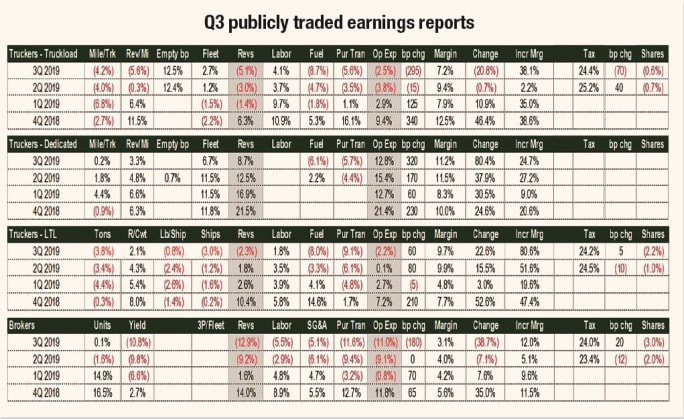
Third-quarter results for many freight companies were impacted by weak industrial volumes, excess truck capacity, low freight rates, and uncertainty in global markets.
Source: Company Reports, Tahoe Ventures LLC
Jeff Kauffman has been a recognized transportation authority for almost 30 years, most notably heading freight transportation research for Merrill Lynch. Currently, he is managing director for Loop Capital Markets and also heads Tahoe Ventures, a transportation consulting company. He can be reached at jkauffman@truckinginfo.com.
Subscribe to Our Newsletter
More Fleet Management

Sponsored•September 16, 2026
Color Match Smarter: Tools That Restore & Perform
For fleet managers and collision repair professionals keeping heavy-duty trucks on the road, getting the color right the first time isn't just about appearance — it's about efficiency, turnaround time, and bottom-line results. Discover how today's digital color tools are transforming the repair process from guesswork to precision.
Read More →
FMCSA Pauses Biennial-Update Enforcement Amid Motus Transition
Carriers whose updates were due on or after June 1 have more time, while FMCSA works to stabilize its new registration system and warns of phishing sites impersonating its new carrier registration system, Motus.
Read More →
Sponsored•September 14, 2026
2026 Blueprint for Countering Smarter Supply Chain Theft
Cargo theft is no longer just the cost of doing business. It's a multi-billion-dollar criminal enterprise exploiting vulnerabilities across your fleet, drivers, and supply chain.
Read More →


Sponsored•September 1, 2026
How Telematics Improves Visibility, Control, and Performance in Refrigerated Fleets
Explore how telematics help refrigerated fleets improve visibility, uptime, efficiency, compliance, and cargo protection across connected cold chain operations.
Read More →
What the U.S.-Canada Trade War Means for Trucking
Escalating U.S.-Canada tariffs could disrupt cross-border freight, reduce truck volumes, raise costs, and create new uncertainty for carriers on both sides of the border.
Read More →
What Are Trucking’s Top Concerns for 2026?
The American Transportation Research Institute wants to know what's worrying trucking fleet managers, drivers, and other stakeholders in its annual Industry Issues survey.
Read More →
American Trucking Associations Looks for a New Leader
ATA President and CEO Chris Spear abruptly left his job at the association on August 21, at a pivotal time for the trucking industry.
Read More →
Public Wi-Fi Cybersecurity Risks: How Truck Drivers and Fleets Can Protect Their Data
Public Wi-Fi can expose truck drivers and fleets to credential theft, malware, and other cyber threats. Here’s how to reduce the risk on the road.
Read More →
For Nicky Cupp, Fleet Innovation Starts With Frustration
HDT Truck Fleet Innovator Nicky Cupp turns everyday pain points at Fraley & Schilling into opportunities for better technology and smarter processes.
Read More →
Adam Buttgenbach’s Approach to Electric Trucks: Start With Where They Fit
HDT Truck Fleet Innovator Adam Buttgenbach helped PepsiCo build one of North America’s largest EV fleets by focusing on where electric trucks make operational sense.
Read More →