




Can Emissions Repair Costs be Contained?
The addition of selective catalytic reduction and diesel particulate filter aftertreatment to modern trucks forced fleets and manufacturers to shift expectations on the fly. These two fleets met the emissions maintenance monster head-on — and won.

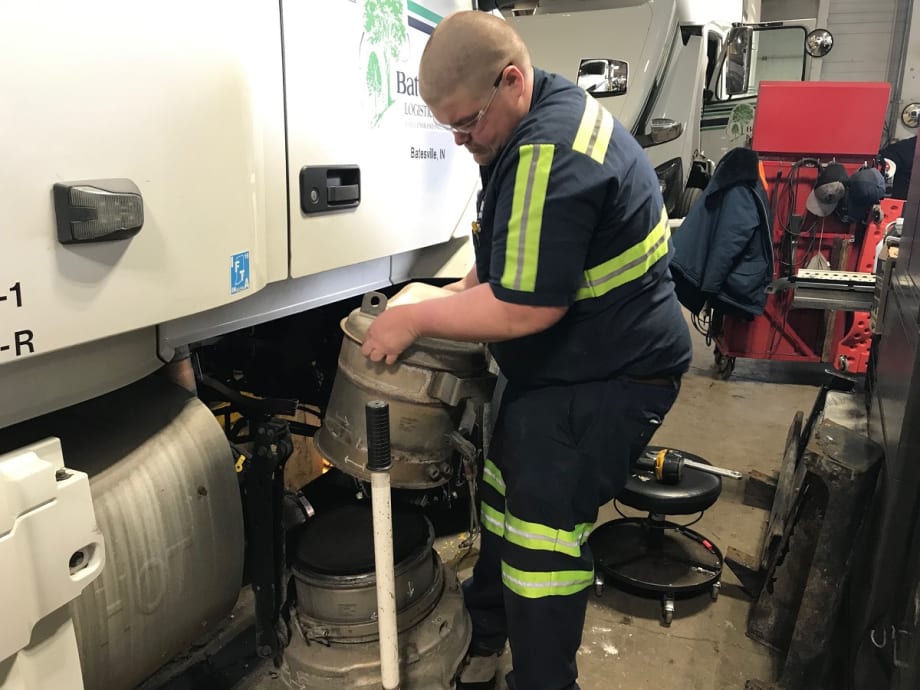
Batesville Logistics is unhitching its exhaust system PM from OEM recommendations and now cleans DPFs every 100,000 miles.
Photo: Batesville Logistics
As traumatic as it was at the time, the addition of selective catalytic reduction and diesel particulate filter aftertreatment to modern trucks will likely go down as one of the industry’s greatest technological triumphs.
As late as 2005 and 2006, diesel engine manufacturers weren’t even sure the stringent 2010 EPA emissions regulations were attainable for heavy-duty diesel trucks. As one engineer said at the time, “We’re going to have to schedule some inventions along the way, if we’re going to do this.”
But the industry eventually delivered — in spades. True, there was an unpleasant exhaust gas recirculation stopgap phase that still conjures up nightmares from fleet managers who lived through it. But with the introduction of SCR systems using a diesel exhaust fluid formula to chemically scrub nitrous oxides out of diesel exhaust smoke, trucking finally had reliable exhaust aftertreatment systems that not only helped keep the air clean, but offered a significant boost in fuel economy as well.
According to the Diesel Technology Forum, SCR aftertreatment systems are part of a complex emissions reduction system that has reduced NOx emissions by up to 90%, hydrocarbon and carbon dioxide emissions by 50%-90%, and particulate matter emissions by 30%-50%, compared to pre-2010 diesel engines.
According to the Diesel Technology Forum, "SCR technology is designed to permit nitrogen oxide (NOx) reduction reactions to take place in an oxidizing atmosphere. It is called 'selective' because it reduces levels of NOx using ammonia as a reductant within a catalyst system. The chemical reaction is known as 'reduction' where urea-based diesel exhaust fluid (DEF) is the reducing agent that reacts with NOx to convert the pollutants into nitrogen, water and tiny amounts of CO2. The DEF can be rapidly broken down to produce the oxidizing ammonia in the exhaust stream. SCR technology alone can achieve NOx reductions up to 90 percent."
Moreover, truck and diesel engine OEMs argue, the aftertreatment systems they developed have largely proven to be safe and reliable — although admittedly the new technology came with new maintenance requirements to keep the systems clean and functioning properly. In the grand scheme of things, the argument goes, this is a small price to pay for cleaner air and better fuel economy.
Or is it?
The monster of aftertreatment repair costs
Jim Buell is executive vice president of sales and marketing for FleetNet America. He is also the liaison official working on a joint benchmarking initiative with the American Trucking Associations’ Technology & Maintenance Council. Since 2017, the group has been tracking various maintenance repairs and costs for TMC members as a way to compile data that will enable fleets to compare their own performance against fleets nationwide and identify areas to improve performance or cut costs. One of the metrics this task force has been tracking is exhaust aftertreatment systems.
“Five hundred and fourteen dollars,” Buell says bluntly when asked about heavy-duty emissions repair costs. “It’s actually $513 and some change — but that’s the average cost of any diesel emissions repair today associated with VRMS code 043. And,” he adds, “that cost has gone up 27% since the first quarter of 2017 when we began gathering this data. A year ago, a fleet could expect to pay an average of $405 per exhaust system repair.”
The fact that fleets are reporting cost issues doesn’t surprise Buell. “When you look at the data we have so far on how many miles exhaust aftertreatment systems last until failure, things are all over the map,” he says. He notes that currently, fleets nationwide are averaging 213,967 miles before a breakdown. “But, he notes, “we have one fleet that is logging 1.4 million miles on its systems before they fail. So there is definitely a lot of room for improvement.”
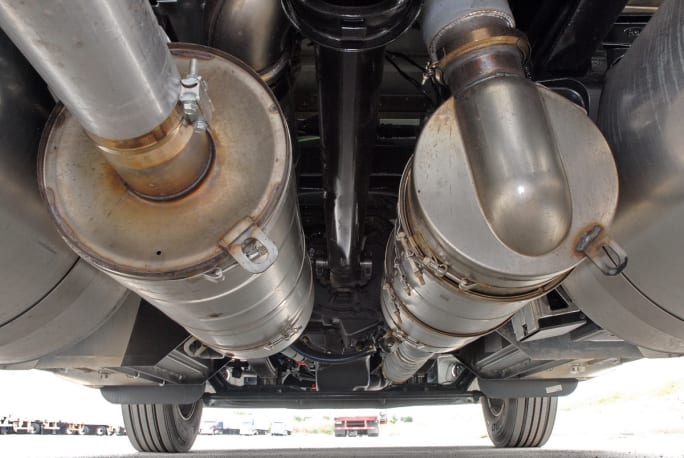
Many exhaust system failures begin “upstream” under a truck’s hood. Treating the aftertreatment system as a self-contained entity can lead to repeated failures of the same component.
Photo: Jim Park
A new maintenance reality
“You say, $514, and people say, ‘Well — that’s not so bad,’” says Randy Obermeyer, terminal manager for Batesville Logistics, a private long-haul private fleet based in Batesville, Indiana. “But keep in mind, we’re talking about a vehicle system that until very recently you never really had to mess with — unless an exhaust pipe rusted through, or something cracked or there was a turbo failure.”
There is no doubt that costs associated with exhaust systems are rising, Obermeyer says. “In 2004, we were spending around $1,200 a month for exhaust system maintenance,” he says. “Last year, we were averaging $27,000 a month across our fleet for those repairs. That’s a 1,837% increase. And this is a whole new expense for us.”
Maintaining and repairing today’s heavy-duty diesel exhaust systems means entering a world of high-temperature EGR coolers and valves, clogged diesel particulate filters, DEF dosing system malfunctions, and all-important sensors with the power to de-rate a truck to “limp” mode if the computer decides the EPA’s emissions standards aren’t being met. “These systems work as advertised,” Obermeyer concedes. “But on the expense side of the equation, fleet maintenance costs associated with them have gone through the roof.”
But that doesn’t have to be the case.
“I think the OEMs have a point,” says Joel Morrow, who is chief driver and head of research and development for Ploger Transportation, a small, innovative regional fleet based in Bellevue, Ohio, specializing in food-grade cargo. “We really don’t have a lot of problems with exhaust systems today, generally speaking. But we used to. And the reason we don’t have them today is that we are fundamentally changing our thinking and our procedures to address the problem.”
In the early days of the SCR era, Morrow says Ploger trucks were experiencing exhaust failures — particularly plugged DPFs — which many fleets are still struggling with. “We were following the OEM guidelines for the systems,” he explains. “And we were taking the trucks in to the dealers to fix the same damn issues again and again and being told the same damn reasons for the failures again and again. And the more I thought about the intervals they were suggesting — which is 400,000 miles for DPF cleanings — the more it occurred to me that those numbers were based on large fleets with relatively fast trade cycles who don’t want to touch the trucks any more than they have to.”
As Morrow starting adding up all the variables that came into play with exhaust systems — different geography, fuel quality, weather, applications and so on, he realized that the higher-mileage maintenance intervals the OEMs recommended for exhaust system components simply didn’t work for Ploger’s operations.
The answer, Morrow finally decided, was to start benchmarking the aftertreatment system and bring all exhaust maintenance in-house. It was a massive gamble — one that kept Joel and his brother, who is co-owner of Polger Transportation, awake at night wondering if they were making the right move. “We bit the bullet and spent some serious money,” Morrow says. “We hired some technicians with aftertreatment training and paid them some wages we weren’t accustomed to paying. And it scared the hell out of me. Because we had to make it work.”
Looking back, Morrow says the move was a no-brainer. He declines to give out the PM figures the Ploger team finally settled on, but says emissions breakdowns have become virtually a non-issue for the fleet. “We are very aggressive on emissions maintenance today,” he says. “Our PM schedule is way sooner than what the OEMs call for. And we check everything on the system — sensors are cleaned and replaced as needed, we check all the values in the fuel system and verify all system pressures, and we have our own numbers for what differential figures we want to see. We look at all of those things every time the truck is in shop.”
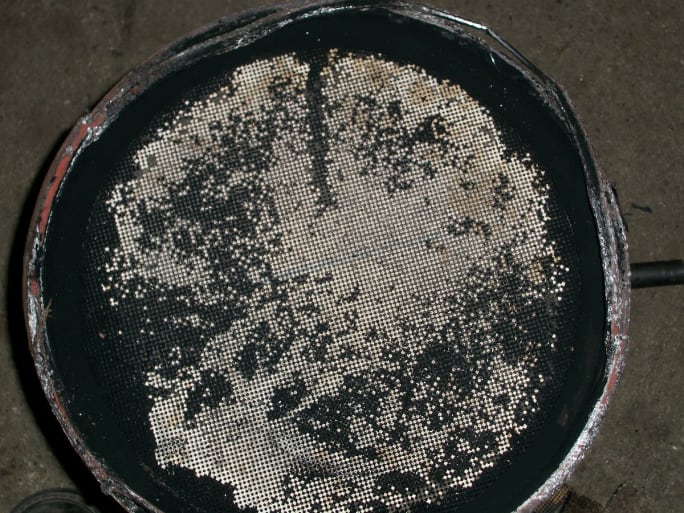
Diesel particulate filters need to be cleaned before carbon buildup is packed in so tightly it can’t be removed. This may happen sooner than the OEM-recommended cleaning interval.
Photo: Batesville Logistics
Going upstream
Obermeyer says Batesville, too, is unhitching itself from the OEM recommendations on exhaust maintenance. He says his technicians discovered that if they waited until 300,000 or 400,000 miles to pull the filter and clean it, as recommended by the OEMs, carbon was packed so tightly into the unit that the entire exercise was pointless. Today, he says, his technicians routinely pull DPFs every 100,000 miles for cleanings, which has helped with both maintenance costs and fleet fuel economy averages.
Obermeyer also thinks too many fleets make the mistake of treating the exhaust system as if it’s a self-contained entity that is somehow separate from the rest of the engine. “Everything runs downstream,” he notes. “But too many fleets and dealers just replace a part that’s failed and never bother to trace the problem upstream to find out if the problem is being caused by a seemingly unrelated issue.”
For example, Obermeyer says if you’re dealing with premature DPF failures due to plugging, it could be something going on in the engine, such as a gasket leak allowing coolant into the engine oil. “You take the truck into the shop with a failed turbo or EGR cooler, and the dealer diagnoses the problem, gives you a quote and replaces the part,” he says. “And the truck goes back out on the road. And a few weeks later it’s back in the shop with another failed DPF. You have to understand these are not isolated events and deal with them appropriately.”
Although many fleets are still struggling with emissions issues and costs, Morrow says his experience has taught him the problem can be contained — once you put the work in and understand the values that work for your fleet and your application. “Once you’ve got those in hand,” he says, “the engines really do run good. There are very few problems with the aftertreatment system. And fuel economy improves.”
Editor's note: This story was updated March 25, 2019 at 12:13 CST to better differentiate the role SCR plays in working with other emissions reduction systems to reduce diesel exhaust emisions.
More Fuel Smarts

How Volvo Updated Its D13 for EPA 2027 [Watch]
Volvo’s updated D13 promises lower emissions without sacrificing performance or fuel economy. Take a closer look at what changed inside the engine in this HDT Spotlight video.
Read More →
Diesel Price Spike Shortens Payback for Natural Gas Trucks, Report Says
Energy Vision estimates fleets could recover the higher purchase price of an RNG-fueled Class 8 tractor in 1.3 to 2.8 years under current fuel-price scenarios.
Read More →
Calstart Becomes Catalyst Mobility, Reflecting Broader Focus
Calstart is now Catalyst Mobility, reflecting the nonprofit’s growing national role in clean transportation, including zero-emission trucks, infrastructure and incentive programs.
Read More →

Record Diesel Prices Squeeze Trucking Fleets
Average U.S. diesel prices have climbed to nearly $6 a gallon, surpassing the 2022 record as tight refinery capacity and Middle East disruptions keep fuel costs elevated.
Read More →
How Fuel Delivery Shapes Engine Performance
Fuel delivery depends on more than what happens at the injector. For fleet, maintenance and technical professionals, looking at the full path from pump to injector can provide useful context for understanding engine performance.
Read More →
East Coast Port Launches $45M Electric Truck Push
The Port Authority of New York and New Jersey announced millions in incentives for zero-emission drayage trucks, yard tractors, and new charging hubs near the port.
Read More →
California Bill Could Shed Light on Electric Truck Prices
Why do battery-electric Class 8 trucks remain so expensive? A California bill headed to Gov. Gavin Newsom would give fleets and state agencies more visibility into what manufacturers charge.
Read More →
Detroit Opens Orders for EPA 2027 Engines
Detroit isn’t starting from scratch to meet EPA 2027 diesel emissions standards. Its Gen 6 DD13 and DD15 engines keep much of today’s platform while updating the fuel and aftertreatment systems.
Read More →
Zero-Emission Truck Corridor Planned for West Coast
California, Oregon, Washington, British Columbia and Baja California are coordinating plans for truck charging and hydrogen fueling from Canada to Mexico.
Read More →
A Closer Look at Kenworth’s Electric T880E Vocational Truck [Video]
Learn more about Kenworth's T880E battery-electric vocational truck at the Paccar Technical Center, including its range, applications, upfitting considerations, and PTO options, in this HDT Spotlight video.
Read More →