





Related: Driver Dilemma - A Year-Long, In-Depth Series on the Driver Shortage
Can Autonomous Trucks Solve the Driver Shortage?
One thing the developers of autonomous technologies have emphasized is that they are not a “driverless truck.” So how can they help with the driver shortage? Part 7 in HDT's Driver Dilemma series on the driver shortage.
July 16, 2015
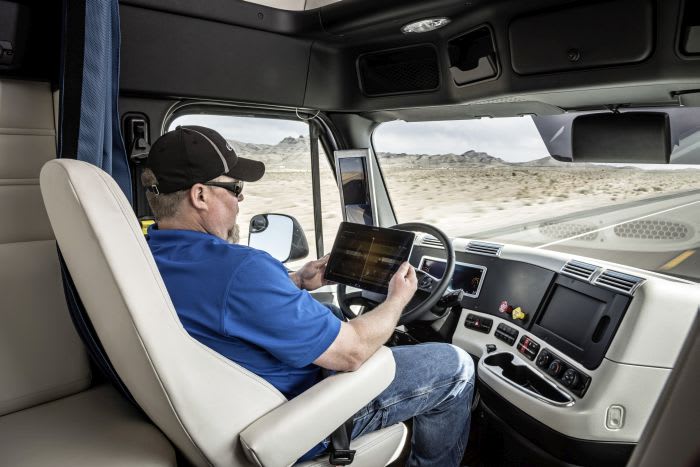
Being able to do other things while in autonomous mode could make the job more productive and attractive to drivers. Photo: Freightliner
7 min to read

Being able to do other things while in autonomous mode could make the job more productive and attractive to drivers. Photo: Freightliner
Last year, the world was abuzz over images of a truck driver sitting back and reading on his tablet while his Mercedes Actros negotiated traffic on an unopened stretch of German autobahn. It led to some comments that the driver shortage will be solved once “driverless trucks” make it onto the scene.
While these autonomous technologies may indeed help alleviate the shortage, it won’t be because they are literally taking drivers out of the cab. At least not in the next couple of decades.
Very few vehicles today are totally free of autonomous features, from cruise control to electronic stability control. The National Highway Traffic Safety Administration defines different levels of automation. Level 4 would be a full self-driving vehicle, requiring no driver control other than someone to input the destination.
Freightliner has already said it has no interest in developing a Level 4 truck.
The kinds of trucks that have been demonstrated so far are Level 3, “limited self-driving automation,” which allows the driver to cede control of all safety-critical functions under certain conditions. The driver is expected to be available to take back control when needed.
Research firm Frost & Sullivan predicts that by 2035, about 182,000 Level 3 trucks could be sold globally – but that’s not a big chunk out of a total market of 1.6 million.
There already is agricultural and mining equipment operating without drivers. However, these situations do not have the complexity of sharing the road with other vehicles and people, pointed out Wilfried Achenbach, senior vice president, engineering and technology for Daimler Trucks North America, during a session at the Mid-America Trucking Show Fleet Forum, “The Road to the Self-Driving Truck.”
“It’s amazing what our human brain and eyes can handle,” he said. When you drive, he explained, about 10 times a second you get input from your surroundings, primarily through your eyes. A driver must process that information and make the right decision 10 times a second.
“Software today is far from being able to handle that,” Achenbach said. That’s why current autonomous-technology programs focus on less-complex on-highway operations, or pre-programmed routes, with the driver “on call” to take over when necessary.
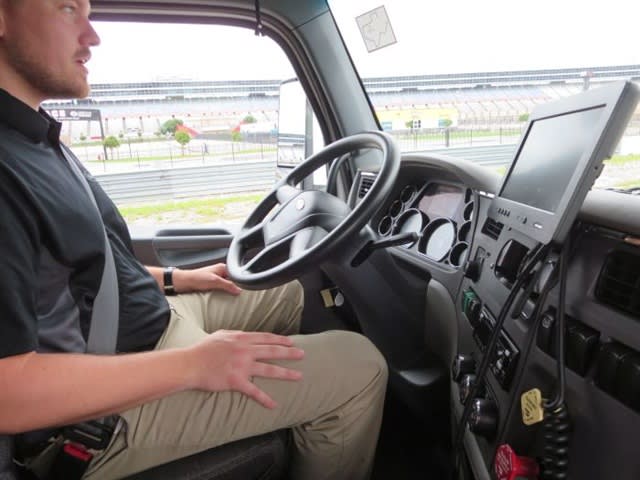
Peterbilt demonstrates its “advanced driver assist systems,” the truck navigating a road course with no help from the driver at the Texas Motor Speedway. Photo: Deborah Lockridge
The technologies
The Mercedes-Benz Future Truck 2025, a specially equipped tractor-trailer, last summer drove itself in simulated real-world driving conditions, even making a partial lane change automatically in order to safely clear an emergency vehicle on the side of the road. The driver’s seat swiveled back, allowing the driver to relax, read a book or use a mobile computer tablet.
The Highway Pilot technology on the Future Truck used a combination of radar sensors at the front and sides of the truck, a stereo camera behind the windshield, three-dimensional maps and V2V/V2I communication (vehicle to vehicle/vehicle to infrastructure), which is the exchange of information between the truck and other vehicles and with the roadway.
In May, Daimler Trucks North America followed up with its Las Vegas unveiling of the Freightliner Inspiration Truck.
The first such vehicle to be licensed for use on public roadways, the Inspiration Truck requires the driver to be ready to take over control under Nevada’s autonomous vehicle rules, so the driver’s seat stayed in its normal configuration.
The driver makes the decision when to engage the Freightliner Highway Pilot system once the vehicle has safely entered the highway. A radar unit in the front bumper keeps the truck the correct distance from vehicles ahead and identifies obstacles. A front stereo camera recognizes lane markings and communicates with the steering gear to keep it centered in the lane. Adaptive Cruise Control Plus combines active cruise and distance control with the ability to stop and go without driver intervention. It can control distance and speed from 0 mph to maximum rated speed (although right now the system is limited to 60 mph.)
Peterbilt, too, has been researching autonomous technologies. At a technology showcase event in late May, it showed off two trucks equipped with what it calls “advanced driver assist systems.” Bill Kahn, manager of advanced concepts at Peterbilt, doesn’t really like to call them “autonomous,” though they operated without driver hands or feet on controls. He characterizes the technology as the “cruise control of the future” and a “stepping stone to autonomous vehicles.”
Bumper-mounted radar or lidar systems determine the distance from the truck to the vehicle or obstacle ahead. For on-highway situations, they and a windshield-mounted camera provide data to keep the truck in the lane. Adaptive cruise keeps the truck the right distance from the vehicle in front of it and can bring it to a complete stop if necessary.
In addition, the Peterbilt concept trucks featured a GPS-based autopilot system (accurate to up to 5 centimeters) that would allow the truck to operate autonomously in urban environments on a preprogrammed course that had been “mapped” by one of the autonomous vehicles.
“The driver becomes less of a driver and more of a decision maker,” Kahn says.
Dedicated short range communications radio antennas allow the vehicles to communicate with each other, as in a platoon situation.
Platooning uses vehicle-to-vehicle communications and other technologies such as adaptive cruise control, collision avoidance systems, radar and GPS data to allow two or more trucks to “platoon” in a very tight formation at highway speeds. The trucks constantly maintain a communication link. If the lead truck’s collision avoidance system activates its adaptive cruise control to slow down, the following truck or trucks will do the same.
Platooning may be closer to reality than other autonomous technologies. Peterbilt has been working with Peloton, a California-based company, to demonstrate a platooning system.
Volvo Trucks, which recently invested in Peloton, is a big proponent of platooning and has been involved in research in Europe. Susan Alt, Volvo Group senior vice president of public affairs, said during the Fleet Forum session that the SARTRE (Safe Road Trains for the Environment) project “has shown it is technologically possible and could be reality in five to 10 years. What could take time is legislation and public acceptance.”
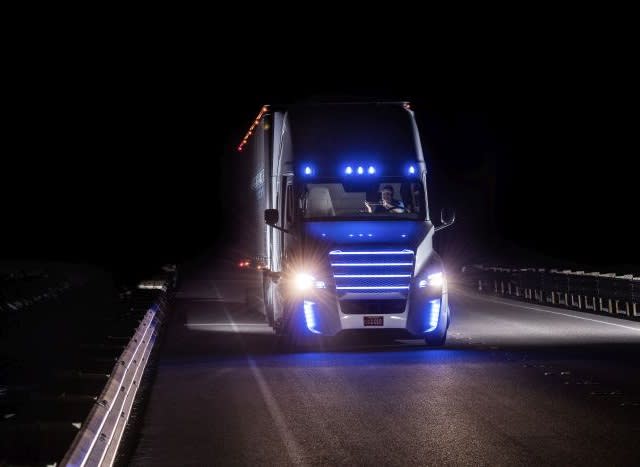
Testing of Freightliner’s Inspiration Truck (above) shows autonomous vehicle technology helps drivers feel more alert (left). Photo: Freightliner
Solving the driver shortage
One thing the developers of all these technologies have emphasized is that they are not a “driverless truck.” So how can they help with the driver shortage? By improving drivers’ quality of life, making the job easier – plus the technological “cool” factor.
As Daimler Trucks North America explains, autonomous vehicle systems can help reduce driving stress, cut the amount of monotonous time periods on long trips, and have a positive effect on driver health.
In Freightliner research on a closed track, a measure of brain activity showed that sleepiness is reduced by as much as 25% when operating in autonomous mode. When drivers were asked questions about their level of sleepiness, again it showed a more rested driver.
Peterbilt’s Kahn says the company’s autonomous lanekeeping technology is capable of taking 85% of the active steering out of the driver’s hands, leaving him much more refreshed.
In addition, one of the reasons for the driver shortage is that young people don’t see truck driving as an attractive career. As Sandeep Kar with Frost & Sullivan said during the MATS Fleet Forum, “If we can give that environment to a young driver, where he can connect to the world outside on his iPad while going down the road, it can be used to attract young drivers.”
Good, safe drivers also tend to be attracted to companies with a commitment to safety. Illinois-based fleet Nussbaum Transportation works closely with Freightliner as a test fleet, and CEO Brent Nussbaum was at the Inspiration Truck unveiling. He’s intrigued by the safety benefits of autonomous technologies. For instance, he says, current lane departure warning systems can only warn drivers. “Sometimes, the driver is already over in the other lane before he can react,” he says.

The SARTRE (Safe Road Trains for the Environment) research project in Europe successfully combined trucks and passenger cars in a platoon. Photo: Sartre
Productivity gains
Finally, if you can make your existing trucks drivers more productive and efficient, that’s another way to tackle the driver shortage.
“Think about the possibility of letting that driver handle some back office applications or some sort of connectivity related activity, maybe locating a backhaul,” Kar said.
Daimler officials have expressed hope that autonomous vehicle operation could provide an efficiency boost in the form of relaxed or extended hours of service rules.
Alt predicted that “it’ll be a long time to go completely driverless, if we ever will,” citing regulatory, legal and social acceptance roadblocks. “Airplanes are fully capable of doing their thing without a pilot, but there are times when something goes wrong and you want the pilot to take over.
“However, there are incremental things we are doing, and there are real lives to be saved and real amounts of emissions reductions to be had, and we will continue to invest in it and implement what we can when we can.”
Subscribe to Our Newsletter
More Drivers

Truck Drivers Need More Than Another Alert
Fleets have more visibility into truck health, safety events, and driver activity than ever. The next challenge is turning all that information into useful guidance for the person who has to decide what to do next.
Read More →
FMCSA Removes 110 Truck Driver Training Schools from Certified ELDT List
Federal regulators also are targeting more than 160 additional training providers and launching a nationwide audit of third-party CDL skills testers as part of a broader crackdown on trucking fraud.
Read More →
Hours of Service Pilot Programs: FMCSA Readies for 2027 Rollout
Two pilot programs could eventually reshape hours-of-service rules, giving truck drivers options to pause their 14-hour clock or use longer split sleeper rest periods.
Read More →
Medical Cards, English Proficiency Reshape Roadcheck Violations
Medical-card violations jumped to the top of the driver out-of-service list during CVSA’s 2026 International Roadcheck, while English-language proficiency violations appeared among the leading violations for the first time.
Read More →
Driver Trust Can Make or Break the Success of Fleet Safety Technology
New Teletrac Navman research suggests that onboarding, transparency about driver data, and positive feedback can play a significant role in how commercial drivers respond to safety and coaching technology.
Read More →
EEOC Sues KLLM Over Alleged Sex Discrimination in Driver Training
KLLM is facing a federal sex-discrimination lawsuit over policies the EEOC alleges put female truck driver trainees at a disadvantage.
Read More →
FMCSA Moves to Codify English Language Requirements for Commercial Drivers
By changing regulations on English-language proficiency requirements for commercial drivers, rather than relying on a guidance memo, the FMCSA said future administrations won't be able to walk back the Trump administration's stricter enforcement with just a memo.
Read More →
Drivers Put Western Star Trucks to the Test at Star Nation Experience
Watch to get an inside look at the Western Star trucks, technology, and community behind the Star Nation Experience 2026!
Read More →
Trump Administration Looks to Put More Veterans Behind the Wheel
The Freedom Haulers program pulls together existing and expanded programs at several federal agencies to recruit veterans to drive commercial heavy-duty trucks and cut the red tape for them to get a CDL, training, and employment.
Read More →
Putting Mack’s Command Steer to the Test
A test drive of Mack’s Command Steer active steering system evaluates how it can make truck driving easier and less tiring.
Read More →