




Heavy Duty Trucking Logo
MenuMENU
SearchSEARCH

Fleets Can Help Drivers Maximize Fuel Economy

The right equipment for the job improves the fleet’s and the driver’s chances for success. Part 6 in HDT's Driver Dilemma series on the driver shortage.

Jim Park
Jim ParkFormer HDT Equipment Editor
Read Jim's Posts
June 18, 2015
Fleets Can Help Drivers Maximize Fuel Economy

The right equipment for the job improves the fleet’s and the driver’s chances for success. 

5 min to read


The right equipment for the job improves the fleet’s and the driver’s chances for success.

The beatings will continue until morale improves.” You’ve probably seen that expression on a T-shirt somewhere. It’s a distasteful poke at some corporate and institutional cultures that propose solutions to problems that are quite at odds with the objective. It’s not unlike the approach some fleets take in trying to improve fuel economy. They stress the importance of such change, but don’t offer drivers the training or the tools they need to fulfill the demand.

Ad Loading...

We often hear from drivers who have just been assigned a new truck, maybe four of five years newer and more advanced than the last one they had, but they are offered no instruction or orientation on the new equipment. How can drivers be expected to achieve optimum performance from trucks they don’t know how to operate?

Ad Loading...

“Giving a seasoned professional driver the keys to one of these [highly advanced] trucks is like giving a dirt track racer the key to a Formula 1 car and sending him off to race,” notes owner-operator Jeff Clark. “It does not mean they can’t drive. It means to optimize performance, they need to be trained on the specific equipment.”

There is much fleets can do to improve fuel economy, and investing in new technology is certainly high on the list. But do we still need to invest in training drivers for better fuel economy? Absolutely, says Bill Bliem, senior vice president of Fleet Services for Vineland, N.J-based NFI Industries.

“Even with all the automation we see today, you still need to train drivers,” he says. “We are in the process of switching over to 100% automated manual transmissions, so you might think that would take the driver’s shifting habits out of the equation. It pretty much does, except you still need to explain to them how to drive the AMT.”

While it may seem counterintuitive, Bliem says it’s often the veteran drivers who need the nudging.

“The new drivers are a little easier to train than the guys who have to change old habits,” he says. “It’s a bit harder for them to adjust their thinking.”

Ad Loading...

He describes a training exercise in which veteran drivers were taken over a mountain course and taught how to lug the engine down before downshifting.

“They wanted to shift at 1,400 rpm but the trainer wouldn’t let them, and again at 1,300 and 1,200,” Bliem says. “They were shocked when the truck went over the top at 1,100 rpm and the truck was gaining speed. We actually had to show them the torque curves so they could see there was no power up in the 1,700 rpm range where they are used to driving. There is no power there anymore, just noise.”

Clark says his conversations with other drivers lead him to believe there’s not a lot of fuel economy training going on any more. He says he’s aware of a few fleets with very good programs, but they seem to be the exception.

“I think training and incentives are the two best ways of improving fuel mileage,” he says. “There’s not a lot of return for a company driver who is working to do better with his fuel mileage, so they don’t have much of a reason to do things differently. Tie some of his take-home pay to a fuel mileage benchmark and watch what happens.”

It’s a little different with owner-operators. Their fuel savings is money earned, but fleets can still encourage better performance by offering trailing equipment that is as fuel efficient as possible.

Ad Loading...

“There’s not a lot in it for us to deck our trailers out with skirts and low-rolling resistance tires, but we offer that kind of equipment as a recruiting incentive,” says John Elliott, CEO of Load One based in Taylor, Mich., an owner-operator expedited fleet. “Putting the aero packages on the trailer is a benefit for the owner-operator, but I’m not sure all of them realize how much of an advantage that provides. We also keep the trailers lubed and aligned to minimize drag and rolling resistance. We check that twice a year. It’s incremental but it adds up.”

Elliott makes fuel and mileage data from the satellite records available to owner-operators so they can see how they are doing. He says that while the company can’t force an owner-operator to drive a certain way, he can make it easier for them to see how they are doing.

“It’s hard to get the data from the owner-operator to show them what a difference it can make,” Elliott says “But showing them the before and after numbers we have can be an eye-opener for some of them.”

Elliott also stresses the importance of putting the driver into the right truck, especially in a lease/purchase program.

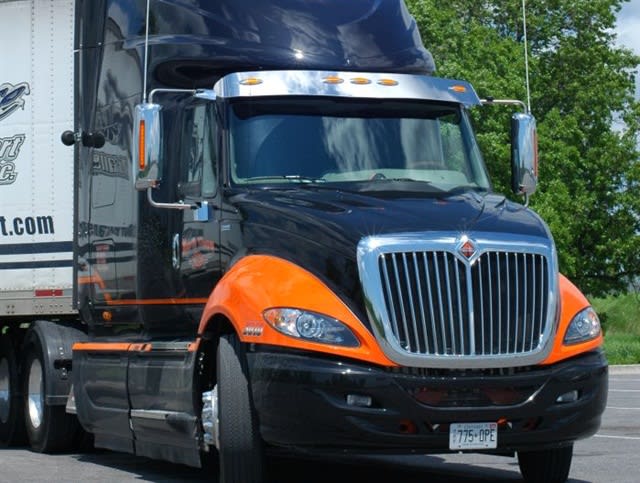
“Big, shiny, pretty trucks are an easier sell, but the drivers won’t make as much money with one of those,” he says. “Fuel economy is so vitally important today, I hate to see well-intentioned owner-operators limiting their chances with the wrong truck.”

Ad Loading...

The right truck can certainly make a difference. It’s not uncommon anymore to see fuel mileage in the 9-mpg range. Royal Jones, CEO of Mesilla Valley Transportation, says his fleet average is around 9 mpg, but adds that some of his drivers are besting 10. They aren’t accomplishing that in heavy, over-powered, non-aerodynamic trucks.

Independent Henry Albert just posted 9.9 mpg over a three-month period. He has the right truck, obviously, but he drives it properly, too.

“I’m working to improve my fuel mileage every day,” he says. “I let the computers on the truck do their job and I do mine, too. Together, we’ll get to 10 mpg over a three-month period. For me, it’s a combination of technology, training and determination.”

Skilled drivers can certainly improve fuel economy, but skills don’t come naturally.

Top 5 ways drivers can instantly improve fuel economy

Driver skill, or lack thereof, along with habits and behavior can have a huge impact on fuel efficiency. It is said there can be a difference of something like 30% between a fleet’s best and worst driver. Sure, technology can level that playing field to some extent, but some things computers can’t fix. Here are five tips guaranteed to save fuel, no matter how your trucks are spec’d:

1. Avoid unnecessary braking — Maintaining a few miles per hour slower than the prevailing traffic flow will reduce the need to decelerate for slower traffic and then speed up again. Getting off the throttle pedal sooner and coasting to a stop light rather than braking, when possible, means less fuel burned. Use gravity-generated momentum when safe to do so by rolling down a hill and part way up the other side, rather than braking on the hill to maintain a prescribed speed.

2.  Don’t idle, ever Vehicles equipped with auxiliary climate control systems do not ever need to idle except a few moments before shutdown after a hard pull. Remind drivers that all the myths they have ever heard that idling is necessary to warm up an engine, or that less fuel is burned during five minutes of idling than when starting an engine are just that, myths. Shut off the engine whenever possible, even for a few minutes.

3. Accelerate gently Drive the truck like you have an egg between your foot and the throttle pedal. Even though AMTs will shift according to their programming, most take cues from how aggressively the driver hits the pedal. High throttle demand usually produces higher revs between gears and more aggressive shifts.

4. Reduce the gap When proper axle loading permits, keep the trailer cinched up as close to the tractor as possible. The tractor-trailer gap is a big fuel waster, and it should be minimized whenever the opportunity arises.

5. Drive the truck Drivers have one big advantage over most of the automated functions on a truck; they can see the road. Rather than leaving the cruise control on all the time, manage speed and momentum in hills by backing off the throttle when nearing the crest of a hill, for example. There’s no need to go over the top at full power. Back off the throttle sooner when coming to a stop, and manage road speed according to traffic conditions rather than letting the cruise bring you in so close to another car that you have to brake. 

Subscribe to Our Newsletter

More Drivers

Illustration of Department of Labor building, diesel technician at a computer, and driver training semi trailer
Driversby Deborah LockridgeMarch 10, 2026

Federal Proposal Would Allow Pell Grants for Shorter-Term Job Training

The Department of Labor plans to expand Pell Grant eligibility to some shorter workforce training programs, a move the American Trucking Associations said will help strengthen commercial driver training schools and diesel technician training programs.

Read More →
Illustration of truck owner operator and magnifying glass with the word "regulations"
Driversby Deborah LockridgeFebruary 26, 2026

Owner-Operator Model Gets Boost as DOL Proposes 2024 Independent Contractor Definition Reversal

For an industry that has watched this issue go back and forth for years, the independent contractor proposal marks the latest swing in the regulatory pendulum.

Read More →
 Truck with door open and enforcement officer talking to driver about ELD
DriversFebruary 26, 2026

FMCSA Reinstates Field Warrior ELD to Registered Device List

One electronic logging device has been reinstated to the FMCSA's list of registered ELDs.

Read More →
Ad Loading...
Photo of truck driver in yellow safety vest walking alongside tractor-trailer
Driversby Deborah LockridgeFebruary 25, 2026

How One Company is Using Smart Suspension Technology to Reduce Driver Injuries and Improve Retention

America’s Service Line adopted Link’s SmartValve and ROI Cabmate systems to address whole-body vibration, repetitive strain, and driver turnover. The trucking fleet is already seeing measurable results.

Read More →
Illustration with photos from some of the 2026 Best Fleets to Drive For honorees
Driversby News/Media ReleaseFebruary 24, 2026

CarriersEdge Announces 2026 Best Fleets to Drive For

The 18th annual contest recognizing the best workplaces for truck drivers sees changes to Top 20, Hall of Fame

Read More →
Illustration of driver students around trucks with distressed graphic elements and safety cones
Driversby Deborah LockridgeFebruary 19, 2026

FMCSA Targets 550+ ‘Sham’ CDL Schools in Nationwide Sting Operation

The Federal Motor Carrier Safety Administration issued more than 550 notices of proposed removal to commercial driver training providers following a five-day nationwide enforcement sweep. Investigators cited unqualified instructors, improper training vehicles, and failure to meet federal and state requirements.

Read More →
Ad Loading...
 Illustration showing a driver behind the wheel, DOT offices, and examples of problematic non domiciled CDL
Driversby Deborah LockridgeFebruary 18, 2026

DOT Alleges Illinois Issued Illegal Non-Domiciled CDLs

Illinois is the latest state targeted and threatened with the loss of highway funding by the U.S. Department of Transportation in its review of states' non-domiciled CDL issuance procedures. The state is pushing back.

Read More →
 Illustration showing a driver behind the wheel, DOT offices, and examples of problematic non domiciled CDL
Driversby Deborah LockridgeFebruary 12, 2026

FMCSA Locks in Non-Domiciled CDL Restrictions

After a legal pause last fall, FMCSA has finalized its rule limiting non-domiciled commercial driver's licenses. The agency says the change closes a safety gap, and its revised economic analysis suggests workforce effects will be more gradual than first thought.

Read More →
Photo of Stone's Truck Stop
Driversby News/Media ReleaseFebruary 5, 2026

Trucker Path Names Top Truck Stops for 2026

Truck driver ratings reveal the best chain and independent truck stops in the country.

Read More →
Ad Loading...
SponsoredFebruary 1, 2026

6 Dashcam Tactics to Improve Safety & ROI

6 intelligent dashcam tactics to improve safety and boost ROI

Read More →







