




Alignment Matters: Taking vehicle alignment for granted could cost you
When it comes to the alignment on your truck, "close enough" can cost you a lot of money

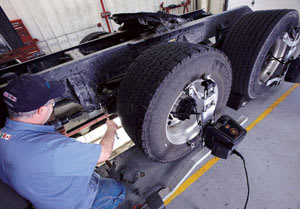
When it comes to the alignment on your truck, "close enough" can cost you a lot of money.
Jerry Thrift, manager of new product development at Ryder Systems in Miami, Fla., knows how much shortened tire life costs, and he's done something about it: Ryder developed its own internal alignment specs.
"Alignment is extremely important from a tire-cost perspective," Thrift says. "And with the cost of fuel today, we need to be grabbing every advantage we can. If the truck isn't properly aligned, fuel economy will suffer right along with tire life."
In fact, the two are interrelated. Where do you think the energy needed to scrub that rubber off your tires comes from? Right out of your fuel tank. If you are experiencing irregular tire wear due to misalignment, fuel economy is suffering, too.
Most truck makers recommend annual alignments, and the Technology & Maintenance Council of the American Trucking Associations' Recommended Practice 642A says alignment should be performed at regular intervals. But are you sure what's coming from the factory is set to spec every time?
Thrift, who takes delivery of thousands of trucks every year, says no.
"Gross misalignment is rare," he says. "You're more likely to see minor variations that can still impact tire life."
Truck manufacturers build in a manufacturing tolerance (see sidebar on page 38) that provides a little wiggle room on the assembly line, but the truck should still be within spec. Thrift says that's not always the case.
"Alignment should be checked when the truck is delivered," he says. "Not at the first PM, not after the vehicle has 'settled.' If it's not right when it's brand new, it's not going to be right later on." If you check it before the truck has any miles on it, you can make a warranty claim.
Thrift says the problems he sees most are imprecise toe-in and drive axles not parallel to each other or perpendicular to the frame.
"Typically camber is okay. But the drive axles can be off quite a bit, usually not centered exactly" on the frame, he says. "Toe-in is another one that's hard to get right. It's a precise setting, but it matters a lot to tires."
We contacted two truck manufacturers that Thrift said do a pretty good job. Neither chose to comment, one noting it didn't want to share any proprietary information on manufacturing processes.
John Wensel, president of Wensel's Truck & Trailer Repair in Spring City, Pa., has been on both sides of the discussion. Before opening his service shops, which feature alignment bays, he managed a fleet of 1,000 trucks for about 10 years. In those days, he had the dealers inspect all the trucks when they came in from the factory, and after 2,000 miles or so, they'd check the tires for signs of irregular wear.
"We could see the tire wear right away on some trucks," he says. "We'd send those out for alignment until we got our own alignment equipment.
Once we had our own equipment, the alignment became part of the in-service inspection. We found then that a lot of the rear specs were out - thrust lines and centering."
But is it realistic not to expect a truck to settle out at least a little from the time it was built until it's put into service?
"It's less common with air suspensions than it was when we used steel springs," Wensel says. "You'd ' have spring settling, but today we have steer axles with air suspensions, and that changes things too. Maybe the factory didn't get the ride height set properly. There's a lot going on when you're talking about vehicle geometry."
Getting it right
If you're within spec, but because of tolerances, the vehicle still isn't running true, what's next?
Wensel says he turns to the preferred spec - unless the customer won't pay for it.
"We have some customers who won't pay for any more than what we call a toe-and-go, and we have others who say, 'that's why we come to you,'" he says. "We get really stringent with the settings, and because of our experience with different vehicles, we sort of know what works and what doesn't. It's not always by the book, but it's stuff we've learned over the years."
Mike McCoy, national and special accounts manager at alignment-system manufacturer Bee Line Co., Bettendorf, Iowa, agrees with the problem of manufacturing tolerances.
"When the manufacturer builds a truck, that's their manufacturing spec. In other words, if it's within that specification, then it's your truck," he says. "But if you want to get the very best tire mileage, then there's probably another spec you should be setting it to. Just don't expect the OE to pay for it."
Here are McCoy's perfect-world recommendations: 1/16-inch toe-in, less than 1/4-degree camber, caster 3.5 degrees left, 4 degrees right, no setback on the front axle, and the drive axles 90 degrees to the centerline of the vehicle.
Some say you can fine-tune the alignment for the pavement crown if you run a lot of miles on high-crown roads rather than relatively flat Interstate highways.
Either way, the OE manufacturing spec probably isn't going to suit your needs as well as it possibly could.
Vocational chassis
Wensel says it's particularly important to verify the alignment on vocational equipment, because adding the body or additional equipment changes the vehicle - sometimes considerably.
"When the factory aligns the truck, it's just a cab and chassis," he points out. "After the upfitters have added the body or other chassis equipment, the weight distribution and geometry of the vehicle can be altered significantly."
He finds utility trucks are among the most prone to the problem.
"You're adding sometimes a heavy lift bucket or some other equipment to a relatively light cab and chassis. Everything is going to change."
You can't take vehicle alignment for granted, because dealing with it can be an expensive chore. Or you can make sure you're getting what you pay for, or at least are optimizing the alignment. The money you save on fuel and tires will more than cover the extra upfront cost.
The trouble with tolerance
Tolerance is often a good thing. But if you're buying a product you expect to be built to exacting standards, tolerance might not be so welcome. In truck alignment, a quarter of a degree here or a sixteenth of an inch there can make a huge difference in handling, tire wear and fuel economy.
If you look at various original equipment standards for total vehicle alignment, you'll find just such variations in alignment specs.
"The problem is the wide tolerance," says Mike McCoy of alignment systems provider Bee Line Co. "When someone brags about restoring your truck to the factory settings, they really aren't promising much because the tolerance is so great. They can be way off what the vehicle really needs, but still be within spec."
On the other hand, a spec with no tolerance can be equally impractical.
Those looking for guidance on alignment specs might turn to American Trucking Associations'Technology & Maintenance Council and its Recommended Practice 642A. It was more than 20 months in development, created with input from dozens of stakeholders.
However, Ryder System's Jerry Thrift says the problem with RP-642A is the lack of tolerances.
"If you've got a tech trying to achieve the 642A alignment spec, and they're off a little bit, they're going to have to go back, tear it all down and start again. That's not realistic. There has to be some tolerance built into the spec."
If you're looking to RP-642A for guidance on setting tractor steer-axle toe-in settings, for example, you won't find them. Instead it offers "recommended realignment targets," and says to consult the vehicle manufacturer for its specific recommendations.
So which specifications should you use? The following table contains alignment settings gathered by McCoy to illustrate the variation in specs for a particular setting.
If you deal with an alignment shop with enough experience, you may come across what's called a "preferred spec." According to John Wensel of Wensel'sTruck &Trailer Repair, "the preferred spec isn't in the book, but it represents settings the technician has documented over a period of time that work well on particular trucks in particular applications.
"That's the art of alignment. You could just throw something on the machine and align it to factory settings, but it might not be right." Wenzel says. "When you want to get it right, you align for the truck and application, regardless of what the book says. If you happen to still be within tolerance, all the better."
From the September 2012 issue of HDT.
More Maintenance
What Three Fleets Are Doing Differently When Buying Truck Parts in 2026
With freight improving but costs still climbing, fleet maintenance executives explain how they're balancing price, quality, and supplier relationships.
Read More →
Paccar Recalls 2027 Trucks Built This Summer for Possible Electrical Problem
The nearly 6,000 Kenworth and Peterbilt trucks in the recall could potentially lose engine power, among other things.
Read More →
Will API PC-12 Oil Change Trucking Fleet Maintenance?
The new API PC-12 heavy-duty engine oil category reflects the changing demands of modern diesel engines. But fleets like Foodliner are looking to getting their own data before making decisions on adopting the new oils and questions such as extending oil drain intervals.
Read More →
Brake Safety Week to Focus on Drums and Rotors
Commercial vehicle inspectors will be focusing on brakes during CVSA's Brake Safety Week, August 23-29.
Read More →
Possible Battery-Cable Fires Prompt Recall of 15,000+ International MV and HV Trucks
On the recalled vehicles, manufacturing variations can cause the battery interconnect cable to contact the auxiliary stud and hold down the bracket.
Read More →
Rush, MCT Team Up to Grow Refrigeration Service Network
The joint venture will operate MCT's network of Carrier Transicold dealerships and mobile service locations, with the companies promising greater service capacity and uptime for refrigerated fleets.
Read More →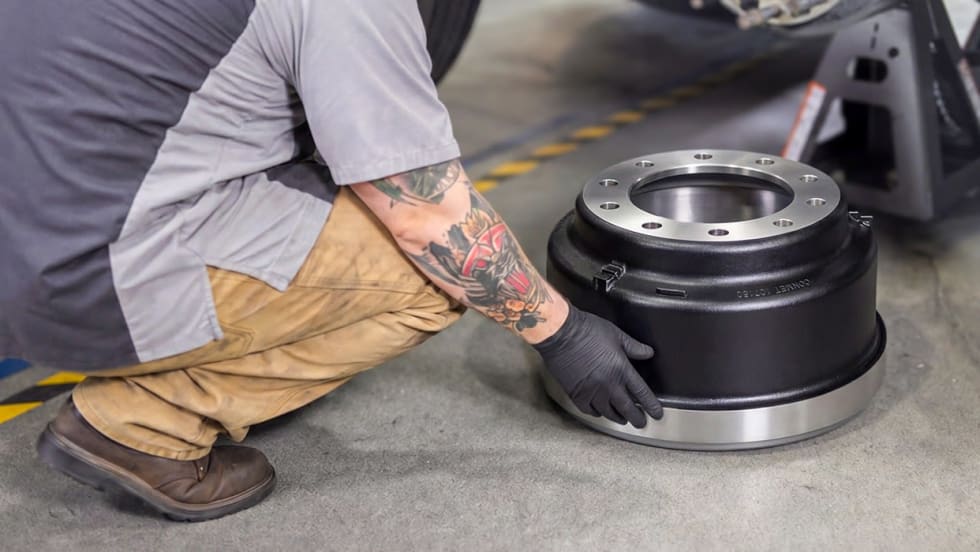
ConMet Expands Aftermarket Brake Drum Lineup With TruCast
A new heavy-duty truck brake drum option in the aftermarket gives customers more flexibility within the ConMet product family.
Read More →
Mack Expands Premium Service Contract Coverage to Medium-Duty MD
With a service contract, inspections, preventive maintenance and repairs can be handled in a single visit instead of multiple ones.
Read More →
Maintenance in the Messy Middle Part 5: Battery-Electric Trucks
No oil changes. No diesel exhaust fluid. No exhaust aftertreatment. But NACFE battery-electric trucks still require specialized maintenance procedures.
Read More →
Trucking Fleets Faced Record Operating Costs During Third Year of Freight Recession
ATRI's annual operational cost report shows carriers trimmed fleets, delayed equipment purchases, and ran older trucks as expenses continued to outpace freight rates.
Read More →