




Airing on the Side of Safety
How much force would it take to hurl a 16-pound bowling ball three-quarters of a mile? About the same amount of potential energy packed into an 11-by-22-inch truck tire inflated to 100 psi, says the Tire Industry Association

How much force would it take to hurl a 16-pound bowling ball three-quarters of a mile? About the same amount of potential energy packed into an 11-by-22-inch truck tire inflated to 100 psi, says the Tire Industry Association.
The near-instantaneous unleashing of nearly 60 cubic feet of air compressed to eight or nine times normal atmospheric pressure packs a heck of a punch.
To illustrate the destructive power of an inflated truck tire in another way, a British-produced safety video posted on YouTube shows a crash-test-dummy tire technician perched on an inflating tire as it explodes. The tire and the dummy (minus a leg and possibly an arm) are launched 20 feet into the air amidst a cloud of dust and debris. If lift-off didn't do enough damage, upon its return to earth, the tire/rim assembly lands squarely in the middle of the test-dummy's chest.
In untrained or inexperienced hands, tires can become life-threatening devices. To prevent damage and injury resulting from improper handling of tires, the Occupational Safety and Health Administration developed regulation 29 CFR 1910.177, requiring employers to provide proper tire handling training for all shop personnel doing tire maintenance and service. The regulation also features lists of equipment and facilities required to do the work safely.
In addition to the OSHA requirements, the Tire Industry Association and the major tire manufacturers have developed safe tire handling procedures and training programs.
The tire technician's world is a safer place because of the regs, but some fleets and tire shops haven't yet caught on. Fortunately, the better operations are leading the charge.
Todd Labbe, the metro manager of a Wingfoot Commercial Tire outlet in Brunswick, Ohio, says safety is the first priority at his shop, even before customer service.
"It can be a dangerous job, and that's why we have all the OSHA programs in place as well as a number of our own, developed by Goodyear and the Tire Industry Association," he says. "We have a number of zero-tolerance items on our safety check lists that carry immediate dismissal warnings. On top of that we have all the proper tools and equipment, and we use them the way they were intended - even if that slows the process down."
But there are plenty of tire shops, and fleets, that still err on the side of expediency. Sean Doyle of Kal Tire in Stoney Creek, Ontario, says he gets the odd customer complaint about the time a tire change takes at his shop, but he's unapologetic.
"We've got procedures in place for a reason," he stresses. "I'd forfeit the business before I'd jeopardize one of my people. If those guys don't appreciate that rushing a job and cutting corners is dangerous, they can go elsewhere."
Tooling a shop and certifying technicians for tire work can be an expensive undertaking.
Coupled with the difficulty of finding trained technicians, as well as the liability inherent with tire service, many fleets opt to outsource their tire work. Southeastern Freight Lines' tire manager, Harold Black, says his technicians (who are some of the best-trained fleet techs in the country) do no repairs or tire breakdown work - it's all outsourced.
"Our technicians are responsible only for airing up tires that are not flat, for conducting inspections, and removing and installing tires on vehicles," Black says. "We have a policy requiring any tire that is less than 80 percent inflated (for us, this is 80 psi) to be removed from the vehicle and sent to our vendor for inspection, evaluation and possible repair."
Black says his technicians will do only the odd bead-seating job in the shop, but he still has to have all the prescribed safety equipment. "We have tire inflation cages in all 21 of our shops. We use locking air chucks in all of our shops." The tire inflation cages are a bit of overkill, he says, because they do not routinely inflate tires at the low end of the inflation range, but they're used nonetheless.
Even though Southeastern Freight Lines outsources most of the "dirty" tire work, the staff are trained and certified in the company's ACE (Associate Continuing Education) tire modules, an internal company certification. These are part of a 16-module training system, and technicians are required to recertify every three years.
On top of that, in the last two years, the company has put all its tire technicians and maintenance managers, along with 28 percent of its line technicians, through a comprehensive training regimen presented in Greenville, S.C., by Michelin, says Jim Boyd, manager of fleet technical services at Southeastern Freight Lines. "That's a two-day course covering all aspects, from basic safety to managing tires for reduced operating costs."
Risks And Responsibilities
Done improperly, tire service can indeed be dangerous. But when procedures are followed, both the techs and the tires are more than likely to survive the process. Proper tire care starts with careful inspections of tire condition to keep the tires rolling and to prevent damaged tires from being worked on or inadvertently returned to service.
"Our casing life is carefully managed so that when a casing reaches its expected safe and reliable life, it is pulled from service," Boyd says. "We also have very strict tolerances for the numbers of repairs that may be allowed on a casing, along with carefully managed restrictions for the allowable size of the damaged area. Since we only use one vendor for the repair of all tires, we find we can control the manner in which our tires are repaired very carefully."
Wingfoot's Labbe says proper pre- and post-repair inspections can save a technician a world of grief. If repairs are not done properly, or if internal damage somehow goes undetected, it's the installer who'll find out about it.
"We inspect everything very carefully before airing up a tire," he says. "Even though a tire is caged as it's inflated, an explosive failure can still do some damage. I don't want a front row seat to an event like that."
Aside from the more dramatic events like zipper ruptures (see box on facing page), it's still easy to get hurt working with heavy truck tires. Gloves, steel-toed boots, and protective eyewear should be mandatory attire for anyone working with tires.
There is also some specific equipment required - not just by OSHA, but by common sense - before one starts working on truck tires. OSHA demands that all tires be inflated to working pressure inside a safety cage designed to withstand the force of an exploding tire. Cages should not be bolted to the floor in case the force of an exploding tire shears off the bolts and makes projectiles out of them, too. OSHA recommends cages be placed in a clearly marked area at least 1 foot away from other surfaces. Multiple tire cages in one shop should be 3 to 5 feet from each other, and every tire cage should be inspected before use for damage or wear that might decrease its effectiveness.
It should be noted that bolting the wheel back on to the truck prior to re-inflation is not a suitable substitute for a tire cage. Yes, the wheel hub will restrain the wheel in the event of a rapid pressure loss. It will not prevent debris from flying outward from the tires. This practice may also cause considerable damage to the body and possibly the chassis of the vehicle.
When inflating a truck tire, OSHA requires clip-on air chucks, which are not permanently attached to the valve stem. Air chucks that must be held on by a technician or that are screwed onto the valve stem are not OSHA compliant, Michelin says. Presettable regulators that limit inflation pressure are permitted.
That's the boilerplate stuff.
Policy and Procedure
Following the application of an approved lubricant to both the rim and the bead surface, and seating of the tire on the rim, inflating the tire to 5 psi is permitted outside the tire cage. In
More Maintenance
What Three Fleets Are Doing Differently When Buying Truck Parts in 2026
With freight improving but costs still climbing, fleet maintenance executives explain how they're balancing price, quality, and supplier relationships.
Read More →
Paccar Recalls 2027 Trucks Built This Summer for Possible Electrical Problem
The nearly 6,000 Kenworth and Peterbilt trucks in the recall could potentially lose engine power, among other things.
Read More →
Will API PC-12 Oil Change Trucking Fleet Maintenance?
The new API PC-12 heavy-duty engine oil category reflects the changing demands of modern diesel engines. But fleets like Foodliner are looking to getting their own data before making decisions on adopting the new oils and questions such as extending oil drain intervals.
Read More →
Brake Safety Week to Focus on Drums and Rotors
Commercial vehicle inspectors will be focusing on brakes during CVSA's Brake Safety Week, August 23-29.
Read More →
Possible Battery-Cable Fires Prompt Recall of 15,000+ International MV and HV Trucks
On the recalled vehicles, manufacturing variations can cause the battery interconnect cable to contact the auxiliary stud and hold down the bracket.
Read More →
Rush, MCT Team Up to Grow Refrigeration Service Network
The joint venture will operate MCT's network of Carrier Transicold dealerships and mobile service locations, with the companies promising greater service capacity and uptime for refrigerated fleets.
Read More →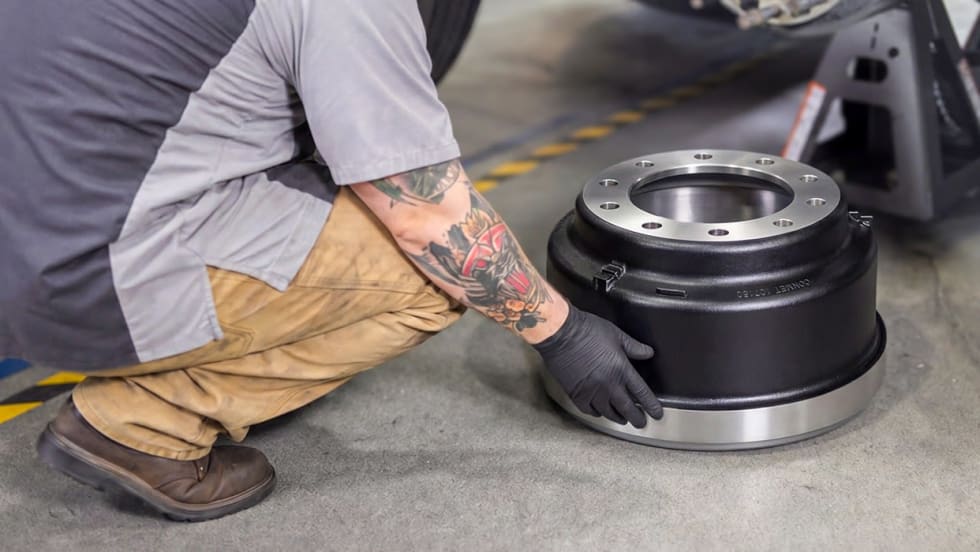
ConMet Expands Aftermarket Brake Drum Lineup With TruCast
A new heavy-duty truck brake drum option in the aftermarket gives customers more flexibility within the ConMet product family.
Read More →
Mack Expands Premium Service Contract Coverage to Medium-Duty MD
With a service contract, inspections, preventive maintenance and repairs can be handled in a single visit instead of multiple ones.
Read More →
Maintenance in the Messy Middle Part 5: Battery-Electric Trucks
No oil changes. No diesel exhaust fluid. No exhaust aftertreatment. But NACFE battery-electric trucks still require specialized maintenance procedures.
Read More →
Trucking Fleets Faced Record Operating Costs During Third Year of Freight Recession
ATRI's annual operational cost report shows carriers trimmed fleets, delayed equipment purchases, and ran older trucks as expenses continued to outpace freight rates.
Read More →