




Advances in Tire Pressure Monitoring Systems Make it Easier than Ever to Get the Most Out of Your Tires
Pneumatic or "balloon" tires go back to 1845, when Robert W. Thomson filled a leather-covered rubber tube with air and wrapped it around a wheel

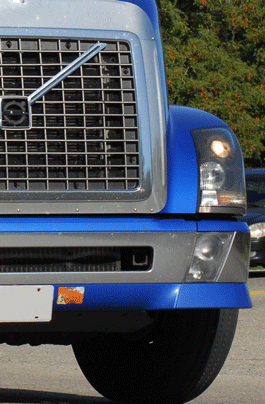
Trucks with flat tires don't go anywhere. TPMS can prevent flats or run-flat conditions that stop trucks and ruin tires. (Photo: Jim Park)
Pneumatic or "balloon" tires go back to 1845, when Robert W. Thomson filled a leather-covered rubber tube with air and wrapped it around a wheel.
But it used 70 or so fasteners to keep the tire on the rim, and they were a handful to repair.
John Boyd Dunlop developed the first practical inflatable tires for use on his son's bicycle in 1887. In 1904, someone else developed demountable rims so users could fix their own flats. As time went on, engineers made great advances in structure and performance.
But there was always the chore of keeping the air inside the tire at the correct pressures.
Aside from the wooden tire thumper, it wasn't until around 1980 that before the first mechanical pressure-monitoring systems hit the market. Today, electronic monitors will detect over- or under-inflated tires, plus warn of high temperatures. And they'll send electronic messages to anyone that needs to know about an inflation event, archive and distribute tire inflation and service history data, and practically book themselves service appointments at tire shops.
Like early inflatable tires, early tire pressure monitoring systems were pretty basic, giving drivers visual indications of actual tire inflation pressure. Drivers had to walk around the truck occasionally and observe the pressure indicators.
At least two mechanical systems are still in common use: the Cat's Eye by Link Manufacturing and the Crossfire by Dual Dynamics. These allow air to flow between a pair of tires in a dual mount configuration, equalizing pressure between the two tires. The systems also have visual indicators of a range of tire inflation pressure. Both are functional and inexpensive, but themselves require some maintenance and a driver's mindful eye.
Early electronic systems used pressure sensors mounted inside tires or at the valve stems. These sent radio-frequency signals to a dash-mounted display alerting drivers to pressure irregularities. They couldn't account for rises in pressure due to normal operating temperature increases, and few were set up to detect high wheel-end temperatures.
Contemporary versions of such systems can do all that and a whole lot more.
Peggy Fisher, president of TireStamp, coined the term TPMS 2.0 to differentiate between basic electronic TPMS installations and the more advanced systems that include telematic data transfer and data logging and reporting.
"The early systems - I call them TPMS 1.0 - were driver-focused," she says. "The driver was the only one who saw the low-pressure alert. Fleets could only hope the driver would take the appropriate action upon getting a low pressure alert."
While TPMS 2.0 is a term coined to describe the functionality of TireStamp's TireVigil product, it could be applied to all systems that include telematic data transfer.
"TPMS 2.0 is a fleet-focused concept where data obtained from the tires is sent immediately to the fleet so a manager can make the maintenance call, instructing the driver how to proceed," Fisher says. It communicates system and location data off a vehicle using satellite, cellular, Wi-Fi, or other wireless technologies.
In the early stages of the development, it looked like the various TPMS sensors and readers made by different suppliers might become separate islands in the data stream. Emerging technologies often take different paths to the same destination, but a degree of interchangeability does exist today.
Fleets can combine sensors and readers from different manufacturers, but they're not universal. Managers are advised to check with suppliers to see if there is compatibility among parts. This is especially true in situations where fleet acquisitions force the merger of different systems.
On the plus side, systems using some sort of telematic interface with a remote location push data onto the J1708 or J1939 buses on the truck, which are linked to upload devices such as Qualcomm, PeopleNet and Zonar. There's a high degree of interoperability, even if not all the tire pressure monitoring systems can yet talk to each other.
Monitoring systems are all about maintaining tire inflation pressure. At stake are tread wear and ultimately tread life, casing quality, fuel economy, and safety. Proper tire pressure for the application reduces tire rolling resistance and prevents heat build-up in the casing due to friction created when the sidewalls flex excessively. When the tire can maintain its optimal footprint, traction is improved and inflation-related irregular tread wear is minimized.
Several fleets embraced TPMS when they switched from dual tires to wide-base singles, because everyone knows that if a wide-single tire goes down on the road, the truck is stuck. Supply and distribution of wide-base singles have caught up with use, and they are easy to find at truckstops and such. But the truck will still sit until the replacement tire gets to it and a strong guy changes it.
These facts have prompted fleets to take extra precautions against low-pressure situations that could cause a blow-out. A blow-out means the destruction of an expensive tire and possibly the rim. So in addition to other functionality, TPMS is seen as cheap insurance for wide-base singles.
"Wide-base singles are very sensitive to tire pressure, and tread life suffers if pressures aren't maintained," says Kyle Fuemmeler, who does contract maintenance through MHC Kenworth for Waller Trucking of Excelsior Springs, Mo. "We're now integrating wide singles into the Waller fleet. Before we started, we asked a number of other fleets about their experience with the tires, and the common thread throughout the discussions was the need for very accurate tire inflation pressure management."
Fuemmeler says he heard from fleets getting less than 120,000 miles from those tires until they discovered the virtues of pressure monitoring.
"My colleagues tell me that TPMS upped their tire life from 120,000 to nearly 300,000 miles. That tells me there's something to better pressure management," he says. "It takes the guesswork away from drivers who kick or thump tires. They may feel they are doing the right thing checking the tires every morning, but there can be 30 psi difference between what feels like a hard tire and the actual required pressure."
Brink Farms of Hamilton, Mich., runs a multi-axle fleet of about 100 trailers and 40 power units. We're talking six- and seven-axle semitrailers running in nine- and 10-axle Michigan trains. He has a lot of rubber on the road - and much of it is retreads. The guy responsible for all of it, Kevin Rosencrans, emphasizes that heat is the mortal enemy of a retread, and under-pressure conditions generate heat that kills not only retreads, but new tires too.
"We've seen a drop in recap failures since we brought TPMS into the fleet," he says. "We run local so we see the trucks every day or so. TPMS has forced us to improve our inflation pressure management plan. Now that we see the tire pressures, we go after the wheels that need attention.
"Before TPMS, we did pressure checks every few weeks or when a truck came through the shop. It has made the problem visible, and we are rising to the challenge of doing better tire maintenance. Bottom line: TPMS is saving us money."
Punctures and leaks are inevitable, but TPMS brings them to the attention of at least the driver much earlier than would be the case without it.
"We still have problems with nail holes and valve stem issues," says Rosencrans, "but we're made aware of them much sooner and we can take measures to repair the tire before it has run flat. When we become aware of an issue on the road we can divert the truck to a tire shop for service."
TPMS has also improved Fuemmeler's understanding of
More Maintenance

What Three Fleets Are Doing Differently When Buying Truck Parts in 2026
With freight improving but costs still climbing, fleet maintenance executives explain how they're balancing price, quality, and supplier relationships.
Read More →
Paccar Recalls 2027 Trucks Built This Summer for Possible Electrical Problem
The nearly 6,000 Kenworth and Peterbilt trucks in the recall could potentially lose engine power, among other things.
Read More →
Will API PC-12 Oil Change Trucking Fleet Maintenance?
The new API PC-12 heavy-duty engine oil category reflects the changing demands of modern diesel engines. But fleets like Foodliner are looking to getting their own data before making decisions on adopting the new oils and questions such as extending oil drain intervals.
Read More →
Brake Safety Week to Focus on Drums and Rotors
Commercial vehicle inspectors will be focusing on brakes during CVSA's Brake Safety Week, August 23-29.
Read More →
Possible Battery-Cable Fires Prompt Recall of 15,000+ International MV and HV Trucks
On the recalled vehicles, manufacturing variations can cause the battery interconnect cable to contact the auxiliary stud and hold down the bracket.
Read More →
Rush, MCT Team Up to Grow Refrigeration Service Network
The joint venture will operate MCT's network of Carrier Transicold dealerships and mobile service locations, with the companies promising greater service capacity and uptime for refrigerated fleets.
Read More →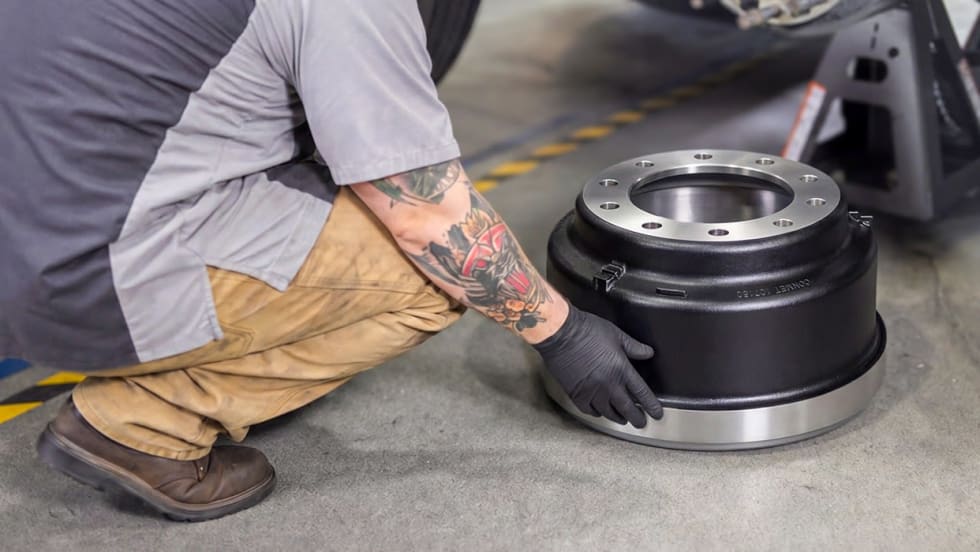
ConMet Expands Aftermarket Brake Drum Lineup With TruCast
A new heavy-duty truck brake drum option in the aftermarket gives customers more flexibility within the ConMet product family.
Read More →
Mack Expands Premium Service Contract Coverage to Medium-Duty MD
With a service contract, inspections, preventive maintenance and repairs can be handled in a single visit instead of multiple ones.
Read More →
Maintenance in the Messy Middle Part 5: Battery-Electric Trucks
No oil changes. No diesel exhaust fluid. No exhaust aftertreatment. But NACFE battery-electric trucks still require specialized maintenance procedures.
Read More →
Trucking Fleets Faced Record Operating Costs During Third Year of Freight Recession
ATRI's annual operational cost report shows carriers trimmed fleets, delayed equipment purchases, and ran older trucks as expenses continued to outpace freight rates.
Read More →