





Related: 6 Ways Fleets Should Take Advantage of a Strong Economy
6 Trucking Transportation Trends for Now and the Future
John Larkin, investment banker and longtime transportation investment research analyst, outlined the trends he’s seeing in freight transportation, many of which are being driven by the evolution of the retail supply chain.
October 5, 2018
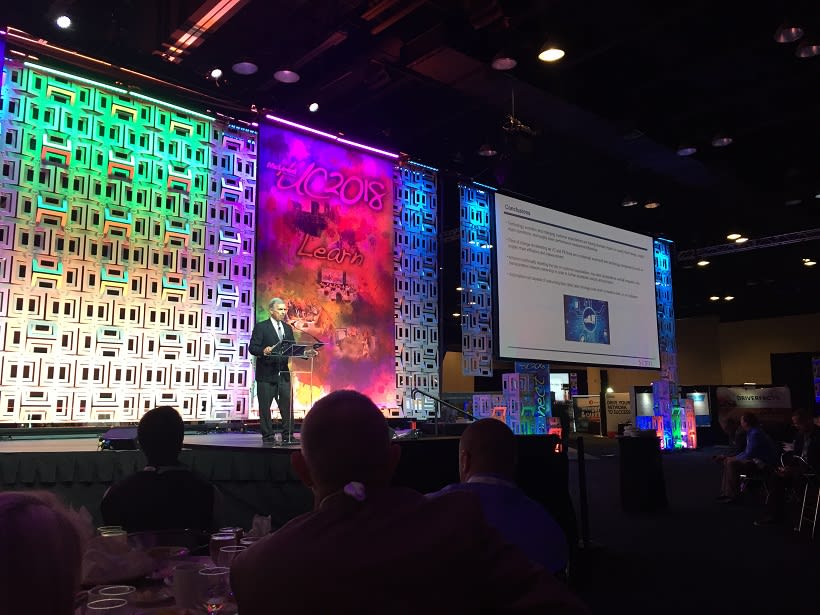
John Larkin, investment banker and longtime transportation investment research analyst said that the trends he’s seeing in freight transportation are being driven by the evolution of the retail supply chain.
Photo: Deborah Lockridge
10 min to read
Speaking at the McLeod Software Users Conference in Birmingham, Alabama on Oct. 2, John Larkin, investment banker and longtime transportation investment research analyst, outlined the trends he’s seeing in freight transportation, many of which are being driven by the evolution of the retail supply chain.
“When I was a kid you had a manufacturer, typically in the U.S., and freight moved directly from the manufacturer to retail stores," he said. "There was trucking involved in moving that freight, typically what we think of today as LTL, in those pre-deregulation days.
He said what happened next is a push driven by Walmart and other big box stores, led to the shift to a distribution center "out in the middle of nowhere— in typical non union locations— and truckloads or intermodal containers would be run into the facility, while dedicated or private fleets would deliver full truckloads out of the distribution center, delivering a truckload of mixed merchandise to each store."
Then, with the rise of e-commerce, driven largely by Amazon, you began to see manufacturers loading truckload or intermodal containers that move the freight to a regional distribution center. Then it’s moved to a fulfillment center in an urban area, and a last mile delivery provider will deliver it directly to your home. Larkin noted that some of the traditional big box retailers have gone with an omnichannel strategy, where a store is not only a regular retail store, but also a showroom and distribution point for e-commerce shipments where people can pick up the product they buy online.
Another big change is in customer expectations. “We want to order what we need on our handheld device," he said. "Delivery options are becoming more and more varied; we’re seeing folks experiment with delivering into your home inside your door; say, your freight needs to be delivered to your refrigerator. Or delivered to the trunk of your automobile in the parking lot at work, or to a locker at Whole Foods. So, customers are becoming much more demanding and expect a higher velocity supply chain.”
Larkin said now we're seeing a move toward direct shipments, "where it may be made anywhere in the world and delivered directly to your house. And last but not least is 3-D printing, where the facility is located near your house or there’s even a vehicle circulating through your neighborhood where your tailored design is sent to the printer and it’s delivered to your house." Regular truck movements in this case are mostly limited to the substrate, the material used to make the 3-D printed object, and maybe last-mile delivery. “This changes everything dramatically; no longer are goods being shipped all over the world.
“So, there are massive changes in the retail supply chain and lots of implications for the transportation industry,” he added
1. It’s a Great Time to be in Truckload
The truckload sector is still the largest sector of transportation and logistics by a wide margin, although it’s still relatively fragmented even 38 years after deregulation, Larkin said, noting that even the largest carrier has only 1-2% of the market.
This is a great time to be in the truckload business, he said, as demand continues to grow and capacity is difficult to come by. Reasons for that tight capacity include a driver shortage as well as the loss in productivity brought on by mandatory electronic logging devices for hours of service. ELDs, he said, “have forced some carriers who were loose with the regulations to be compliant.” No longer can they run 800 miles in a single day with a single driver.
As for the driver shortage, he pointed out that in a country with near full employment, there are other jobs available that pay more money and allow people to stay closer to home, such as some of the oil field driving jobs. In addition, “people are a little frightened given all the regulations and the fact that autonomous trucks will be with us two weeks from now,” the latter remark said with sarcasm. “Would you believe 25 or 30 years from now? But the press has blown that out of proportion.”
Small fleets are being created, he said, although at a slow clip, and some of them are growing at a pretty rapid rate, having benefited from the depressed used truck market that existed until recently.
The spot market has been strong since the September 2017 hurricanes, he said, although there has been some softening over the summer as some spot freight transitioned into the contract market.
Contract pricing started to move up about a year ago; many carriers took price increases at the end of last year, and in the first half of this year, “and are going back to the well for the third time in the second half of the year,” he said. “They aren’t being too greedy about it, passing half to two thirds of it on to drivers.” But there’s still enough money left over for wider margins, he said, predicting that third quarter financial results will be very strong across the industry.
2. E-Commerce is Causing a Less-Than-Truckload Resurgence
“I remember 10, 20 years ago, people were writing off the LTL industry for dead, and everyone was moving to a big distribution center model with truckloads coming in one side and out the other,” Larkin said. “E-commerce has changed that, automation in manufacturing has changed that, and now we have very strong demand on LTL side as well, including overflow from truckload,” where shippers will offer a partial truckload to an LTL carrier when they can’t get it covered in the truckload market."
Smaller-footprint urban fulfillment centers often require smaller shipments to accommodate the broad range of SKUs needed to fulfill the expectation of e-commerce customers for fast delivery. As a result, Larkin said, LTL shipments are more often the optimal shipment size.
“So, LTL is gaining overall market share as a result and most of the carriers are doing extremely well. Their business model benefits from density.”
The automated manufacturing trend is another factor, he said, as subassemblies and components move between facilities, much of it by LTL.
Labor availability on the LTL side is better than on the truckload side, he said, “although the last couple of years you've seen LTL carriers forming recruiting departments because it’s becoming difficult for them to find labor as well.”
They do have an advantage over truckload, he said, because they can hire younger workers and let them start out on the dock and work their way up to moving trailers around the yard, then to pickup and delivery, and eventually to linehaul drivers. “So, there's more of a career path and more of a predictable home life. Still, the LTL carriers are struggling to find workers.”
Larkin said it doesn’t appear there’s going to be a lot more consolidation in the LTL market, and alliances amongst regional carriers seem to be working well. “Without a lot of new entrants, the big players should do extremely well,” he said.
“It does seem we’re going to see predictive analytics and APIs help drive dynamic pricing in the LTL sector,” he said, outlining a scenario where a carrier’s freight is looking a little light next Wednesday between Kansas City and Chicago, but a short-term price discount “could fill that extra capacity up almost overnight.”
3. Railroads Fail to Deliver on Intermodal Promise
Intermodal is retreating to high-density/long haul lanes only, Larkin said, with “no viable intermodal solution for shorter haul, less dense lanes. Service quality is dramatically below what you see with over-the-road truckload, and there doesn’t seem to be a big plan to improve that... the railroads have more or less scrapped any projects that would allow intermodal transportation to take some market share in shorter haul.”
Meanwhile, coal, a rail carloads mainstay, “has been suffering despite President Trump’s initiatives; it turns out natural gas is so plentiful, cheap and clean that it makes more sense and typically doesn’t move by railroad.”
4. Warehousing’s a Hot Commodity
E-commerce is driving massive changes in the warehouse sector. “There are some cities where warehouse space is more expensive than office space,” Larkin said. With e-commerce, in order to provide the near-immediate delivery that customers expect, it’s important to have all those products positioned in an urban area. Not only is urban real estate more expensive than rural real estate, he said, in some areas, the approvals required to build new warehouses are lengthy and difficult.
The labor shortage is a big issue in warehousing and distribution centers as well, which means more and more operators are automating warehouses, he said. “I think you’ll see that a lot faster than you’ll see autonomous trucks on the highways.”
5. Last Mile Delivery is up for Grabs
It’s not clear who the winners and losers are going to be in the last-mile delivery space, Larkin said. Rolling delivery robots are being tested on the streets of Europe, he noted, while UPS and others are investigating the possibility of flying drones for last-mile delivery, particularly in remote and rural areas.
Then there’s crowdsourcing, much like Uber or Lyft, where companies use people driving their own cars to drop off packages. He also pointed to Amazon’s recent Sprinter van order, with the idea of creating independent contractors for last-mile delivery.
“Then there are white glove carriers that deliver things that can’t be put in a package and moved via via conveyor,” he said – things like refrigerators, washers and dryers that have to be installed. The biggest is probably XPO Logistics, he said, but LTL carriers are playing a role as well. A. Duie Pyle, a regional LTL in the Northeast, has invested in Class 5 trucks for delivery in urban areas.
“So there’s still a lot of development to take place here,” Larkin remarked.
6. Technology Offers Supply Chain Visibility
“Shipper fixation with shipment tracking has led to the development of many internally funded or venture-capital-funded shipment tracking apps,” Larkin said, from C.H. Robinson’s app that allows shippers to see every shipment globally, no matter whether it’s in a warehouse, truck, or plane, to companies such as Amber Road, Descarte Macropoint, Trimble 10-4, Trucker Tools, FourKites, Locus Traxx, Blue Prism, DAT Ontime, and McLeod Software’s new app.
“It’s unclear who the big winners and losers are going to be here and how all this data is going to be used to optimize transpiration operations, but clearly with the pace of change it won’t be too long before this data is used to further optimize operations," he said. "Of course, it’s important that all of this data is somehow fed into the TMS that shippers and carriers and logisticians are using. Every time a package is loaded or unloaded it’s got to be scanned. We’re making huge progress in terms of outfitting the whole network to really understand where anything is at any given time.”
Ultimately, he said, all this information will help us optimize routing, optimize pickup and delivery timing, and optimize which distribution center door we request. It will help us optimize shipping configurations, it will help us select the mode for today, not just for the year, which may be different from the mode for tomorrow — and the carrier within the mode.
“We think data analytics and AI are finally coming into the industry to help predict near term and even medium term futures, so we can plan manpower requirements and capacity requirements and anticipate service failures that might be caused by weather, bridge out, other kinds of issues and take action that may be recommended by the system," he observed. "This all helps reduce costs and leads to better satisfaction with customers.”
And for some, the holy grail of that information flow is blockchain, which Larkin predicted is likely to be in use sooner than autonomous trucks will be.
“It is a wonderful foundation that will enable us to speed up all the back room functions associated with moving freight,” he said. McLeod Software was a founding member of the Blockchain in Transportation Alliance. BiTA, Larkin explained, is developing the standards and protocols that will be applied to blockchain so that shippers, carriers, receivers– everyone in the supply chain-- can talk to each other electronically. He said using blockchain improves transaction security, helps manage working capital efficiently, and increases accuracy.
Subscribe to Our Newsletter
More Fleet Management

Sponsored•September 16, 2026
Color Match Smarter: Tools That Restore & Perform
For fleet managers and collision repair professionals keeping heavy-duty trucks on the road, getting the color right the first time isn't just about appearance — it's about efficiency, turnaround time, and bottom-line results. Discover how today's digital color tools are transforming the repair process from guesswork to precision.
Read More →
FMCSA Pauses Biennial-Update Enforcement Amid Motus Transition
Carriers whose updates were due on or after June 1 have more time, while FMCSA works to stabilize its new registration system and warns of phishing sites impersonating its new carrier registration system, Motus.
Read More →
Sponsored•September 14, 2026
2026 Blueprint for Countering Smarter Supply Chain Theft
Cargo theft is no longer just the cost of doing business. It's a multi-billion-dollar criminal enterprise exploiting vulnerabilities across your fleet, drivers, and supply chain.
Read More →


Sponsored•September 1, 2026
How Telematics Improves Visibility, Control, and Performance in Refrigerated Fleets
Explore how telematics help refrigerated fleets improve visibility, uptime, efficiency, compliance, and cargo protection across connected cold chain operations.
Read More →
What the U.S.-Canada Trade War Means for Trucking
Escalating U.S.-Canada tariffs could disrupt cross-border freight, reduce truck volumes, raise costs, and create new uncertainty for carriers on both sides of the border.
Read More →
What Are Trucking’s Top Concerns for 2026?
The American Transportation Research Institute wants to know what's worrying trucking fleet managers, drivers, and other stakeholders in its annual Industry Issues survey.
Read More →
American Trucking Associations Looks for a New Leader
ATA President and CEO Chris Spear abruptly left his job at the association on August 21, at a pivotal time for the trucking industry.
Read More →
Public Wi-Fi Cybersecurity Risks: How Truck Drivers and Fleets Can Protect Their Data
Public Wi-Fi can expose truck drivers and fleets to credential theft, malware, and other cyber threats. Here’s how to reduce the risk on the road.
Read More →
For Nicky Cupp, Fleet Innovation Starts With Frustration
HDT Truck Fleet Innovator Nicky Cupp turns everyday pain points at Fraley & Schilling into opportunities for better technology and smarter processes.
Read More →
Adam Buttgenbach’s Approach to Electric Trucks: Start With Where They Fit
HDT Truck Fleet Innovator Adam Buttgenbach helped PepsiCo build one of North America’s largest EV fleets by focusing on where electric trucks make operational sense.
Read More →