




5 Deadly Tire Sins
Negligence and apathy consign more tires to early graves than road hazards ever will. Here are the Top 5 reasons you might be straining your tire budget to the breaking point, and how you can stem the financial hemorrhage.

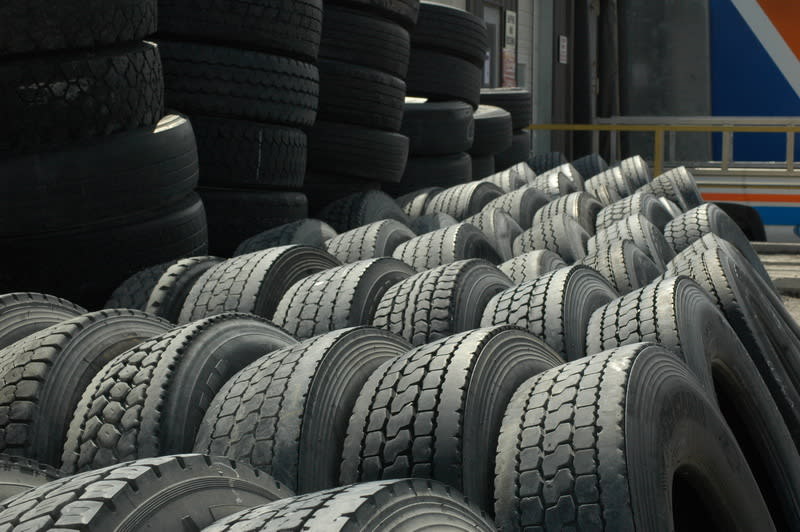
How many tires in your scrap pile arrived there before their time?
How many tires in your scrap pile arrived there before their time?
Negligence and apathy consign more tires to early graves than road hazards ever will.
An inspection of almost any tire scrap pile will show most of the tires in the pile with a good portion of useable tread still on them died because of neglect. Irregular wear, mechanical problems, even mis-matched dual tires or inflation pressures across two tires in a dual assembly have tell-tale signs, and too often those sign are ignored until it's too late to salvage the tire.
Here are the top five reasons you might be straining your tire budget to the breaking point, and how you can stem the financial hemorrhage.
1. Under-Inflation
"You don't go from properly inflated to a blowout instantaneously unless you hit something on the highway," says Curtis Decker, manager of product development at Continental Tire. "We estimate that about 80% of the roadside tire failures are a direct result of creeping air loss."
In other words, 80% of blowouts could be prevented if tires were kept properly inflated.
The chief cause of under-inflated tires is lack of basic maintenance. Tire pressures need to be checked at a minimum on a weekly basis. While acknowledging that's almost impossible in fleets that have trailers hidden in drop-yards all around the country, some inexpensive technology can alert drivers to under-inflated tires before driving away with one -- and with telematics, alert fleet managers. Or better still, automatic inflation systems can re-inflate low tires before they leave the drop yard.
A recent DOT roadside tire survey found some significant tire pressures problems that fleets could remedy fairly easily and inexpensively.
56% of tires are 5 psi off target pressure
22% of dual sets are mismatched by 5 psi or more
22% of vehicles have one tire under-inflated by 20 psi or more
41% of fleets surveyed report inflation problems when picking up spotted trailers
Don't lull yourself into thinking your fleet doesn't have those problems too.
2. Out of Sight, Out of Mind
Following on the previous item, fleets that don't see their trailers regularly have more tire problems that fleets that can perform regular preventive maintenance and tire pressure checks. Herman Miller, president of HJM Fleet Management based in Green Bay, Wis., says trailers are the classic example.
"A lot of the big companies have problems seeing their trailers to get an annual inspection done on them; monthly or weekly maintenance is almost out of the question," he says. "They can’t do the job of tire maintenance they’d like to because they don’t see their equipment often enough."
Among the possible solutions are outsourcing equipment maintenance to a local service provider, providing on-board or remote tire pressure monitoring or automatic inflation systems. Any of those are a better prospect than beseeching your driver to check tire pressure before pulling seldom-used trailers out onto the highway.
3. Mechanical Problems
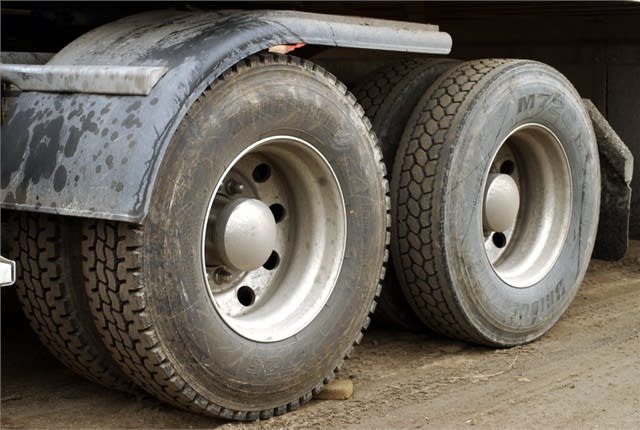
Mis-matched dual tires kill two tires for the price of one.
Here, we'll include problems lying somewhere other than with the tire itself, even though the tire will bear the brunt of the damage. Any condition that prevents the tire from running straight and true, and making constant and consistent contact with the pavement, will cause accelerated wear. It will often occur in patterns on the tire that can aid in diagnosing the problem.
Misalignment is responsible for a high percentage of premature wear, but it can come in many forms: drive axles out of alignment or bad steering geometry for example. Take feather wear across a rib steer tire tread. Feathering is when the ribs wear from high to low across each rib. If the feathering pattern is identical across both steer tires, suspect drive axle or chassis misalignment. If the feathering patterns are in opposite directions, suspect a toe-in or toe-out condition.
Loose wheel bearings, bent axles, or axles that flex excessively can cause rapid wear of the inner shoulder of the inner tire on a dual wheel. Worn shock absorbers will allow a tire to bounce more than it should, affecting the contact patch of the tire. Since that type of defect is random in nature, watch for irregular patterns of localized cupping or a scalloped appearance.
TMC's RP 219B, Radial Tire Wear Conditions and Causes: A Guide to Pattern Analysis, is an excellent resource in diagnosing tire wear problems. It's available through the Technology and Maintenance Council of the ATA.
4. Induced Flaws and Failures
Tires are often damaged through neglect or inattention. Running mismatched tires in a dual assembly is an easy way to kill two tires for the price of one. The larger diameter tire will bear more than its share of the load, which will ultimately damage the sidewall. Because of the differential in diameter and revolutions per mile between the two mismatched tires, the tread on the smaller tire will scrub off very quickly.
"While that may not sound like much, a diameter mismatch of just 5/16 inch, means the larger tire will drag the smaller one a distance of about 13 feet for every mile, or 246 miles for every 100,000 miles," says Guy Walenga, director of engineering for commercial products and technologies at Bridgestone Bandag Tire Solutions.
Many fleets don't bother at all with tire and wheel balancing. If they do, they'll probably do only the steer tires -- and mostly to avert driver complaints about vibration. Many argue that given the quality and consistency in tire manufacturing today, balancing is hardly necessary, but that doesn't take into account the rest of the hardware spinning around on the axle spindle.
Peggy Fisher, a highly regarded tire expert and president of TireStamp, says a properly balanced tire will wear more evenly over its life, so there are advantages to taking the extra step, if only because it's cheap insurance.
"Unless you have a flat spot from a skid, or something mechanical goes bad that causes the tire to run irregularly, in most cases, if it's left to its own devices, and if it was mounted correctly and balanced, it should run okay," she notes. "But if a fleet is really interested in getting every last 32nd of an inch out of a tire, they'll balance."
5. Improper Tire Selection
"One of the easiest ways to 'kill a tire' is by running it in the wrong application. Running truck tires not suited for a specific application is a sure way to reduce the tire's effectiveness," says Michelin's product marketing manager, Don Baldwin.
If a truck runs approximately half of its operation time in an off-road environment, but the tires are strictly on-highway tires, that presents a potential tire-killing situation. Taking advantage of an application-specific tire will greatly help with the tire's -- and ultimately the vehicle's -- performance and productivity.
More Maintenance

International Launches Online Truck Parts Store
Fleetrite.com lets fleets and repair shops find OEM and all-makes parts, check prices and availability, and order without calling a parts counter.
Read More →
Continental Introduces New Regional Truck Tires
Continental says its new Generation 5 steer and drive tires for regional operations offer longer tread life, with estimated mileage gains of 22% and 19%, respectively.
Read More →
How AI Can Help Your Techs’ Efficiency
The technician shortage isn't going away, and no single fix can close the gap on its own. Trent Broberg makes the case that AI's real job in the shop is protecting the billable hours and job satisfaction of the techs you already have, not asking them to work faster.
Read More →


Color Match Smarter: Tools That Restore & Perform
For fleet managers and collision repair professionals keeping heavy-duty trucks on the road, getting the color right the first time isn't just about appearance — it's about efficiency, turnaround time, and bottom-line results. Discover how today's digital color tools are transforming the repair process from guesswork to precision.
Read More →
Wrong Repair Prompts Recall of Freightliner, Western Star 4x2 Trucks
DTNA is recalling more than 2,400 trucks that received an incompatible software fix instead of the hardware repair required to address brake valve corrosion.
Read More →
Truck Drivers Need More Than Another Alert
Fleets have more visibility into truck health, safety events, and driver activity than ever. The next challenge is turning all that information into useful guidance for the person who has to decide what to do next.
Read More →
The Maintenance Checks Trucking Fleets Should Prioritize Before Fall Freight Picks Up
Making it through August isn’t the same as being ready for the next several months of operation. Find out what systems may have suffered from summer heat and need to be checked out before fall.
Read More →
What Three Fleets Are Doing Differently When Buying Truck Parts in 2026
With freight improving but costs still climbing, fleet maintenance executives explain how they're balancing price, quality, and supplier relationships.
Read More →
Paccar Recalls 2027 Trucks Built This Summer for Possible Electrical Problem
The nearly 6,000 Kenworth and Peterbilt trucks in the recall could potentially lose engine power, among other things.
Read More →
Could New Engine Oils Mean Longer Drain Intervals?
New CL-4 and FB-4 engine oils are coming in 2027. Foodliner wants to know whether they could support longer oil drains, but it won’t change its maintenance schedule without data from its own trucks.
Read More →