




4 Ways to Get More Miles from your Tires
Irregular tire wear is usually a symptom of some other malfunction such as poor alignment, improper inflation or even poor driving habits. The peril with mechanically induced irregular wear is that it begins the day you install the tire, though it won't produce any visible signs until weeks or perhaps months later. By then, its progress is almost irreversible.

Irregular tire wear is usually a symptom of some other malfunction such as poor alignment, improper inflation or even poor driving habits. The peril with mechanically induced irregular wear is that it begins the day you install the tire, though it won't produce any visible signs until weeks or perhaps months later. By then, its progress is almost irreversible.
Simply taking off the wearing tire and replacing it with a fresh one will likely consign that tire to an early grave as well.
Contrary to fleets' wishful thinking, the problem is usually not with the tire. The premiere tire companies have evolved tire manufacturing to such a high level that truly bad tires are rare indeed. If your tires aren't living up to expectations, it's probably your truck or your own neglect that's killing them.
These four tips will help get better life from your tires.
1. Proper Inflation for the Load
Proper inflation is key to maintaining an appropriate amount of sidewall flex and the optimum contact patch and tread footprint. The proper inflation also helps the tire resist impact damage and stone drilling.
The sidewalls of an under-inflated tire flex excessively, which creates high internal temperatures. Excessive casing temperature also weakens the rubber compounds that keep the casing and the tread together -- this applies equally for retreaded tires. Tire service companies tell us under-inflation is number-one underlying cause of blowouts and subsequent roadside service calls.
Underinflation also changes the footprint of the tire, which leads to irregular wear on tire's the shoulder and crown areas. If you want to get maximum miles-per-thirty-second from your tires, inflate them for the load they carry according to the tire manufacturers' load and inflation tables. And take all necessary steps to maintain that pressure. Fortunately, that task is much easier today thanks to tire pressure management systems and automatic inflation systems currently available for non-driving axles.
In 2007, the U.S. DOT conducted an extensive field test of TMPS and ATIS systems, and found that TPMS and/or ATIS reduced fuel consumption on the equipped vehicles, reduced road calls for damaged/flat tires of equipped vehicles and did not introduce any unscheduled maintenance for the systems themselves. Both of the fleets involved in the DOT field test kept the systems on their trucks upon its completion.
2. Wheel Balancing
Few fleets actually balance any tires other than steer tires and fewer fleets do regular alignments. Proof of the need for both service items may lie no farther away than your own scrap pile
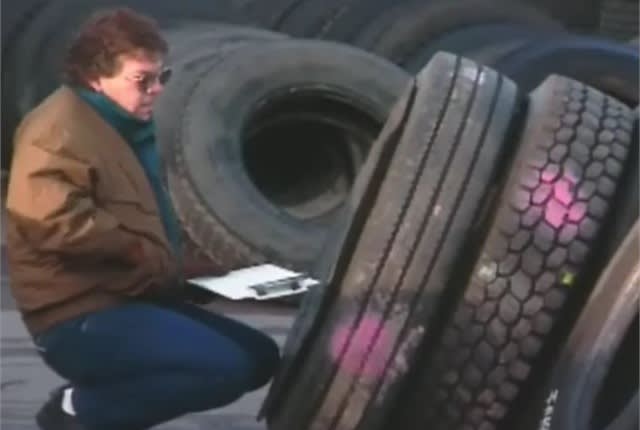
"Carefully examine your take-offs and you'll see specific wear patters," advises Guy Walenga, Bridgestone's director, Engineering, Commercial Products and Technologies. "If you see tires that have tread on them, but it's worn irregularly, you know you have a problem. You now need to identify the trucks those tires came from and fix what's causing the wear."
Bridgestone has produced a useful video on scrap tire analysis. You can view it here.
Classic symptoms of an out-of-balance condition are cupping and scalloping. By the time irregular wear patterns show up, the tire may be beyond redemption. Balancing it after the fact may slow the wear, but you can't stop it.
According Mike Beckett of MD Alignment in Des Moines, Iowa -- a guy with no stake in the balancing game, but who has tons of experience with tire problems and their fixes -- balancing can improve tire life by 15% to 20% by preventing irregular wear that isn’t caused by some external source.
"Balance is a hard thing to sell," Beckett says. "A lot of people seem to think balance is related only to cupping problems. Balancing will not solve cupping wear; that is caused by something else. Balancing can help tires wear more evenly from the start. It can also compensate for existing wear, like cupping or flat-spotting, by stabilizing the balance of the tire in the areas where rubber has already disappeared."
Yokohama offers a useful worksheet on wheel balance here.
3. Vehicle Alignment
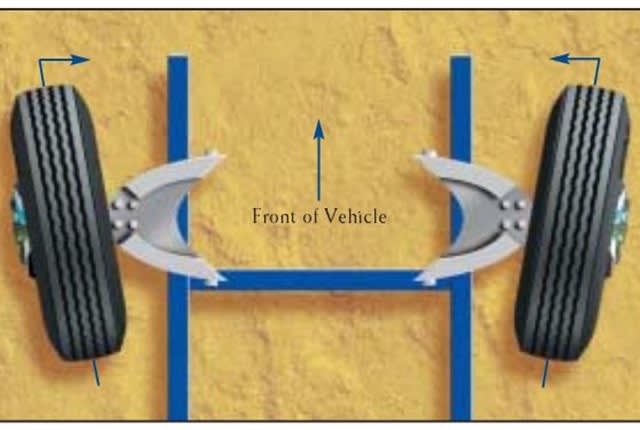
The need for alignment is often judged on its ROI. Do you spend a few hundred bucks every year to possibly save a tire costing roughly the same? Again, go back to the scrap pile, or take a walk through the yard and look for alignment related tire wear. This includes feathered wear, high-to-low left-to-right wear, and shoulder wear on steer tires.
When sourcing an alignment service, choose one that will correct the problem rather than just resetting the truck back to OEM specs.
"The OEM specification is a manufacturing tolerance," says Mike McCoy, National/Special Accounts Manager at Bee Line. "If I was a fleet owner, I wouldn't be satisfied with someone setting my alignment to within OE tolerance."
McCoy points to camber as an example. Some OE specifications allow for as much as 7/16 of a degree positive or negative. "TMC's RP 642 calls for less than one-quarter of a degree," he says.
Balance and alignment are both dynamic conditions. They change over the life of the tire, so don't expect the set-it-and-forget-it approach to work with balance or alignment. Goodyear offers a good explanation of wheel alignment's effect on tires here.
4. Installation
You can't expect good performance from any tire if it's not properly mounted in the first place. When a tire sits non-concentrically on a wheel, or if the wheels is not running true to the spindle, it will wear rubber off the tire very quickly.
First, the wheel must be checked for damage and incongruities. Warpage can cause lateral run-out, bent flanges can cause radial run-out, and bad bead seats can cause pressure loss.
All tires have a thin ring embossed near the bead seat used to verify concentric mounting. The distance between the ring and the wheel should be the same all the way around; if not, remount the tire.
Getting the wheel mounted concentrically on the hub is just as tricky. First, the mounting surfaces of the hub and the wheel must be brushed clean and free of loose material. Don't rely on the hub pilots to center the wheel on the hub. Manufacturing tolerances are too wide.
And here's the important part. Check for concentric mounting with a run-out gauge, or an object placed near the tire sidewall and tread face. Even a sixteenth of an inch out will affect tire wear. Sure, it's a pain in the posterior, but it will improve tire life.
Irregular tire wear won't show up immediately, but it won't take long. At the first sign of some unexpected wear, remove the tire and fix the problem before installing another tire. If your tire people are not experts in tire wear, consult someone who is. A valuable source of information is the Technology and Maintenance Council's (TMC) Recommended Practice RP 219 - Radial Tire Wear Conditions and Causes: a Guide to Wear Pattern Analysis.
Remember, tire wear is usually a symptom of some other problem.
More Drivers

Truck Drivers Need More Than Another Alert
Fleets have more visibility into truck health, safety events, and driver activity than ever. The next challenge is turning all that information into useful guidance for the person who has to decide what to do next.
Read More →
FMCSA Removes 110 Truck Driver Training Schools from Certified ELDT List
Federal regulators also are targeting more than 160 additional training providers and launching a nationwide audit of third-party CDL skills testers as part of a broader crackdown on trucking fraud.
Read More →
Hours of Service Pilot Programs: FMCSA Readies for 2027 Rollout
Two pilot programs could eventually reshape hours-of-service rules, giving truck drivers options to pause their 14-hour clock or use longer split sleeper rest periods.
Read More →
Medical Cards, English Proficiency Reshape Roadcheck Violations
Medical-card violations jumped to the top of the driver out-of-service list during CVSA’s 2026 International Roadcheck, while English-language proficiency violations appeared among the leading violations for the first time.
Read More →
Driver Trust Can Make or Break the Success of Fleet Safety Technology
New Teletrac Navman research suggests that onboarding, transparency about driver data, and positive feedback can play a significant role in how commercial drivers respond to safety and coaching technology.
Read More →
EEOC Sues KLLM Over Alleged Sex Discrimination in Driver Training
KLLM is facing a federal sex-discrimination lawsuit over policies the EEOC alleges put female truck driver trainees at a disadvantage.
Read More →
FMCSA Moves to Codify English Language Requirements for Commercial Drivers
By changing regulations on English-language proficiency requirements for commercial drivers, rather than relying on a guidance memo, the FMCSA said future administrations won't be able to walk back the Trump administration's stricter enforcement with just a memo.
Read More →
Drivers Put Western Star Trucks to the Test at Star Nation Experience
Watch to get an inside look at the Western Star trucks, technology, and community behind the Star Nation Experience 2026!
Read More →
Trump Administration Looks to Put More Veterans Behind the Wheel
The Freedom Haulers program pulls together existing and expanded programs at several federal agencies to recruit veterans to drive commercial heavy-duty trucks and cut the red tape for them to get a CDL, training, and employment.
Read More →
Putting Mack’s Command Steer to the Test
A test drive of Mack’s Command Steer active steering system evaluates how it can make truck driving easier and less tiring.
Read More →