




3 Big Challenges of Shop Management
Four maintenance executives share their thoughts on the tough issues faced from behind the shop manager’s desk.

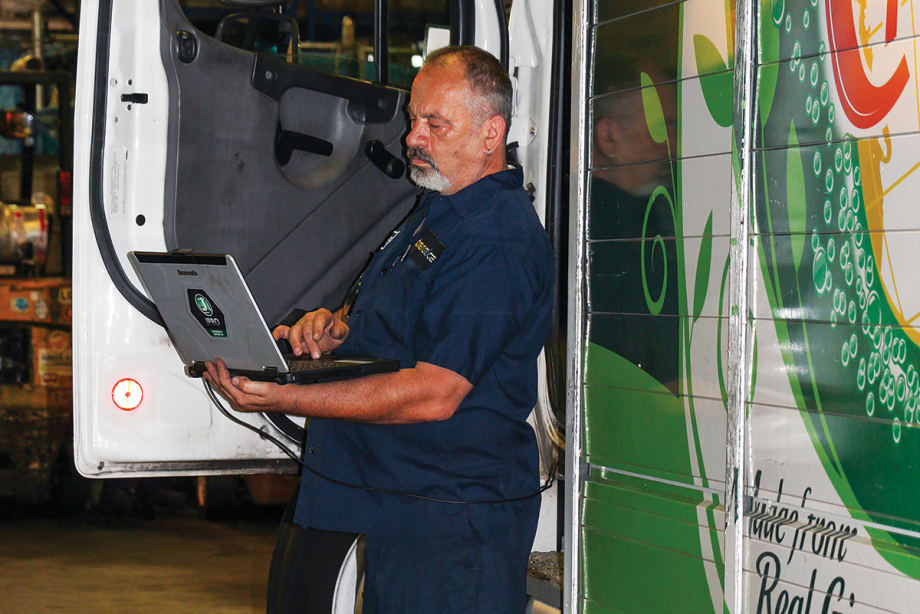
Keeping up with technology is one headache faced by maintenance managers, from training technicians to making sure software is updated and consistent across shops.
Photo: Transervice
Managing a shop or a maintenance program takes different skills than turning wrenches or chasing down tough diagnostic problems. Running a shop or a fleet requires knowing how to manage people, budgets, and politics, along with the ever-changing technology.
“Managing a fleet is very difficult,” says Darry Stuart, a limited-time fleet maintenance executive. “The pressure’s coming from the bottom up and from the top down. It’s a very, very tough job, and there’s very few people that are coming into it.”
Companies must realize the need to grow technicians into management jobs, giving them the training they need, and making sure they understand the big picture.
“Maintenance managers today must be well-rounded to understand the numbers,” says Jarit Cornelius, vice president of asset management and compliance for Tennessee-based truckload carrier Sharp Transport. “Not just pertaining to maintenance, but how these numbers play a role in everything else company-related.”
We asked four well-respected fleet maintenance managers about the biggest challenges faced by those managing shops and maintenance programs, and some tips for addressing them
Keeping Truck Technicians Productive
“One area that needs to be explored is how we lessen the burden of non-technical tasks consuming technician labor,” says Joe Puff, vice president of truck technology and maintenance at NationaLease. “I am referring to things like parts ordering, RO input, chasing parts, shop clean up, technicians on hold waiting for tech support from the factories, walking back and forth to computers and parts rooms, etc.”
It might be worth hiring someone at a lower wage to handle some of the more menial functions.
“Even though pulling a truck in and out of a shop only takes 10 minutes, if you have 10 technicians and they are doing that 20 times a day, next thing you know you have a full-time job that you can pay someone $15 an hour to do and free up your technician workforce,” he says.
Stuart calls it managing by the minute.
“My theory for 40 years has been that everybody worries about cost per hour – I worry about cost per minute. If you really calculate all your expenses, including overhead, heat, payroll, etc., it calculates out to an internal labor rate of $60 per hour – approximately a dollar per minute.”
So, if three technicians are standing around for half an hour talking about what they did last weekend, it will cost you nearly $100.
“The way I try to control costs is to explain to my employees my dollar-a-minute theory,” Stuart says. “You’ve got a better chance of controlling it and understanding what true cost is.”
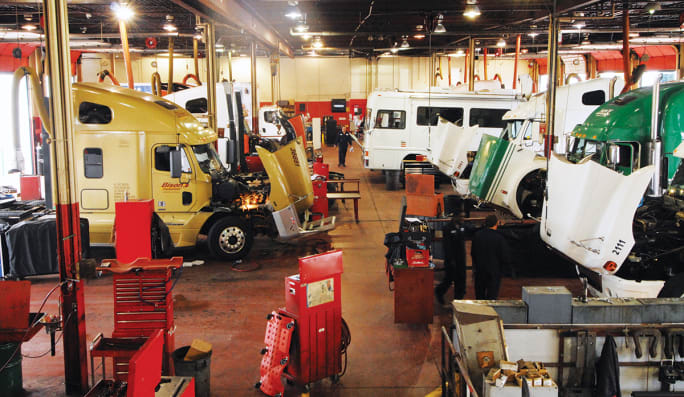
Everyone in the shop needs insight into the big picture. How is the company performing? How does the shop contribute to that, both on a team and on an individual level?
Photo: Jim Park
Sharp’s Cornelius also believes in the importance of sharing more of the big financial picture with technicians.
“You have to not only understand the difference between direct and indirect, but also be able to explain it to your team in a way they get the big picture – because if you don’t, they’ll just take it as you’re a micro-managing, whip-cracking manager, and they’ll become more disengaged than ever.”
He takes every opportunity to make sure everyone in the shop gets insight into the big picture.
“Every employee should be treated as a business partner. No, they don’t need to sit in on financial meetings around the conference table, but they need to have a general understanding that what they do matters, to everyone.”
Uniformity Across Multiple Shops
Bruce Stockton is acting director of corporate maintenance for Miller Truck Lines and Paul Transportation out of Tulsa, Oklahoma, and does consulting for other fleets.
“Whether it’s from integration of multiple companies or just trying to create uniformity among one company’s multiple shops in various locations, meeting the request of ownership to ‘do things the same way in Tulsa as we do in Portland’ is easier said than done,” Stockton says. This is not the first merger he’s worked on, going back to the CFI/Con-way transition in 2007.
“There’s one common thread I’ve learned exists in trying to create uniformity: Use one system [software] of the same version – but be ready for cultures to always be different.” Conformity to uniform procedures “will be 50% at best by existing staff and not reach a 90% level until new faces replace old faces.”
Stuart says some companies, in their effort to standardize and centralize maintenance procedures, end up making decisions based on short-term financial considerations that don’t fully take into account actual maintenance concerns. He cites one company he knows of that sent out a memo near the end of the year advising its shops to curtail spending in order to meet year-end goals. “Do not spend anything, postpone fixing trucks, don’t buy pencils, supplies, even toilet paper,” he says the memo directed.
Yet postponing maintenance on a truck could result in higher costs later, whether that be a roadside breakdown and unexpected downtime or a safety-related component malfunctioning and causing a crash.
“It’s like the old Fram filter commercial: ‘Pay me now or pay me later,’” Stuart says.
Heavy-Duty Technician Training
“Trying to operate a shop today with people who are not trained can be a very costly endeavor,” says Puff. “I tell people all the time to make sure their technicians are trained on whatever it is that they are working on, and don’t try to do more than your shop is designed to do. If you don’t have the schooling, the tooling or the work force to do it, send it out. Utilize your people in the areas in which they are trained and are the most efficient.”
That means you need to know the skill sets of your technicians and match them to the job.
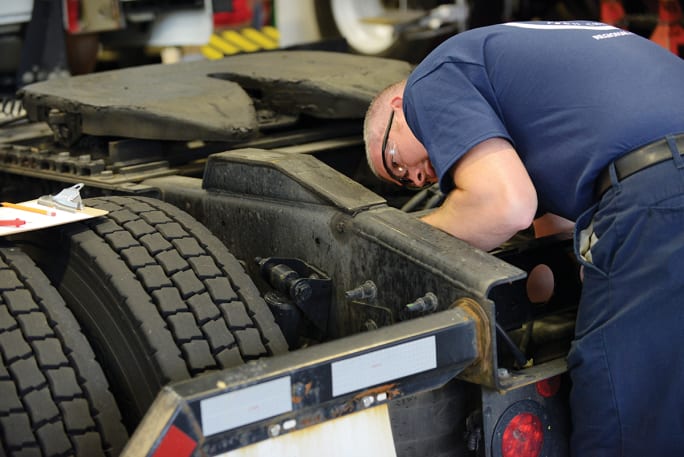
“One area that needs to be explored is how we lessen the burden of non-technical tasks consuming technician labor,” says Joe Puff, vice president of truck technology and maintenance at NationaLease.
Photo: NationaLease
With the rapidly changing pace of truck technology and frequent software upgrades, Stockton says, “mechanics constantly feel like they are learning as they go vs. learning from the OE trainers.” The lack of training and confidence means technicians are more likely to operate reactively, fixing trucks when they break down, rather than being proactive to prevent breakdowns in the first place. “It’s one of the biggest challenges I see in the majority of today’s shops.”
More Maintenance

Color Match Smarter: Tools That Restore & Perform
For fleet managers and collision repair professionals keeping heavy-duty trucks on the road, getting the color right the first time isn't just about appearance — it's about efficiency, turnaround time, and bottom-line results. Discover how today's digital color tools are transforming the repair process from guesswork to precision.
Read More →
Wrong Repair Prompts Recall of Freightliner, Western Star 4x2 Trucks
DTNA is recalling more than 2,400 trucks that received an incompatible software fix instead of the hardware repair required to address brake valve corrosion.
Read More →
Truck Drivers Need More Than Another Alert
Fleets have more visibility into truck health, safety events, and driver activity than ever. The next challenge is turning all that information into useful guidance for the person who has to decide what to do next.
Read More →

The Maintenance Checks Trucking Fleets Should Prioritize Before Fall Freight Picks Up
Making it through August isn’t the same as being ready for the next several months of operation. Find out what systems may have suffered from summer heat and need to be checked out before fall.
Read More →
What Three Fleets Are Doing Differently When Buying Truck Parts in 2026
With freight improving but costs still climbing, fleet maintenance executives explain how they're balancing price, quality, and supplier relationships.
Read More →
Paccar Recalls 2027 Trucks Built This Summer for Possible Electrical Problem
The nearly 6,000 Kenworth and Peterbilt trucks in the recall could potentially lose engine power, among other things.
Read More →
Will API PC-12 Oil Change Trucking Fleet Maintenance?
The new API PC-12 heavy-duty engine oil category reflects the changing demands of modern diesel engines. But fleets like Foodliner are looking to getting their own data before making decisions on adopting the new oils and questions such as extending oil drain intervals.
Read More →
Brake Safety Week to Focus on Drums and Rotors
Commercial vehicle inspectors are focusing on truck brakes during CVSA's Brake Safety Week, August 23-29.
Read More →Possible Battery-Cable Fires Prompt Recall of 15,000+ International MV and HV Trucks
On the recalled vehicles, manufacturing variations can cause the battery interconnect cable to contact the auxiliary stud and hold down the bracket.
Read More →
Rush, MCT Team Up to Grow Refrigeration Service Network
The joint venture will operate MCT's network of Carrier Transicold dealerships and mobile service locations, with the companies promising greater service capacity and uptime for refrigerated fleets.
Read More →