




Keep the Shop Up and Running Despite COVID-19
COVID-19 is taking the team out of teamwork, but the best fleets are staying ahead of the virus. Kevin Bergman of Prime and Mike Gomes of Bison explain how they are adopting to social distancing in the shop.

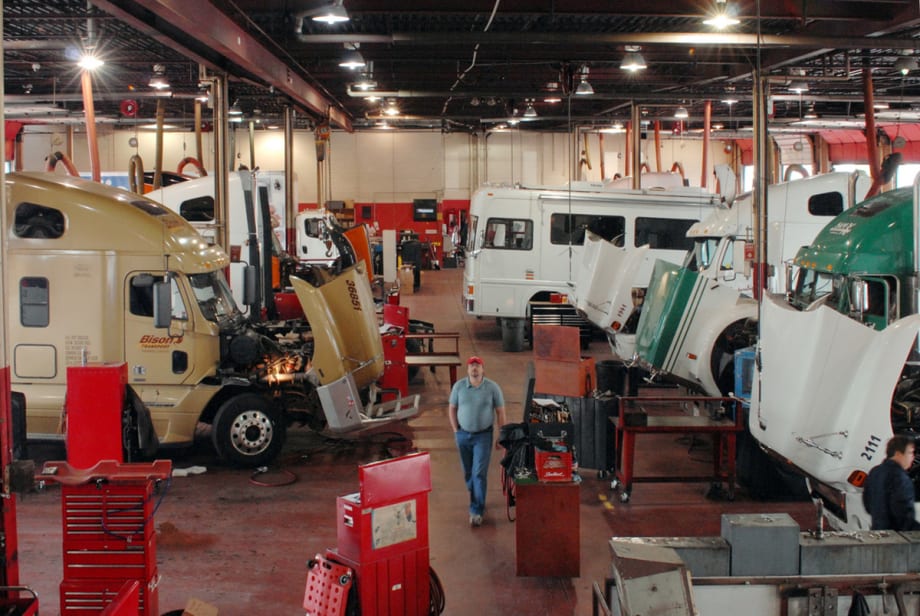
Fleets need to maintain separation of workers and keep drivers and non-essential personnel out of the shop to protect the health of the working technicians.
Photo: Jim Park
Fleets need to rethink everything about vehicle maintenance if they hope to stay ahead of the game during the COVID-19 outbreak. From shift scheduling and technician isolation to not letting PM intervals slide, the virus is testing the mettle of maintenance managers everywhere.
Presenting during a webinar hosted by the Truckload Carriers Association in mid-April, Kevin Bergman, director of fleet maintenance for Prime, Inc., said his greatest challenge now was reduced throughput in his network of maintenance facilities. He said traffic is down anywhere from 15-35%, which he fears that will create havoc with scheduled PM intervals. "It's hurting our workload now, but it's going to create demand that will be hard to take care of later," he said.
Bergman usually sees about 1,500 tractor-trailers a week come through its Missouri terminal, but that's down 30%. That means 500 trailers a week he isn't getting close to. He says about 40% the trailers that come through the shop need some kind of work, sometimes it's only small cosmetic stuff, but it's work, just the same.
"That's about 200 trailers a week, or 800 trailers per month that should have had repairs but have not," he said. "I'm concerned that when this calms down, we are going to start seeing a lot more traffic and that's going to put a lot of stress on the shops. And we haven't started talking about tractors or tires. I foresee our over-the-road tire expense is going to go up substantially during this period."
Similarly, Mike Gomes, vice-president of maintenance at Bison Transport, said a slow-down from some of the large-volume shippers and an increase in the personal products and grocery business, has forced changes in equipment utilization rates. "We're trying to adapt to the shift of the network and trying to make sure we have equipment ready when it's needed, along with trying to keep the shops busy."
Because Bison has broad network of terminals, Gomes says the units are still hitting the shops regularly where he can keep an eye on them and get the inspections done.
"We don't foresee any reduction in the inspections, but we're mindful of costs making sure we're not doing anything early, just to keep shops busy," he said. "We're really keeping a tight eye on planning to make sure that we're bringing equipment in at the right time and then putting the resources to it without sacrificing safety."
Whether the shops are busy or slow, there are still technicians in the building, and there's always some degree of risk when groups of any size gather. Prime has taken an aggressive approach to social distancing in the shop, with a couple of unique strategies. Anyone who comes to the shop has their temperature taken and they are asked a series of now familiar questions about their exposure to the coronavirus. If there's any doubt, they are turned away with no further contact, or tested on site.

Parts counters use to be a natural place for socializing, but social distancing constraints are forcing team members to keep their distance.
Photo: Jim Park
"We understand that our associates are going to go to grocery stores, so it's more likely that they'll get the virus outside of Prime than in one of our shops," Bergman said. "If it does get into one of our shops, we want to mitigate [the risk] so we have plans in place to make sure it doesn't spread from associate to associate."
Those plans include:
Creating siloed teams of four of five technicians that work, eat and take breaks together. Each of those teams also works within a select area, segregated by lines painted on the floor. The thinking is to isolate the teams as best they can, but if one member in that silo gets sick, it hopefully only impacts only four to five workers, not the rest of the workers on the shift.
Prime is a 24/7 operation on 12-hours shifts. They changed the shift to 11.5 hours so that the day shift never sees a night shift and vice versa. That helps limit any possible exposure to only one shift.
Prime is also physically moving departments around, so rather than have a trailer shop and a tractor shop, now each shop is 50/50, tractors and trailers. That way, if the entire building gets exposed, they risk losing only half of the tractor or trailer techs.
All the techs on staff are being offered masks and gloves to wear while at work, as well as abundant supplies of hand sanitizer.
The company also offers an average day's pay to anyone who wants to stay home if they have even a cough or a sore throat, for example. For others whose family members may have pre-existing conditions like low immune systems, they will be paid for the duration of the pandemic. Bergman said Prime got out on front of this thing and made sure the associates knew that the company was standing behind them all the way.
"We have to protect both the health and income of our associates," he said. "The results of the program have been outstanding. I was skeptical about how many of them would take advantage of it, but now I just couldn't be prouder."
Bison, meanwhile, has taken steps to encourage social distancing by staggering coffee and lunch breaks, limiting the number of technicians taking breaks at the same time and by physically removing tables and chairs from break rooms to limit the tendency to congregate.
Bison's other strategies include:
Holding meetings in the shop rather than offices or meeting rooms. It's physically larger area, so it's easier for workers to maintain their distance from coworkers.
At times when it's necessary to get two or more workers in close proximity, as when lifting something heavy, they are instructed to wear gloves and face shields. Masks and shields are optional at other times, and Gomes said they are worn at all times only by about 20-25% of his workforce.
Limiting access to the shop by drivers and other outside contacts. They are instructed to use the intercom when talking with people in the shop.
"You know, we hate to lock out an employee, but we have explained that it's for our protection as well as theirs," he said. "At the outset, some drivers were asking why they were being treated like that, but as we get further into this, everybody understands it, and everyone wants to do the right thing. But we are social people; there's this tendency to congregate."
Distance, Distance, Distance
On an emotional level, it's hard to single out certain team members for additional precautions, but both Bison and Prime are taking steps to limit direct contact with drivers. Anyone who is in contact with others is at some risk if transmission measures aren't taken, even among family members. But drivers, who probably see more exposure to others than the people in the shop, need special consideration.
"It's distance, distance, and distance," said Bergman. "And on top of that, probably some more distance. We have set up physical barriers to enforce the distance, like setting up table in front of windows and we have moved our service writers' desks a couple of feet back from the windows."

Prime has shortened 12-hour shifts to 11.5 hours to avoid mixing of team members at shift change time.
Photo: Jim Park
Prime also upped its parts inventory as the soon as concern over the virus got serious. Bergman said they wanted 24/7 access to a full parts inventory, but they were worried about local suppliers shutting down because of staffing concerns. In fact, some suppliers restricted deliveries to daytime only, leaving the night shifts vulnerable to shortages. They started placing larger orders for parts with fewer deliveries to limit exposure to outside personnel. Vendors and suppliers are instructed to drop deliveries outside, rather than coming into the shop.
Remote Control
Bergman said he has been working from home for a month now, and while he'd rather be in the office, the owner of the company has said, "If you don't have to be at work, you're not allowed to be at work," so the group needs the best communication tools possible.
"We were getting our high-level managers together with Zoom conference calls daily where we talk about the freight market, the economy, possible recessions, and all that," he said. "We are communicating with each of our different departments about what is going on in the economy. You know, morale is a constant everyday question, so we're trying to be as open, but as positive, as possible."
As rule, nobody at Prime is rotating in and out. Everybody who doesn't need to be in the building is staying home full time.
Gomes said early on Bison identified what jobs were essential to the front line and had to be in the building, they have tried to limit exposure. He said they have moved out as many people as possible out of the building, such as their breakdown teams.
"They are all working from home, answering the calls, making sure everything is running as it should," he said. "We saw a minor dip in the response times just as they were getting set up, but we're right back now and we have actually gained a point or two in terms of the percentage of calls grabbed. It's been a fantastic story that way."
Gomes said Bision had rolled out Microsoft Teams just a few months ahead of the onset of the pandemic, not knowing what lay just around the corner. He called it lucky timing.
"We were still getting used to it, and all of a sudden we were relying on it completely," he said. "The amount of communication going back and forth is just phenomenal. Our executive group has been stepping into all sorts of the huddles that are going on; sometimes just to listen or to say hi or provide updates. That's been extremely well received. Everybody's still working, but it's a very stressful time, so communication really helps."
Getting Back to Normal
This too shall pass, as they say, but will the industry change and adopt to the new reality, or slide back to business as usual? Gomes is most concerned that social distancing will be with us for some time, and he worries that drivers in truckstops and techs on the shop floor, indeed, the office staff and everybody else, will quickly drift back to gathering in groups and shaking hands, etc.
"We have to remain vigilant," he said. "It's no secret that people are fatigued with the social distancing and the staying at home. We can't go back just to shaking hands and giving everybody those group hugs. We will have to maintain the distancing and the cleaning protocols. Especially, I fear for our drivers at truck stops. We want to make sure that we can safely ramp up the volumes again while maintaining all these best practices."
Bergman expressed similar concern, but noted he's also worried about parts supplies as business begins to ramp up.
"With the amount of work that's going to fall into our shops after this, I don't foresee parts manufacturers creating an excess amount of parts right now to be able to handle the volume," he said. "And if you use my numbers, 800 trailers a month, they aren't creating an excess amount of parts right now to support the volume they're going to see in a month or two months or three months from now.
"We've already started planning to do some cross training with tractor techs going over to trailers and the trailer techs going over to tractors," he added.
And along with all the protocols put in place to minimize social contact, digitizing the shop workflow will be something fleets need to consider. On top of the practical benefits of traceability, and immediacy, eliminating paper could help reduce the spread of disease, even the common cold.
"This has given us all another good reason to find ways to eliminate the sticky notes and the job jackets and handing stuff from one place to another," said Dick Hyatt, CEO of Decisiv, the webinar sponsor. "This an opportunity to move to a digital environment and for the long term that's really going to be the best thing."
More Maintenance

Color Match Smarter: Tools That Restore & Perform
For fleet managers and collision repair professionals keeping heavy-duty trucks on the road, getting the color right the first time isn't just about appearance — it's about efficiency, turnaround time, and bottom-line results. Discover how today's digital color tools are transforming the repair process from guesswork to precision.
Read More →
Wrong Repair Prompts Recall of Freightliner, Western Star 4x2 Trucks
DTNA is recalling more than 2,400 trucks that received an incompatible software fix instead of the hardware repair required to address brake valve corrosion.
Read More →
Truck Drivers Need More Than Another Alert
Fleets have more visibility into truck health, safety events, and driver activity than ever. The next challenge is turning all that information into useful guidance for the person who has to decide what to do next.
Read More →
The Maintenance Checks Trucking Fleets Should Prioritize Before Fall Freight Picks Up
Making it through August isn’t the same as being ready for the next several months of operation. Find out what systems may have suffered from summer heat and need to be checked out before fall.
Read More →
What Three Fleets Are Doing Differently When Buying Truck Parts in 2026
With freight improving but costs still climbing, fleet maintenance executives explain how they're balancing price, quality, and supplier relationships.
Read More →
Paccar Recalls 2027 Trucks Built This Summer for Possible Electrical Problem
The nearly 6,000 Kenworth and Peterbilt trucks in the recall could potentially lose engine power, among other things.
Read More →
Will API PC-12 Oil Change Trucking Fleet Maintenance?
The new API PC-12 heavy-duty engine oil category reflects the changing demands of modern diesel engines. But fleets like Foodliner are looking to getting their own data before making decisions on adopting the new oils and questions such as extending oil drain intervals.
Read More →
Brake Safety Week to Focus on Drums and Rotors
Commercial vehicle inspectors are focusing on truck brakes during CVSA's Brake Safety Week, August 23-29.
Read More →Possible Battery-Cable Fires Prompt Recall of 15,000+ International MV and HV Trucks
On the recalled vehicles, manufacturing variations can cause the battery interconnect cable to contact the auxiliary stud and hold down the bracket.
Read More →
Rush, MCT Team Up to Grow Refrigeration Service Network
The joint venture will operate MCT's network of Carrier Transicold dealerships and mobile service locations, with the companies promising greater service capacity and uptime for refrigerated fleets.
Read More →