





Related: Working Through COVID-19: A Delivery Fleet’s Perspective
Logistics Startup's Tech Investment Helped Prepare it for COVID-19
For one logistics company, the need for employees to work from home during the COVID-19 pandemic has been made easier with technology. In fact, ProServ Logistics had a head start, as some of its employees were already working remotely.
March 26, 2020

ProServ Logistics' empty offices in Eden Prairie, Minnesota.
Photo courtesy ProServ Logistics
4 min to read
For one logistics company, the need for employees to work from home during the COVID-19 pandemic has been made easier with technology. In fact, ProServ Logistics had a head start, as some of its employees were already working remotely.
“Honestly? We didn’t really intend to be virtual,” says Brian Johnson, founder and CEO of ProServ Logistics, headquartered in Eden Prairie, Minnesota.
“Not all the best people wanted to work in Eden Prairie,” admits David Buhl, co-founder and COO. “They wanted to work but didn’t want to commute.”
“So, I guess we went virtual,” Johnson says with a laugh. “Maybe reluctantly, at first. Before we were comfortable with it. Certainly, before we really knew what it could do for us.”
“And what it can do for our customers,” Buhl adds.
Virtual Offices
Some of ProServ’s key personnel have been remote from the beginning. One of them was Diane Johnson (no relation to Brian), vice president of operations.
“I just reached a point in my life where I wanted to be closer to my family,” she explains. “I love logistics, supply chain, the constant challenges, helping people, preventing problems. But I can do that from home...or my cabin,” she adds, like a true Minnesotan.
Eric Jex, vice president of operations, climbed every hill his “out of college” career choice presented him with. “But I’d chased that rabbit long enough,” he says. “I just wanted to have more meaningful relationships with family, friends, co-workers and customers.”

Brian Johnson, CEO and Co-Founder, ProServ Logistics, working from home during the COVID-19 crisis.
Photo courtesy ProServ Logistics
Jex, initially the most remote employee, joined ProServ when Brian Johnson and Buhl said he could come aboard without being on site. “The lifestyle I want is miles away from Eden Prairie,” he says. “When they said they were cool with me being remote, it was the easiest – and best – decision I ever made.”
ProServ had an office, where most of their employees showed up daily, intent on serving each customer, and committed to growing their business.
“I like coming into the office,” says Perry Torgerson, manager, business development. “I’m a people person, and that’s what ‘having a job’ always meant to me. Until this Coronavirus,” he adds. “Now, a lot of offices are just risky.”
Finding tech solutions
In addition to Johnson and Jex, they added a third remote employee, working from Kalamazoo, Michigan.
“At first, it was easy to communicate the important stuff,” Johnson says. “We were small, and we didn’t always have a lot that we needed to work together on.” But the business grew, and success presented challenges.
“As a service provider, you need your team to communicate, collaborate, and coordinate,” Johnson says.
Buhl, whose expertise is technology, looked on the situation as an opportunity. “We’d been looking at what was out there, kicking some tires, so to speak. We knew it was time to upgrade our technology.”
ProServ agreed to be a beta tester for EKA Solutions, which developed a cloud-based Omni-TMS to allow brokers, shippers, and carriers to more easily work together. They went live the first of this year. That gave the company an advantage when the COVID-19 crisis forced the entire office to work remotely.
“And you know how all of our people are able to work remotely this week?” Johnson says. “Because we’ve been doing it. Working remotely, communicating with each other, helping our customers and carriers use our technology.”
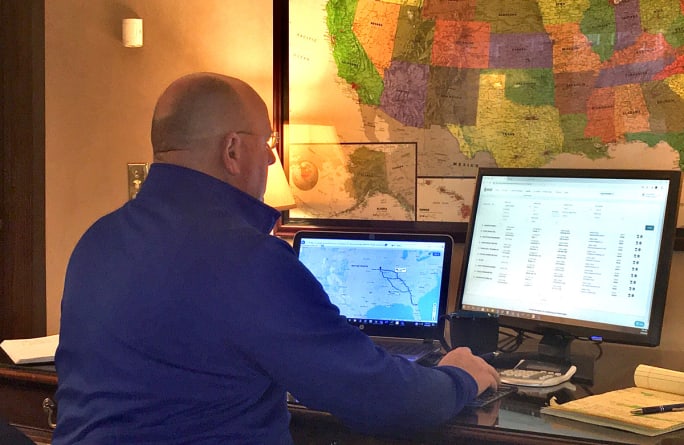
David Buhl, COO and co-founder of ProServ Logistics, working from home during the COVID-19 crisis.
Photo courtesy ProServ Logistics
“EKA is a distributive platform,” Buhl explains. “Its security protocols are second to none, but it allows our people – and trusted partners – single sign-on access, and, it’s role-based.”
“So, was it hard to tell everyone to not come to the office because of the pandemic?” Johnson asks. “Yes, because we’re all used to what we’re all used to. But, did I worry about our business? Or about taking care of our customers? No, because we’ve got the best people, and the EKA platform does everything we need it to.”
Noting that EKA is regularly adding new features to the platform, Buhl says, “I tell them they need to keep pace with ProServ. Our team is working remotely, but we’re going places.”
Subscribe to Our Newsletter
More Fleet Management

Sponsored•September 1, 2026
How Telematics Improves Visibility, Control, and Performance in Refrigerated Fleets
Explore how telematics help refrigerated fleets improve visibility, uptime, efficiency, compliance, and cargo protection across connected cold chain operations.
Read More →
What the U.S.-Canada Trade War Means for Trucking
Escalating U.S.-Canada tariffs could disrupt cross-border freight, reduce truck volumes, raise costs, and create new uncertainty for carriers on both sides of the border.
Read More →
What Are Trucking’s Top Concerns for 2026?
The American Transportation Research Institute wants to know what's worrying trucking fleet managers, drivers, and other stakeholders in its annual Industry Issues survey.
Read More →

American Trucking Associations Looks for a New Leader
ATA President and CEO Chris Spear abruptly left his job at the association on August 21, at a pivotal time for the trucking industry.
Read More →
Public Wi-Fi Cybersecurity Risks: How Truck Drivers and Fleets Can Protect Their Data
Public Wi-Fi can expose truck drivers and fleets to credential theft, malware, and other cyber threats. Here’s how to reduce the risk on the road.
Read More →
For Nicky Cupp, Fleet Innovation Starts With Frustration
HDT Truck Fleet Innovator Nicky Cupp turns everyday pain points at Fraley & Schilling into opportunities for better technology and smarter processes.
Read More →
Adam Buttgenbach’s Approach to Electric Trucks: Start With Where They Fit
HDT Truck Fleet Innovator Adam Buttgenbach helped PepsiCo build one of North America’s largest EV fleets by focusing on where electric trucks make operational sense.
Read More →
Deen Albert: Let Automation Do the Math, People Make the Decisions
HDT Truck Fleet Innovator Deen Albert makes sure people are still at the heart of operations at Grand Island Express, even while adopting artificial intelligence tools. AI-assisted dispatch helped boost revenue 25% with the same number of trucks.
Read More →
Trimble’s New AI Agent Takes Aim at Fleet Back-Office Busywork
Arc Agent works across Trimble TMS products to automate repetitive tasks such as freight orders, maintenance, invoices, fuel costs and more.
Read More →
How HDT’s 2026 Truck Fleet Innovators Are Rethinking Fleet Operations
Meet five trucking leaders who are challenging assumptions, solving operational problems, and putting innovative ideas to work.
Read More →