





Related: Technology and the Tire
New Tire Management Systems Go Beyond Traditional TPMS, ATIS
The latest onboard tire-management systems go far beyond just monitoring and maintaining tire pressure on the road, using telematics, data analytics, and machine learning, as we saw in several announcements at the North American Commercial Vehicle Show.
December 11, 2019
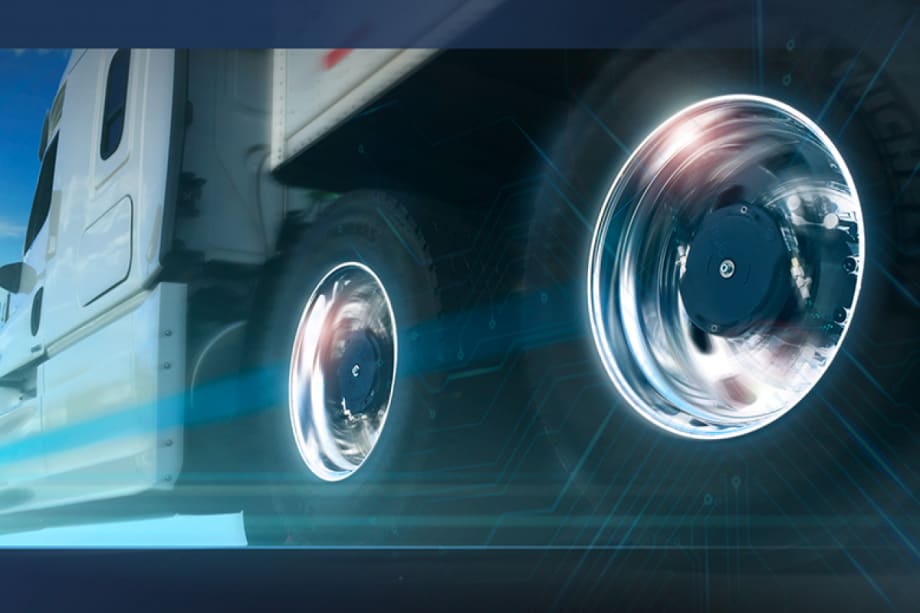
Aperia's Halo Connect offers predictive tire analytics, using machine learning to identify tire-related issues before a simple pressure gauge ever could.
Photo: Aperia
5 min to read
How is it that some fleets experience far fewer tire-related breakdowns than others? Jim Buell, executive vice president of sales and marketing, FleetNet America, tracks such breakdowns. His data shows that best-in-class fleets run far more miles between tire-related roadside breakdowns than the average fleet in his database.
For instance, in the fourth quarter of 2018, the average fleet ran a little more than 29,000 miles between breakdowns. The best fleet in the database? More than 124,000 miles.
Historical data reveals that most non-hazard-related tire failures stem from under-inflation. So, it’s not a huge stretch to imagine those best-in-class fleets pay pretty close attention to their inflation pressures. And the latest technology is making that easier to do than ever.
Once upon a time, you had tire-pressure monitoring systems, which could let drivers (and eventually the back office) know they had a tire with low pressure. And you had automatic tire-inflation systems, which could automatically put air into a leaking tire.
Today, however, sophisticated tire management systems can do all that and much more, with the help of telematics, data analytics, and machine learning. This was quite evident in several announcements at the North American Commercial Vehicle show in Atlanta in late October.
Aperia Technologies Halo Connect
Aperia started full production of its Halo Connect tire system in November, giving fleets real-time insights into tire condition and related maintenance. The system was unveiled in March and has completed an initial test run involving eight fleets and about 1,000 vehicles.
While Halo Tire Inflators use the power of a rotating wheel to create air pressure and automatically inflate tires as needed, Halo Connect goes beyond that to actively measure and adjust tire pressures in real time and feed the fleet real-time data, allowing it to take corrective measures.
Aperia said Halo Connect offers predictive tire analytics, using machine learning to identify tire-related issues before a simple pressure gauge ever could.
During a press conference at the NACV show, the company demonstrated reports associated with a UPS vehicle that had a tire leaking 16 psi per hour. The issue was spotted even when the tire’s pressure was still reaching 100 psi, thanks to the Aperia inflation system and to the fact that pressures are higher when the tire is hot.
Rather than giving fleets reports about every tire in a fleet, the system categorizes tire-related issues by severity. An alert sent to the fleet gives access to dashboards allowing the user to see where the vehicle is, what tire position is affected, graphs that show the tire pressure across time, plus plain-English recommendations on what to do.
“We’ve seen fleets report a 90%-plus reduction in tire-related emergency roadside service since implementing Halo Connect,” said President and CEO Josh Carter.
Hendrickson Tiremaax Pro-LB
Hendrickson introduced its next-generation tire pressure control system, the Tiremaax Pro-LB. Building on the technology of the existing Tiremaax Pro system, which can inflate, relieve and equalize tire pressures across all wheel positions, Tiremaax Pro-LB adds the ability to adjust tire pressure based on load.
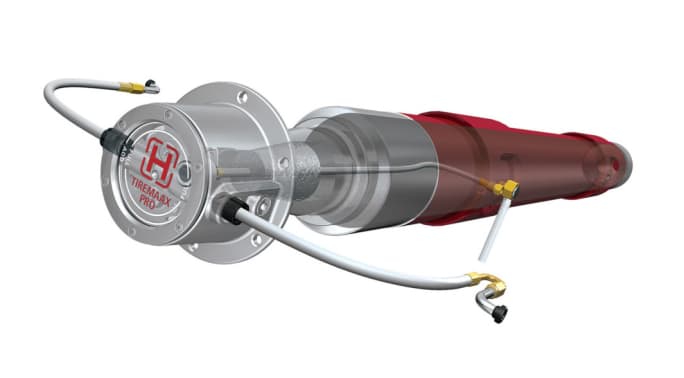
Hendrickson’s next-generation tire pressure control system, the Tiremaax Pro-LB, can adjust tire pressure based on load.
Photo: Hendrickson
“The consensus in the market is that most trailer tires are inflated to a pressure greater than necessary for the typical load. The cold tire target pressure setting is often selected based on a maximum expected load, which may only occur occasionally,” said Matt Wilson, director of controls business unit at Hendrickson Trailer Commercial Vehicle System.
“A load-based tire pressure control system allows for an optimal tire pressure, providing the opportunity to reduce tire wear without negatively affecting fuel economy,” he added.
Cmmercial vehicles experience significant changes in overall vehicle weight between the loaded and unloaded condition – so significant, the optimum air pressure for the tires is different for loaded versus unloaded vehicles. Hendrickson's newest Tiremaax system “helps eliminate the guesswork of tire pressure management. By monitoring the pressure in the air springs, the new system will react to changing loads automatically, with no input from the driver.”
PSI TireView Live
Pressure Systems International unveiled its new TireView Live tire management tool – a data analytics platform for tires, explained Jim Sharkey, vice president global sales and marketing, adding, “Frankly, tire inflation monitoring and inflation provide a snapshot in time – we’re looking for the big picture.”
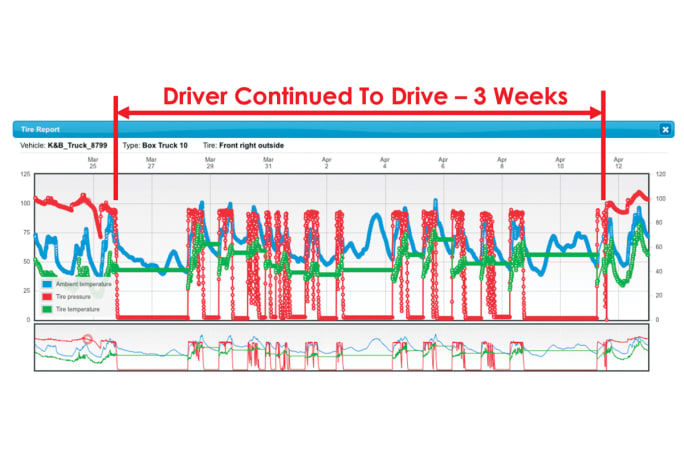
PSI’s Tire View Live offers historical data showing a driver continued to drive for three weeks between the time a tire was punctured and the time it was repaired.
Photo: PSI
PSI unveiled TireView earlier this year, adding tire pressure monitoring to its longtime automatic tire inflation system offerings.
TireView Live takes an extra step, providing a data analytics platform that allows fleets to track and manage tire performance and to compile historical data for pressure and temperature for their tires. This can be critical in evaluating whether immediate action must be taken, or if a repair can be scheduled at the end of the run. And it’s not just viewing data in real time. “You can run a report to find out which vehicles ran on low pressure, how long, what is the percentage they ran underinflated for how long,” said Jonathan Gravell, vice president of business development.
PSI is working through other trailer telematics providers so customers can access TireView Live data through the same dashboard that’s feeding them data on things such as trailer temperature and whether doors are open. The first three partners are Road Ready by Truck-Lite, Phillips Connect Technologies, and FleetLocate by Spireon.
SAF-Holland Smar-te
SAF-Holland launched a new, “intelligent” tire pressure management system called Smar-te Tire Pilot (“Smart”), which not only monitors tires and issues alerts when there is a drop in tire pressure, but also is an automatic tire inflation system that uses the trailer’s own air suspension system data to dynamically measure and adjust tire pressure based on trailer axle load.
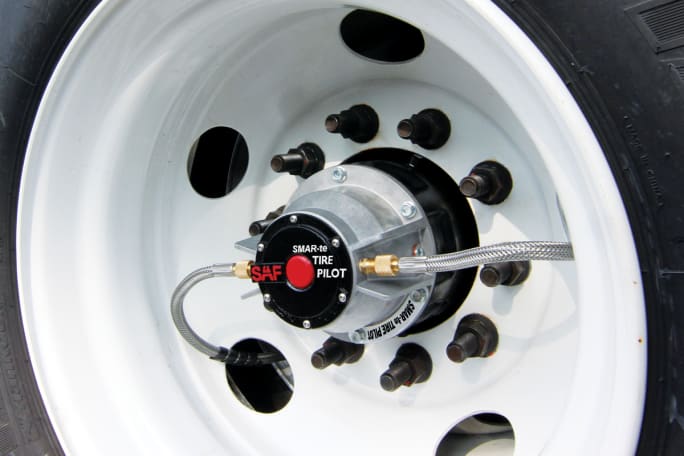
SAF-Holland’s new Smar-te Tire Pilot optimizes tire pressure based on axle load to maximize tire sidewall and tread life.
Photo: SAF-Holland
SAF-Holland partnered with electro-pneumatic controls provider AKTV8 LLC, combining that tech company’s patented control systems with SAF’s Tire Pilot Plus wheel ends.
The Smart-Alert diagnostic LED light warns of minor tire leaks, severe leaks, and overload conditions. Bluetooth and CAN connectivity allow enhanced configurability and serviceability, with optional telemetry integration.
Unlike traditional mechanical tire inflation systems, said SAF-Holland, Smar-te Tire Pilot requires no maintenance or calibration. The ability to more accurately control the proper tire air pressure per the tire manufacturer’s load and inflation standards reduces tire stress, resulting in optimized tire tread and casing life and reduced rolling resistance – and more miles between breakdowns.
Subscribe to Our Newsletter
More Maintenance

Sponsored•September 16, 2026
Color Match Smarter: Tools That Restore & Perform
For fleet managers and collision repair professionals keeping heavy-duty trucks on the road, getting the color right the first time isn't just about appearance — it's about efficiency, turnaround time, and bottom-line results. Discover how today's digital color tools are transforming the repair process from guesswork to precision.
Read More →
Wrong Repair Prompts Recall of Freightliner, Western Star 4x2 Trucks
DTNA is recalling more than 2,400 trucks that received an incompatible software fix instead of the hardware repair required to address brake valve corrosion.
Read More →
Truck Drivers Need More Than Another Alert
Fleets have more visibility into truck health, safety events, and driver activity than ever. The next challenge is turning all that information into useful guidance for the person who has to decide what to do next.
Read More →
The Maintenance Checks Trucking Fleets Should Prioritize Before Fall Freight Picks Up
Making it through August isn’t the same as being ready for the next several months of operation. Find out what systems may have suffered from summer heat and need to be checked out before fall.
Read More →
What Three Fleets Are Doing Differently When Buying Truck Parts in 2026
With freight improving but costs still climbing, fleet maintenance executives explain how they're balancing price, quality, and supplier relationships.
Read More →
Paccar Recalls 2027 Trucks Built This Summer for Possible Electrical Problem
The nearly 6,000 Kenworth and Peterbilt trucks in the recall could potentially lose engine power, among other things.
Read More →
Will API PC-12 Oil Change Trucking Fleet Maintenance?
The new API PC-12 heavy-duty engine oil category reflects the changing demands of modern diesel engines. But fleets like Foodliner are looking to getting their own data before making decisions on adopting the new oils and questions such as extending oil drain intervals.
Read More →
Brake Safety Week to Focus on Drums and Rotors
Commercial vehicle inspectors are focusing on truck brakes during CVSA's Brake Safety Week, August 23-29.
Read More →Possible Battery-Cable Fires Prompt Recall of 15,000+ International MV and HV Trucks
On the recalled vehicles, manufacturing variations can cause the battery interconnect cable to contact the auxiliary stud and hold down the bracket.
Read More →
Rush, MCT Team Up to Grow Refrigeration Service Network
The joint venture will operate MCT's network of Carrier Transicold dealerships and mobile service locations, with the companies promising greater service capacity and uptime for refrigerated fleets.
Read More →