





Related: Amazon Aims for 30 Minute Deliveries with Latest Drone Design
UPS Claims First-Ever Federally Approved Drone Package Delivery
A new UPS subsidiary, UPS Flight Forward, said it will eventually routinely fly package-delivery drones beyond an operator’s visual line of sight.
October 2, 2019
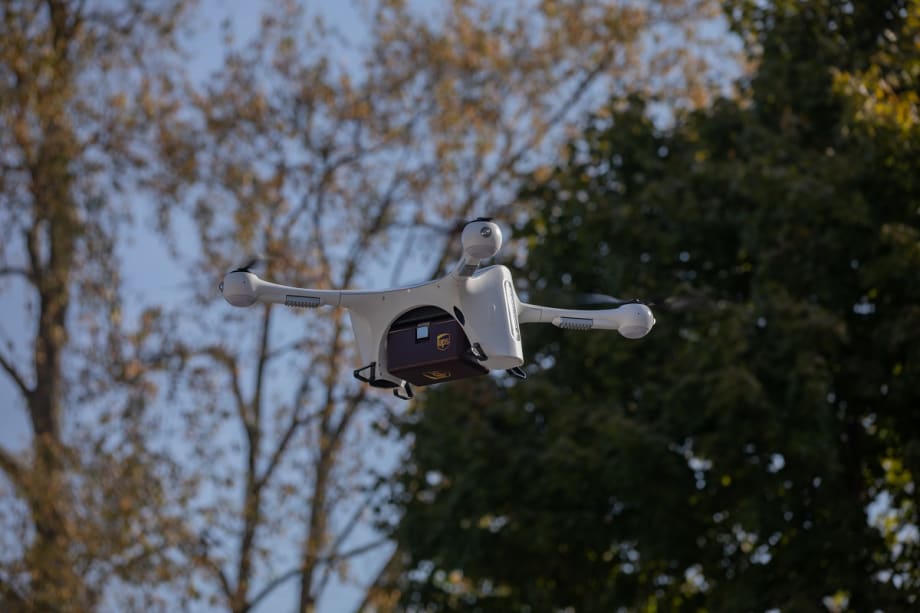
A new UPS subsidiary, UPS Flight Forward, has made the first-ever drone delivery flight under the FAA's Part 135 Standard to WakeMed’s hospital campus in Raleigh, North Carolina.
Photo courtesy UPS
4 min to read
UPS is actively exploring package delivery via drones.
A new UPS subsidiary called UPS Flight Forward has received the U.S. government’s first full Part 135 Standard certification to operate a drone airline. According to UPS, the company will initially expand its drone delivery service further to support hospital campuses around the country, and to provide solutions for customers beyond those in the healthcare industry.
UPS Flight Forward said it plans in the future to transport a variety of items for customers in many industries, and regularly fly drones beyond the operators’ visual line of sight.
The U.S. Federal Aviation Administration (FAA) awarded UPS Flight Forward a Part 135 Standard certification on September 27, 2019. The UPS subsidiary immediately launched the first drone delivery flight by any company under Part 135 Standard at WakeMed’s hospital campus in Raleigh, North Carolina. That flight, using a Matternet M2 quadcopter drone, was flown under a government exemption allowing for a “beyond visual line of sight” (BVLOS) operation, also a first in the U.S. for a regular revenue-generating delivery. UPS said it has proven the need for drone delivery in healthcare operations, where the shortest time in transit can improve efficiency and help healthcare professionals serve their patients better.
“This is history in the making, and we aren’t done yet,” said . “Our technology is opening doors for UPS and solving problems in unique ways for our customers. We will soon announce other steps to build out our infrastructure, expand services for healthcare customers and put drones to new uses in the future.”
The FAA’s Part 135 Standard certification has no limits on the size or scope of operations. It is the highest level of certification, one that no other company has attained. UPS Flight Forward’s certificate permits the company to fly an unlimited number of drones with an unlimited number of remote operators in command. This enables UPS to scale its operations to meet customer demand. Part 135 Standard also permits the drone and cargo to exceed 55 pounds and fly at night, previous restrictions governing earlier UPS flights.
“UPS Flight Forward is benefitting from our knowledge as one of the world’s leading airlines. The Flight Forward organization is building a full-scale drone operation based on the rigorous reliability, safety, and control requirements of the FAA,” said David Abney, UPS chief executive officer.
In a post on the UPS Latitudes blog, Abney expanded on the potential for drone deliveries in a fast-paced logistics environment, writing, In the future, however, drones will make it affordable to move goods directly and in smaller lots. Spare parts, critical medicines or gifts for a loved one no longer will take days to arrive. In the future, they will arrive in hours or even minutes by drone, hyperloop, your UPS driver, an autonomous vehicle with lockers — or more likely, some combination of the above.
Supply chains will become dynamic and more predictive, using advanced analytics that anticipate your needs and move products to a nearby staging area before you even order. Goods will move in real time, too — which means the supply chain never sleeps.
And drones are a part of this bright future.
“This is a big step forward in safely integrating unmanned aircraft systems into our airspace, expanding access to healthcare in North Carolina and building on the success of the national UAS Integration Pilot Program to maintain American leadership in unmanned aviation,” said U.S. Secretary of Transportation Elaine Chao.
UPS said it has established itself as a leader in unmanned aerial vehicle delivery, having tested drones for urgent commercial deliveries over water; funded and supported humanitarian deliveries in Africa; and tested non-urgent commercial residential delivery in rural areas with drones launched from a UPS package delivery car.
UPS also has provided input to government regulators responsible for establishing rules for safe drone operations in the United States. A UPS senior executive has served since 2017 as one of a select group of corporate advisors on the FAA’s drone advisory committee.
Regular and Frequent Flights
UPS Flight Forward is now forging paths to create innovative new services for customers, the company added. Part 135 Standard certification enables UPS to integrate drones into the UPS logistics network, creating potential for new applications in many industries. The company has a long-term plan with important milestones in view. These include:
Expansion of the UPS Flight Forward delivery service to new hospitals and medical campuses around the country.
Rapid build-out of ground-based, detect-and-avoid (DAA) technologies to verify drone safety, while enabling future service expansion.
Construction of a centralized operations control center.
Regular and frequent drone flights beyond the operator’s visual line of sight.
Partnerships with additional drone manufacturers to build new drones with varying cargo capacities.
Adding new services outside of the healthcare industry, including the transport of special commodities and other regulated goods.
More Fleet Management

Geotab Links Fleet Card to Vehicle Data
The new card combines fuel discounts with telematics-based purchase controls. Geotab’s analysis also points to potential savings from choosing lower-priced fuel stops.
Read More →
How MFA Helps Protect Trucking Fleets
Multi-factor authentication adds protection when passwords are stolen. Here’s how it works and where fleets should start.
Read More →
How Better Freight Data Helps Trucking Teams Get Ahead of Disruption
Trucking and logistics teams have plenty of data. The problem is getting the right information in front of the right people soon enough to act. Better-connected data can help teams spot trouble earlier and make smarter decisions before small problems become big ones.
Read More →

Trimble: Taking Artificial Intelligence in Trucking Beyond Faster Tasks
At Insight 2026, Trimble executives argued that fleets may need to redesign workflows to get more from AI as it introduced new products and enhancements. AI’s value will depend on how fleets combine automation with their people's knowledge.
Read More →
Sponsored•September 28, 2026
Build a bulletproof fleet: Uniting ELDs and dash cams for total compliance
An ELD can prove compliance, but it cannot always prove what happened on the road. Discover how uniting accurate ELD data with AI-powered dash cam video can help your fleet strengthen compliance, defend against liability, protect drivers and reduce operational costs.
Read More →
Nominations Open for HDT Emerging Leaders
Heavy Duty Trucking is looking for accomplished trucking fleet professionals under 40 who are making an impact and helping lead the industry forward.
Read More →
Why Private Fleets Are Taking More Freight
Private fleets are putting their own trucks on demanding customers and high-cost lanes as companies seek greater control over service, costs, and capacity.
Read More →
Sponsored•September 16, 2026
Color Match Smarter: Tools That Restore & Perform
For fleet managers and collision repair professionals keeping heavy-duty trucks on the road, getting the color right the first time isn't just about appearance — it's about efficiency, turnaround time, and bottom-line results. Discover how today's digital color tools are transforming the repair process from guesswork to precision.
Read More →
FMCSA Pauses Biennial-Update Enforcement Amid Motus Transition
Carriers whose updates were due on or after June 1 have more time, while FMCSA works to stabilize its new registration system and warns of phishing sites impersonating its new carrier registration system, Motus.
Read More →
Sponsored•September 14, 2026
2026 Blueprint for Countering Smarter Supply Chain Theft
Cargo theft is no longer just the cost of doing business. It's a multi-billion-dollar criminal enterprise exploiting vulnerabilities across your fleet, drivers, and supply chain.
Read More →