




Seating Matters More than You Think
Of all the points of contact a fleet has with a driver, it's seating that is a constant reminder of how much the company appreciates its workers.

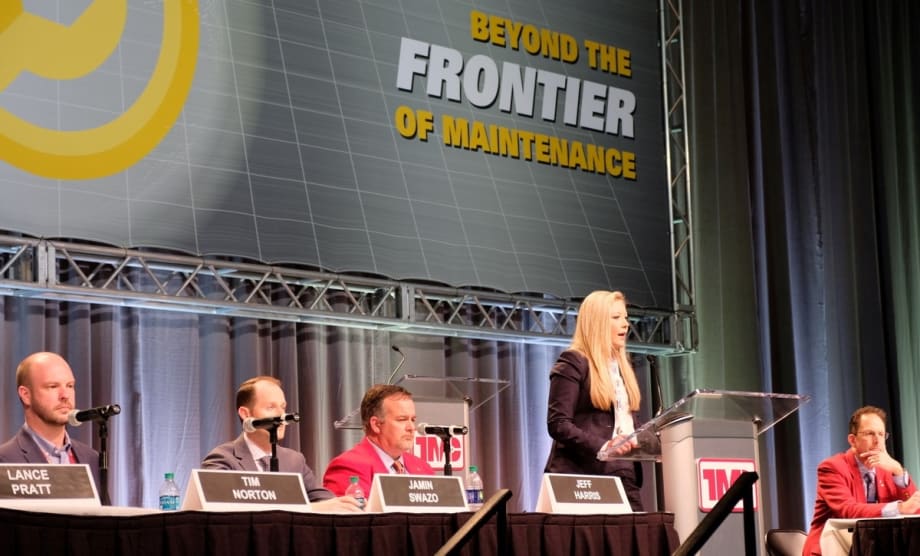
Kelly Muldoon (at podium) of Faurecia's Comfort and Wellness Solutions Div. speaking at the S.4 Cab and Controls Study Group session on spec'ing cabs and sleepers for driver comfort and safety at the Technology & Maintenance Council's Annual Meeting in Atlanta.
Phot: Jim Park
Seating has a profound impact on driver comfort, satisfaction, and ultimately safety. Of all the points of contact a fleet has with a driver, it's seating that is a constant reminder of how much the company appreciates its workers.
Do what you can with safety technology and specs like aluminum wheels and disc brakes, but drivers aren't happy when they aren't comfortable.
"Drivers have a rigorous and physically demanding job being on the road for so long, so they're looking for products and solutions that can address discomfort," said Kelly Muldoon, product marketing director for the Faurecia Comfort and Wellness Solutions Division. Faurecia is a France-based global automotive supplier dating to 1914 whose first product were seats for trams and the Paris Metro.
Muldoon's remarks came as a panelist at an S.4 Cab and Controls Study Group session aimed at looking into spec'ing cabs and sleepers for driver comfort and safety at the Technology & Maintenance Council's Annual Meeting in Atlanta.
There are not many bad seats on the market these days, but some drivers have distinct preferences for one brand or model of seat over another. As retention bonuses, slipping a seat of the driver's choosing into a cab is a pretty easy way to show a driver that their service matters. For fleet managers facing difficulty in attracting new talent and retaining the talent that they have, looking for new ways of keeping drivers comfortable and happy is a necessity.
So, how do we measure comfort? It's subjective, and that's why letting the driver choose a seating product sends the right message. But it's not just the physical aspect, like the thickness of the foam inside the seat cushion. There's something psychological about comfort as well.
Faurecia came up with a way to test drivers' responses to certain products usingelectroencephalograms to measure brain activity and responses to the situation. "That lead to the development of an aftermarket seat cover that you install on the seat after it comes out of the factory," Muldoon said.
"The cover incorporates heat, ventilation, and pneumatic massage, which is different from vibration massage," she continued. "It has inflatable bladders which we find to be more effective. There’s also a lumbar adjustment, which is one of the primary features that drivers have told us was important to them."
And there's a safety side to this as well. "Not only are you addressing physical comfort, but also safety, because of the high risk of developing blood clots from sitting for long periods of time," Muldoon said. "Drivers can't constantly be stopping, so using dynamic massage and ventilation to get the blood circulating impacts safety as well."
Muldoon said there's still a lot of room to incorporate sensor technology into the cockpit of the vehicle and especially into seats.
"You can start taking in biometric data from the driver, things like heart rate and respiration rate, and it becomes really powerful because you start to see and anticipate," she said. "For example, if the driver is becoming drowsy or stressed, Then you take that information and convert it into an action with the full system, like turning on the HVAC system if they're drowsy. Turning on the ventilation in the seat. Having more dynamic massage. All those things impact comfort, but they can also impact safety."
Who would have thought fleets could be collecting data from a seat, but apparently, it's possible. Once fleets learn to recognize patterns in driver data, they can start to make educated decisions about things that are happening in their fleet, according to Muldoon.
She said that if sensors embedded in the seat could reveal patterns in driver breathing or heart rate changes-- in effect, detecting the early onset of sleepiness-- drivers could be advised to take a break or have a nap or take some other corrective action.
"But ultimately, the way we see the future we would like to have the driver exit the vehicle feeling better than when they entered," Muldoon added. "So, it's about enhancing that onboard experience for a safer and more comfortable journey."
And it can all start with a comfortable seat.
More Drivers

Truck Drivers Need More Than Another Alert
Fleets have more visibility into truck health, safety events, and driver activity than ever. The next challenge is turning all that information into useful guidance for the person who has to decide what to do next.
Read More →
FMCSA Removes 110 Truck Driver Training Schools from Certified ELDT List
Federal regulators also are targeting more than 160 additional training providers and launching a nationwide audit of third-party CDL skills testers as part of a broader crackdown on trucking fraud.
Read More →
Hours of Service Pilot Programs: FMCSA Readies for 2027 Rollout
Two pilot programs could eventually reshape hours-of-service rules, giving truck drivers options to pause their 14-hour clock or use longer split sleeper rest periods.
Read More →
Medical Cards, English Proficiency Reshape Roadcheck Violations
Medical-card violations jumped to the top of the driver out-of-service list during CVSA’s 2026 International Roadcheck, while English-language proficiency violations appeared among the leading violations for the first time.
Read More →
Driver Trust Can Make or Break the Success of Fleet Safety Technology
New Teletrac Navman research suggests that onboarding, transparency about driver data, and positive feedback can play a significant role in how commercial drivers respond to safety and coaching technology.
Read More →
EEOC Sues KLLM Over Alleged Sex Discrimination in Driver Training
KLLM is facing a federal sex-discrimination lawsuit over policies the EEOC alleges put female truck driver trainees at a disadvantage.
Read More →
FMCSA Moves to Codify English Language Requirements for Commercial Drivers
By changing regulations on English-language proficiency requirements for commercial drivers, rather than relying on a guidance memo, the FMCSA said future administrations won't be able to walk back the Trump administration's stricter enforcement with just a memo.
Read More →
Drivers Put Western Star Trucks to the Test at Star Nation Experience
Watch to get an inside look at the Western Star trucks, technology, and community behind the Star Nation Experience 2026!
Read More →
Trump Administration Looks to Put More Veterans Behind the Wheel
The Freedom Haulers program pulls together existing and expanded programs at several federal agencies to recruit veterans to drive commercial heavy-duty trucks and cut the red tape for them to get a CDL, training, and employment.
Read More →
Putting Mack’s Command Steer to the Test
A test drive of Mack’s Command Steer active steering system evaluates how it can make truck driving easier and less tiring.
Read More →