




Daimler Nixes Platooning, Focuses on Automation
Saying the technology required to make platooning produces very limited reductions in operating cost, Daimler Truck North America has decided to pass on platooning and focus instead on advancing its position in vehicle automation.
January 8, 2019

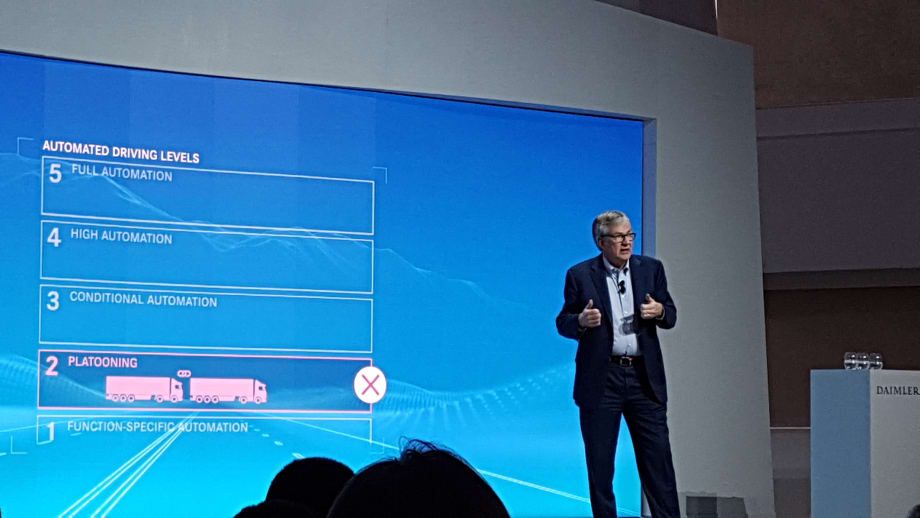
Daimler Truck and Bus chief Martin Daum talks about platooning and autonomous trucks research at CES 2019.
Photo by Jim Park
3 min to read
Saying the technology required to make platooning produces very limited reductions in operating cost, Daimler Trucks North America has decided to pass on platooning and focus instead on advancing its position in vehicle automation.
"The technology we have to put into a truck does not qualify the savings our customers will see with automation," said Martin Daum, the head of Daimler’s truck and bus divisions. "We will continue with the projects where we have ongoing commitments, but we will not be starting another venture project on platooning."
Speaking at a press event in Las Vegas preceding the CES electronics show, where DTNA announced significant advancements in Level 2 autonomous vehicle technology, Daum said the fuel economy gains are modest at best, considering the technical resources required to make it happen, and that Daimler's dollars would be better spent developing systems for Level 4 automation.
According to the Office of Energy Efficiency & Renewable Energy, platooning involves the use of vehicle-to-vehicle communications and sensors, such as cameras and radar, to virtually connect two or more trucks together in a convoy. The virtual link enables all of the vehicles in the platoon to communicate with each other, allowing them to automatically accelerate together, brake together, and enables them to follow each other at a closer distance than is typically possible with unlinked trucks. Studies have shown that 65% of current long-haul truck miles could potentially be platooned, reducing total truck fuel consumption by 4%.
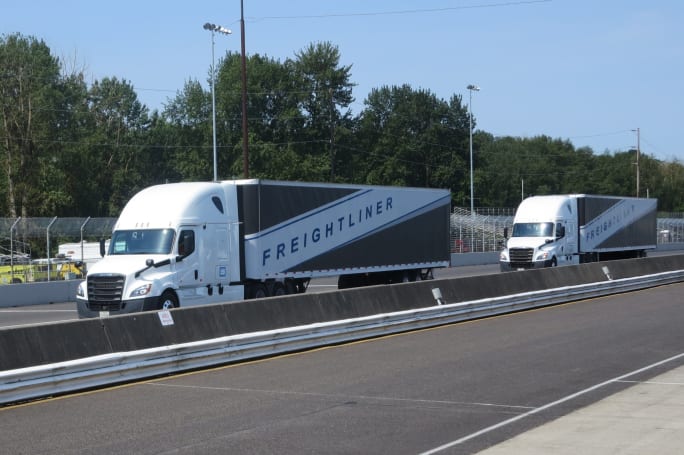
Daimler Trucks North America demonstrated platooning technology at last summer's Capital Market and Technology Day.
Photo by Deborah Lockridge
Even though Daimler's testing appears to show the fuel economy doesn't live up to that promise, the upside to the company's investment in platooning was a greater understanding of what will be required to make driverless trucks a reality.
"Some of you may remember me saying, back in 2016, that I was very skeptical about the future of driverless trucks," said Daum. "Well, we have learned a lot over the past three years. We are farther ahead than we were in those days, and we can now more clearly see the future. Level 4 autonomy is coming, not today necessarily, but in the years to come."
Daimler's pre-CES announcement claimed it is now the first North American truck maker to offer an SAE Level 2 automated truck to its customers. Level 2 is when the vehicle can take over both acceleration/deceleration and steering in certain scenarios, but the driver retains in control of the vehicle at all times.
With the New Cascadia and Level 2 automation, the truck can brake and bring the vehicle to a full stop in emergency situations with the recently announced Detroit Assurance 5.0 and Adaptive Cruise Control. Active Lane Assist can counter-steer to prevent lane drift by inattentive drivers. These features were first unveiled during IAA Commercial Vehicles Show in September on Daimler’s Actros trucks.
Reiterating what Daimler officials said about automation last summer, Daum noted that Daimler will skip over Level 3 automation, called conditional automation. This is when a vehicle can make decisions for itself, such as overtaking slower-moving vehicles, but a human driver would have to be prepared to intervene if the system is unable to execute a task or the system fails.
There is still a ground to cover before Level 4 trucks are plying the highways. Daum mentioned a 10-year window, but he did not commit to any timeframe. He did, however, indicate that it might be sooner than many think.
"We will have a Level 4 truck on the road in the United States this year. Stay tuned."
More Fuel Smarts

California Bill Could Shed Light on Electric Truck Prices
Why do battery-electric Class 8 trucks remain so expensive? A California bill headed to Gov. Gavin Newsom would give fleets and state agencies more visibility into what manufacturers charge.
Read More →
Detroit Opens Orders for EPA 2027 Engines
Detroit isn’t starting from scratch to meet EPA 2027 diesel emissions standards. Its Gen 6 DD13 and DD15 engines keep much of today’s platform while updating the fuel and aftertreatment systems.
Read More →
Zero-Emission Truck Corridor Planned for West Coast
California, Oregon, Washington, British Columbia and Baja California are coordinating plans for truck charging and hydrogen fueling from Canada to Mexico.
Read More →
A Closer Look at Kenworth’s Electric T880E Vocational Truck [Video]
Learn more about Kenworth's T880E battery-electric vocational truck at the Paccar Technical Center, including its range, applications, upfitting considerations, and PTO options, in this HDT Spotlight video.
Read More →
Kenworth T880E Brings EV Power to Vocational Trucks
A closer look at the Kenworth T880E’s range, charging, powertrain and upfit options — and where fleets are showing the most interest.
Read More →
Jennie Abarca Is Proving Electric Trucks Can Do the Job
HDT Truck Fleet Innovator Jennie Abarca is building confidence in fleet electrification one load at a time while openly sharing the challenges she encounters along the way as a small-fleet owner.
Read More →
Cummins Adjusts 2027 Engine Rollout After EPA Proposal
The engine maker will gradually introduce its new Model Year 2027 diesel engines while continuing to offer current models during the transition, citing the EPA's proposed emissions rule changes.
Read More →
EPA Proposal Could Ease 2027 Truck Costs and Buying Uncertainty
The proposal doesn't change the tougher NOx standard, but it would revise key implementation requirements that manufacturers say have driven up costs and complicated fleet purchasing decisions.
Read More →
Cummins, Paccar Ease DEF Derates After EPA Guidance
Updated diesel engine software gives truck operators more time to address emissions-system issues while staying compliant with EPA emissions standards.
Read More →
Maintenance in the Messy Middle Part 3: Biodiesel
Biodiesel can reduce emissions, improve fuel-system lubricity and use existing diesel infrastructure. But NACFE’s Messy Middle maintenance report says fleets must actively manage storage, cold-weather operation, filters and oil drain intervals to avoid problems.
Read More →