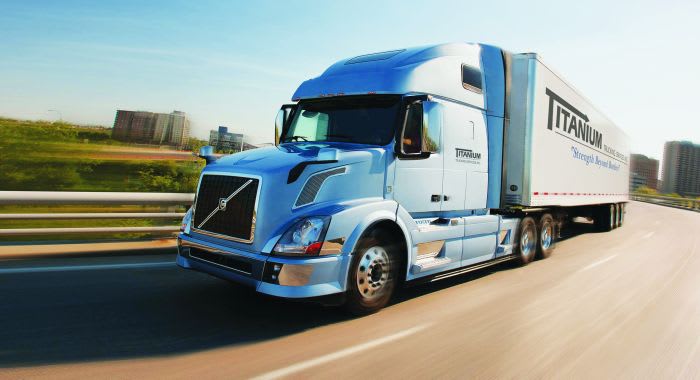
Titanium Transportation Keeps an End-To-End Eye on Trailers
In an effort to boost efficiencies and increase equipment utilization in its growing fleet, Ontario-based Titanium Transportation decided to modernize the way it tracks its more than 1,200 trailers.
Titanium Transportation has adopted the Blackberry Radar, an end-to-end asset management system that provides more benefits than simply tracking trailers on the move.
3 min to read
Titanium Transportation has adopted the Blackberry Radar, an end-to-end asset management system that provides more benefits than simply tracking trailers on the move.
In an effort to boost efficiencies and increase equipment utilization in its growing fleet, Ontario-based Titanium Transportation decided to modernize the way it tracks its more than 1,200 trailers. Add to that a desire to increase customer and driver satisfaction and improve the company’s overall return on investment, and you have a very strong argument for trying a new asset-tracking technology from an unexpected supplier.
Ad Loading...
Once known as an innovative smartphone provider, about two years ago BlackBerry began studying how it could leverage its technology assets to improve the operational efficiency of the cargo transportation and logistics industry. The result was the Radar, an end-to-end asset management system.
“We found BlackBerry Radar very compelling, because it has capabilities beyond traditional trailer tracking that we look forward to using in the future as we expand our use of the solution,” says Marilyn Daniel, Titanium’s chief operating officer. “We have already been able to save driver time by locating empty trailers on customer property.
Ad Loading...
“With BlackBerry Radar, we know exactly where our trailers are on our yards and on our customer’s yards,” Daniel says. “When you are dealing with thousands of trailers in a yard, being able to pinpoint the trailer location immediately saves us a lot of time getting drivers and loads on and off the road quickly.”
And while the system was not purchased as a theft deterrent, Daniel appreciates the ability to secure the status and location of each trailer. The transmitted data is encrypted and the system then authenticates the fleet’s devices and cloud endpoints before sending anything up to the cloud. This protects both company and customer data.
The device might also allow the fleet to cut costs through equipment reduction. Giving fleets the ability to reduce their trailer pools by 7-12% could result in more immediate return on investment and more efficient operations, according to the maker.
The device can also deliver instant alerts to increase the chance that theft can be detected and prevented or recovered; provide regular temperature measurements that exceed regulatory standards; track miles driven to manage trailer maintenance schedules; detect door open/close events; and measure cargo status. This is suitable for less-than-truckload scenarios, fleet leasing, and enhanced delivery management analysis.
“For example, a shipper of perishable goods will benefit from the ability to monitor temperature and humidity in near real-time and get alerts, based on thresholds being exceeded, prior to any loss in cargo quality,” explains Steve West, senior director of business development at BlackBerry Technology Solutions. “An intermodal shipper can increase flow by identifying choke points, and a trailer lessor can benefit by the ability to locate equipment instantly to ensure the customer is using as contracted.”
Ad Loading...
With real-time data that goes beyond tracking, Titanium is able to understand whether a trailer is currently empty or full, which helps Daniel and her team manage schedules more efficiently and get more use out of their trailers.
“Two main benefits of using BlackBerry Radar are its cloud-based analytics dashboard, which quickly and easily produces reports for all levels of management within our company,” says Daniel. “This end-to-end solution delivers business insights which are a great advantage to running our business more profitably.”
Fleet Snapshot
Who: Titanium Transportation Group Inc.
Where: Bolton, Ontario, Canada
Fleet: More than 400 power units and 1,300 trailers, including dry vans, flatbeds, step-decks, and heavy axle trailers.
Operations: Titanium moves truckload and LTL freight all over North America.
Fun Fact: Titanium Logistics’ first truck was a straight truck in 2005.
Challenge: Looking to use technology to manage costs, boost efficiencies, increase fleet utilization
For fleet managers and collision repair professionals keeping heavy-duty trucks on the road, getting the color right the first time isn't just about appearance — it's about efficiency, turnaround time, and bottom-line results. Discover how today's digital color tools are transforming the repair process from guesswork to precision.
Carriers whose updates were due on or after June 1 have more time, while FMCSA works to stabilize its new registration system and warns of phishing sites impersonating its new carrier registration system, Motus.
Cargo theft is no longer just the cost of doing business. It's a multi-billion-dollar criminal enterprise exploiting vulnerabilities across your fleet, drivers, and supply chain.
Explore how telematics help refrigerated fleets improve visibility, uptime, efficiency, compliance, and cargo protection across connected cold chain operations.
Escalating U.S.-Canada tariffs could disrupt cross-border freight, reduce truck volumes, raise costs, and create new uncertainty for carriers on both sides of the border.
The American Transportation Research Institute wants to know what's worrying trucking fleet managers, drivers, and other stakeholders in its annual Industry Issues survey.
HDT Truck Fleet Innovator Adam Buttgenbach helped PepsiCo build one of North America’s largest EV fleets by focusing on where electric trucks make operational sense.