



Related:
Amazon Founder Invests in Launch of On-Demand Trucking Service
Uber, HOS Data Seen as Ways to Address Capacity Crunch
How Changes in Retailing are Driving Changes in Logistics
 MENU
MENU SEARCH
Despite all the talk of the “uberization” of trucking and tons of venture capital poured into startups that promise cheap same-day delivery, companies like FedEx and UPS aren’t likely going anywhere soon — but Amazon has been and will continue to be disruptive to the logistics business, according to Richard “Dick” Metzler, chief marketing officer of uShip.
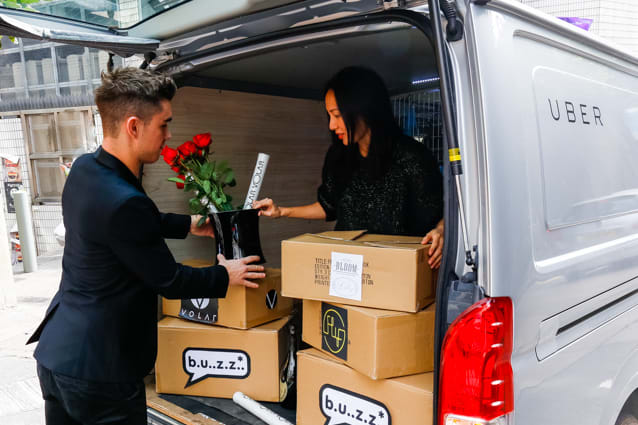
Uber, of course, is part of the move to the "Uber-ization" of freight too.

Uber, of course, is part of the move to the "Uber-ization" of freight too.
Despite all the talk of the “Uberization” of trucking and tons of venture capital poured into startups that promise cheap same-day delivery, companies like FedEx and UPS aren’t likely going anywhere soon — but Amazon has been and will continue to be disruptive to the logistics business, according to Richard “Dick” Metzler, chief marketing officer of uShip.
In a conference call hosted by the investment firm Stifel, Metzler looked at the potential impact of the rapidly evolving “sharing economy” in freight transportation and logistics. Although he now works for uShip, one of the first online freight shipping marketplaces, Metzler has a long career at traditional logistics companies such as FedEx Logistics and XPO Logistics.
Metzler’s definition of the sharing economy is where on-demand companies aggregate demand online but fulfill that demand through offline services. The classic example are on-demand ride-sharing services such as Uber and Lyft, where you use an app to get a ride-share instead of a traditional taxi service. If you’ve bought items directly from individuals online, bought tickets from an online reseller, used online home-sharing services like AirB2B, those are all examples of the sharing economy.
Today, we are seeing the “Uber of everything,” he said, from companies such as Amazon, Google and Walmart to less-well-known operations such as Deliv, TaskRabbit, and Shyp. You can get a hot meal, even a private jet. “You name it, someone has Uberized it.”
In the past couple of years, a lot of venture capital has poured into dozens of startups that aim to take the low-tech business of arranging cargo shipments online. Metzler called it the “fear of missing out” effect and said most of these companies are unlikely to get second rounds of financing.
Metzler pointed out that the “sharing economy” and the “on-demand” economy are not necessarily one and the same, although the two often overlap.
Uber and Amazon both tapped into “latent demand” — a demand for something that consumers sort of didn’t even know they had until someone pointed out it was possible.
“I think Amazon Prime will go down in history as one of the most brilliant combinations of marketing and logistics ever,” Metzler said. “They created the need for speed that leaves others trying to catch up.”
The e-commerce giant Amazon, with its Amazon Prime subscription service that includes free two-day shipping, has helped make the notion of free, fast shipping “table stakes” Metzler said. He questioned how much consumers really want same-day or even one-hour delivery from their e-commerce purchases — or if they want it enough to pay enough for delivery companies to be able to turn a profit doing it.
Metzler cited a "Future of Retail” study that found free shipping was two times more important to consumers than same-day shipping — 88% vs. 49%. Those who shopped online more frequently, however, had higher expectations for delivery speed.
Another survey found that in general, when shipping is free, people don’t expect to get it as quickly — but Amazon Prime members are not as patient. When paying for shipping, people expect to get it faster.
The problem facing companies offering on-demand logistics, and the reason he believes many start-ups won’t make it, are low route density and low revenue per stop, Metzler said.
How does on-demand shipping work? Sort of like Uber. A customer orders shoes online, the order is routed to the nearest stores that sell that style. A driver nearby accepts the order via a smartphone app, goes to the store, buys the shoes, then drives to the customer location, maybe for a $5 delivery charge.
It’s just costs too much to the provider to offer same-day or one-hour delivery. He offered the case study of one company, Bloom, that was struggling to survive due to one-hour delivery cost economics. They cut service back to next day, didn’t lose business and cut their costs by 25%.
“When it comes to delivering stuff there are only two ways to be productive,” Metzler said. One is massive route density, like FedEx, UPS, or Amazon. Or you get much higher revenue per stop, like Cargomatic or uShip. Most of the on demand startups have neither, he contends.
“Amazon built a massive infrastructure and almost has an unfair advantage over every other retailer out there,” Metzler said. “There doesn’t seem to be anybody in the e-commerce world that’s happy with their e-commerce channel because they’re trying to out-Amazon Amazon.”
On the other hand, he said, although Amazon has been investing in planes, trailers and even trucks of its own, “I also think they have a long way to go to compete with UPS and FedEx.”
Nevertheless, he said, “If I was still sitting in Memphis [at FedEx], I would have a nuclear plan on the shelf just in case – and I’m sure they do.”
When the dust settles what are the likely outcome? Metzler outlined five distinct possibilities.
The Amazon effect. Buyers come to expect 1-2 hour service via a high-level Amazon Prime subscription level and can’t live without it.
Reality sets in. Delivery times become more reasonable and largely free, consistent with consumer demands and expectation.
Go big and go home. Large format online e commerce is beginning to grow at a runaway rate — things like gun safes, large appliances, pieces of furniture. Right now consumers essentially have “white glove” service where such items are delivered and installed, or what Metzler dubbed “brown glove,” with LTLs delivering items. He believes we will see more cost-effective solutions in between these two.
Bundle of joy. Carriers and consumers collaborate to have everything they ordered this week delivered this weekend, instead of worrying about being home for a delivery window during the week.
Drones and driverless trucks. This is not a question of if, but when and how, he said. It’s easy to get your mind around drones for super urgent items like organ transplants. It’s harder to imagine how a fleet of Amazon drones will work in the real world, but “I think there will be a role for [drones.]” And the same with driverless trucks.

For fleet managers and collision repair professionals keeping heavy-duty trucks on the road, getting the color right the first time isn't just about appearance — it's about efficiency, turnaround time, and bottom-line results. Discover how today's digital color tools are transforming the repair process from guesswork to precision.
Read More →
Carriers whose updates were due on or after June 1 have more time, while FMCSA works to stabilize its new registration system and warns of phishing sites impersonating its new carrier registration system, Motus.
Read More →
Cargo theft is no longer just the cost of doing business. It's a multi-billion-dollar criminal enterprise exploiting vulnerabilities across your fleet, drivers, and supply chain.
Read More →
Explore how telematics help refrigerated fleets improve visibility, uptime, efficiency, compliance, and cargo protection across connected cold chain operations.
Read More →
Escalating U.S.-Canada tariffs could disrupt cross-border freight, reduce truck volumes, raise costs, and create new uncertainty for carriers on both sides of the border.
Read More →
The American Transportation Research Institute wants to know what's worrying trucking fleet managers, drivers, and other stakeholders in its annual Industry Issues survey.
Read More →
ATA President and CEO Chris Spear abruptly left his job at the association on August 21, at a pivotal time for the trucking industry.
Read More →
Public Wi-Fi can expose truck drivers and fleets to credential theft, malware, and other cyber threats. Here’s how to reduce the risk on the road.
Read More →
HDT Truck Fleet Innovator Nicky Cupp turns everyday pain points at Fraley & Schilling into opportunities for better technology and smarter processes.
Read More →
HDT Truck Fleet Innovator Adam Buttgenbach helped PepsiCo build one of North America’s largest EV fleets by focusing on where electric trucks make operational sense.
Read More →
