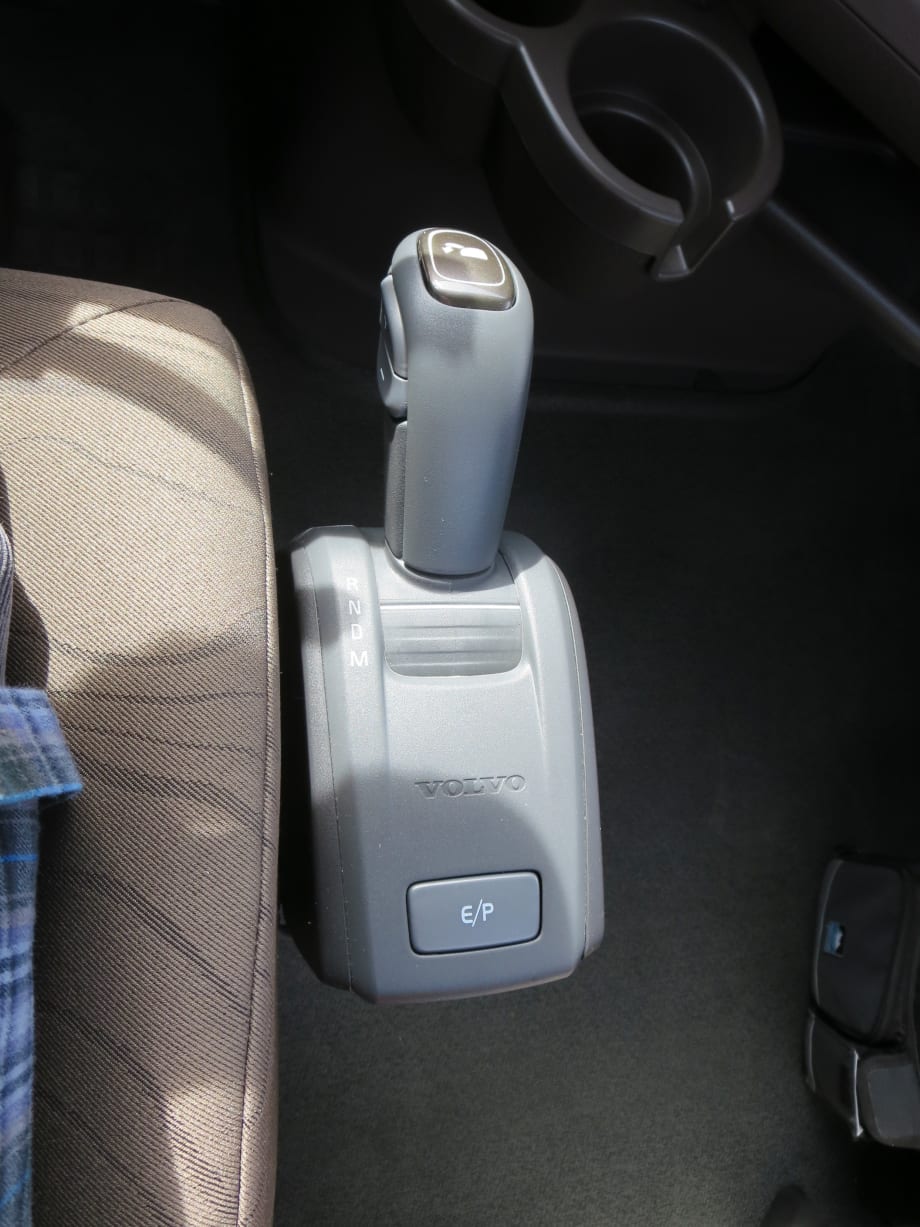
I-Shift's selector does a lot of things, but it won't prompt an upshift to 12th when its controls know that the rig is heavily loaded. Photo:Tom Berg
4 min to read
Photo via Volvo Trucks
Direct drive or overdrive? That’s a years-old question among truck operators concerned with spec’ing transmissions: Should top gear be a direct 1 to 1 ratio, where the output shaft spins at the same speed as the driveshaft with little friction penalty, or a 0.85-or-so overdrive, where the driveshaft spins a little slower, lowering engine cruise speed but suffering a bit of efficiency loss as the extra gear-set churns through lube oil?
Ad Loading...
Sage managers sometimes choose both with a multi-speed manual box where the very top gear is reserved for running empty or with light loads, and the next lower ratio is used for pulling heavy loads. The concept is not new but Volvo Trucks has come up with a new form of execution with its XE-Adaptive Gearing product, announced in August. On Tuesday, Volvo demonstrated it to reporters at its plant in Dublin, Va.
Ad Loading...
Adaptive Gearing is an offshoot of the earlier Extra Efficiency specification, which uses "fast" driveline ratios and electronic controls to “downspeed” the engine and save fuel. Adaptive Gearing doesn’t rely on a driver to remember to choose the correct gear; it’s all automatic.
I-Shift's selector does a lot of things, but it won't prompt an upshift to 12th when its controls know that the rig is heavily loaded. Photo:Tom Berg
The basic component is Volvo’s I-Shift automated mechanical transmission, whose 12th gear is a 0.78 to 1 "super" overdrive while 11th gear is 1 to 1 direct, said Volvo’s product manager for drivetrains, John Moore. Axle ratios are 2.64 to 1 with a D11 diesel and 2.47 with a D13. The other factor in driveline gearing is tire and wheel size, and two demo tractors ran on popular 22.5-inchers.
A sensor in the tandem’s air-ride suspension tells the I-Shift's electronic controls that the load on the rear axles, and therefore in the entire trailer, is heavy enough to lock out the top gear. Once on the highway, the tractor then runs with the gearbox in 11th-direct, where the engine is better able to pull the load and the transmission doesn’t waste fuel “hunting” for the better gear as terrain and headwinds change. Overdrive is never used, even if the driver tries to force an upshift.
The “load trigger” points vary with the two engines, Moore explained. For a D11-powered tractor with the slower (numerically higher) ratio, the factory-set threshold is 68,000 pounds gross combination weight, or a king pin load of about 19,800 pounds. For a D13-engined tractor with the faster (numerically lower) ratio, the load point is 55,000 pounds GCW with an estimated king pin load of 14,000 pounds.
The VNL demos included a D13-powered sleeper-cab hitched to a flatbed stacked with concrete blocks. I drove it first, and noted that its I-Shift did as Moore described: At a 65-mph cruising speed on nearby Interstate 81, the I-Shift stayed in 11th-direct with the engine revving at 1,370 rpm, and thumbing the upshift button on the paddle-handle selector had no effect. Locking out overdrive protects the engine from lugging too low under load.
Ad Loading...
VNL daycab towing an empty flatbed (left) ran in 12th-OD while cruising, but sleepercab with the loaded trailer stayed in 11th-direct. Photo:Tom Berg
Driving the second rig, a VNL daycab towing an empty flatbed, showed that Adaptive Gearing’s sensor detected the no-load situation on the tandem and I-Shift’s controls unlocked 12th-OD. It kicked in smoothly in at 65 mph where the engine loafed at 1,069 rpm and 1,151 rpm at 70 mph, according to Moore’s calculations; the tachometer needle, of course, was less precise. The upshift was at a seemingly high road speed because of the 2.64 axle ratio, which allows the engine to downspeed whether in 11th or 12th gear.
I-Shift will downshift as needed, or as road speed drops; as we drifted onto an exit ramp from I-81, engine revs fell way down to 800 before the tranny went to 11th, and further down as I braked for a stop sign. I-Shift automatically downshifts to raise revs and take advantage of the engine brake, and does so aggressively if the engine brake’s control stalk is pulled all the way down. Under power, comparatively high torque courses through the driveline, which is accordingly beefed up. With dual-torque engine ratings, torque is cut by 200 rpm in the lower seven ratios.
With an XE-only spec and 22.5-inch rubber, the axle ratio would also be 2.64 and the engine cruises at a still-low 1,150 rpm at 65 mph. This allows up- and downshifting between 11th and 12th, said Moore. Compared to XE only, Adaptive Gearing can save up to 1% in fuel while running in 11th-direct and 2.75% while in 12th-overdrive.
The best application for Adaptive Gearing is bulk materials hauling where flatbeds and dry or liquid tankers consistently go out loaded and return home empty, Moore said. This best uses the direct-drive/overdrive capability. It’s especially good when encountering headwinds. Freight hauling in vans or reefers is not a proper application if most miles are loaded.
XE-Adaptive Gearing will be optional in January in VNL and VNM models, and only with Volvo D11 and D13 engines mated to an I-Shift. It’ll be approved for gross combination weights of up to 80,000 pounds.
Hydrogen combustion engine trucks will be especially suitable over longer distances and in regions where there is limited charging infrastructure or time for recharging of battery-electric trucks, according to the company.
Trucking operators are slowing speeds, cutting empty miles, and declining unprofitable freight as diesel costs continue to rise due to conflict in the Middle East.
New guidance allows engine makers to replace problematic DEF sensors with NOx-based systems, aiming to reduce unnecessary derates and downtime caused by failures in the sensors designed to monitor diesel exhaust fluid on trucks.
Artificial intelligence, the software-defined vehicle, telematics, autonomous trucks, electric trucks and alternative fuels, and more in this HDT Talks Trucking interview
The company’s expanded EPEQ ecosystem includes flexible solar panels, lithium batteries, hydraulic power systems, and a portable fast charger for electric trucks.
Listen as Mike Roeth of the North American Council for Freight Efficiency shares insights into battery-electric trucks, natural gas, biofuels, and clean diesel on this episode of HDT Talks Trucking.