




Safety & Compliance: Using a Simulator in Your Safety Program
Although driving simulators have been around for a long time, the current technology is more sophisticated, takes up less space and more affordable.

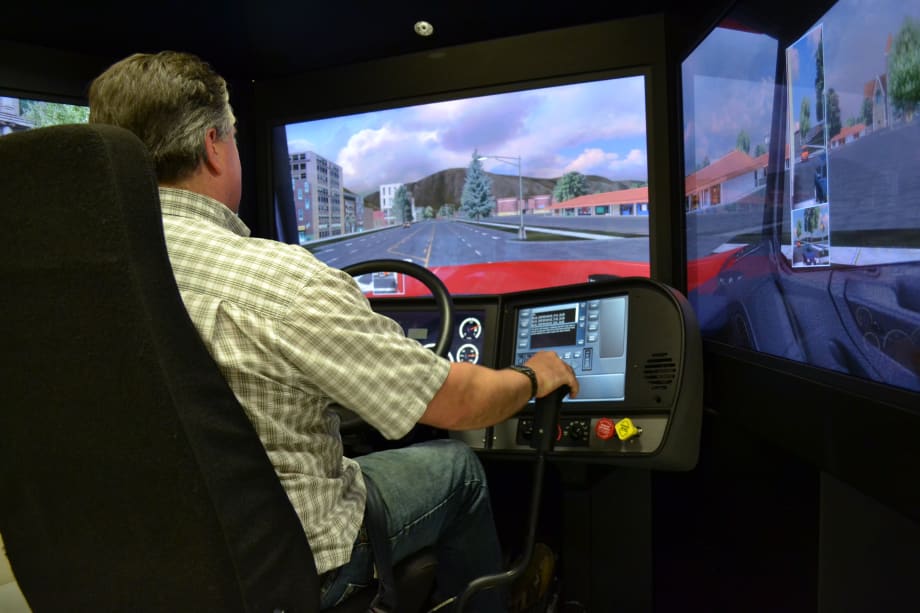
Photo: DriveWise
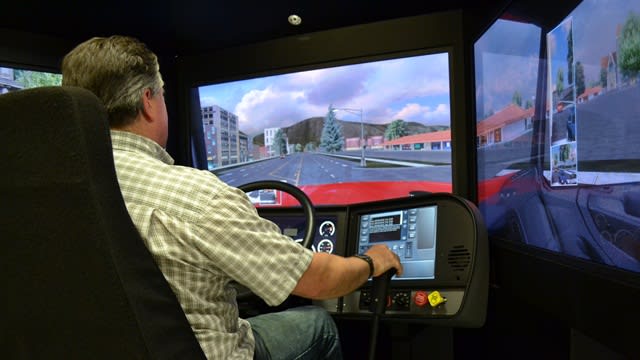
Photo: DriveWise
Less than a year after adding driver simulators to supplement its extensive driver training program, UPS saw a 38% reduction in crashes. And they did it without using a huge full-size truck cab simulator that takes up an entire room.
Driving simulators have been around for a long time. The technology today, however, is more sophisticated, takes up less space and is more affordable.
Historically, simulation has been used when the “cost” of failure is unacceptable, either in terms of lives or equipment — the military or police, for instance, and with high-value assets such as airlines and spacecraft.
Historically, it’s been a big investment, requiring a dedicated room, proprietary hardware and software that’s complex to operate and support. Simulators used to be custom-built for each customer, making changes and updates expensive and time-consuming.
“Think about if you had Apple build you a phone as a custom project, what that would cost,” explained Bob Davis, CEO of Virtual Driver Interactive, during a session at this summer’s Fleet Safety Conference. “But since you buy it as a product, you can take advantage of all those economies of scale.”
The same thing is happening in the world of simulators. The cost is dropping, the quality of the user experience is improving, and you don’t need a whole room anymore. In fact, there are even portable options that make sense for some types of training, which is what UPS used in its program.
At the same time, increased computing power allows for more realistic simulations, says Mike Speers, manager of business development for DriveWise Canada, which uses simulators in its training programs for fleets. “The new image generation cards and computing power enables for crisper, cleaner graphics and the ability to simulate more complex traffic situations.”
Simulation experts emphasize that simulators do not replace real, behind-the-wheel, on-the-road training. However, there are some things simulators can do better than the real thing.
Teaching skills
Simulators allow you to train drivers on situations you can’t reliably replicate and/or are too dangerous to train in real life — a steer tire blow-out, for instance, or hazardous weather conditions.
“One thing that differentiates simulation training from other training models is the fact that during the exercises, the instructor can focus solely on coaching, unlike in-vehicle training where the safety of the student, the instructor and other road users is the No. 1 priority,” says Speers.
In addition, he says, simulators allow for standardized training.
“With the simulator, every driver’s experience is a common one,” Speers says. “If training is done solely in-vehicle, one driver’s experience could involve rain or snow, where another’s could have perfect conditions. This makes it hard to objectively gauge a driver’s skill level or instruct them.”
For instance, Remi Quimper, president of Virage Simulation, notes, “You can have a vehicle coming to an intersection at the right moment to create a potential conflict and see how your driver will react to that,” for better or for worse. Every driver can experience the same scenario.
The ability of simulators to provide another perspective also can be helpful in training skills such as backing, says VDI’s Davis. An inset map with a birds-eye view can help a driver learn exactly what happens to that trailer in response to his or her actions.
For new drivers, simulators are an excellent way for them to practice shifting a manual transmission properly. Virage, for instance, has a simulator where improper gear synchronization results in realistic jerking on the lever and refusal to shift into gear. Using a simulator to provide the repetitious sort of practice needed to master shifting allows training programs to devote more instructional time to more advanced safety training, either in the simulator or in the truck.

Less than a year after adding driver simulators to supplement its extensive driver training program, UPS saw a 38% reduction in crashes.
Better decision-making
Virage’s Quimper says what may be even more important than teaching drivers skills is using simulators to help train better decision-making skills to keep them out of hazardous situations in the first place.
“We can teach recovery from a skid, but I’m not sure that’s the right thing to do,” he says. “You may think you can get into that situation and recover. But you don’t know how slippery it could be in the next curve. What we have to teach is how to prevent these things, how to steer so we don’t get into a skid.”
Schneider National discovered that despite doing remedial training with drivers who had been in an accident, those drivers kept getting into crashes, explained Alan Weisinger, director of driver training, at the 2013 Fleet Safety Conference.
So the fleet started testing drivers after they had been in a crash, using the driver simulators Schneider has in each of its 20 training sites. What they found, he said, is that “90% of our drivers do not have a skills issue. They had a behavior issue.”
So now, instead of a right-turn crash resulting in right-turn training, for instance, the driver comes in for an assessment using the simulator, then goes through a computer-based decision-making training module based on the results of that assessment.
Although Schneider has led the industry in its use of large, sophisticated simulators, you don’t necessarily need a full-motion, full-field-of-view simulator to help teach decision-making skills, according to Virtual Driver Interactive, which worked with UPS on its driver training program.
“When teaching fleet drivers, it’s all about the decisions you make. It’s less about the [vehicle] handling,” Davis says. “No simulator is going to replace the driver’s knowledge of being in the actual truck.”
Efficiency
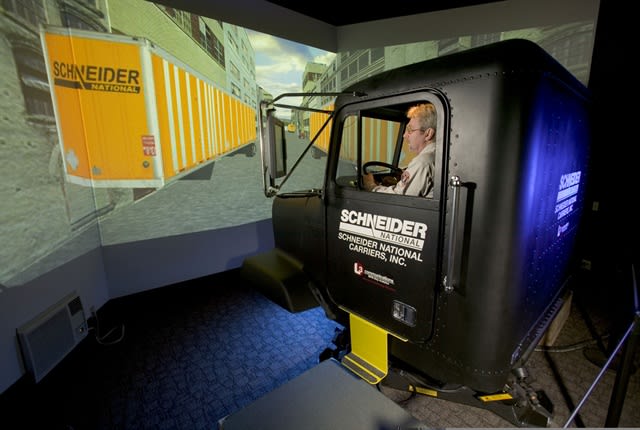
Today, you don’t have to devote a whole room to a full-size cab simulator, like this one at Schneider in 2006.
Simulators, like trucks, aren’t cheap. On one end of the scale, you can get computer-based interactive instruction for less than $10,000, according to Speers. At the other end of the scale are the full-cab, full-motion platforms that can run up to $500,000. The most common are high-fidelity, multi-screen platforms, which run from about $100,000 to $150,000 depending on options.
Just as with trucks, the key is to look at the cost of acquisition and operation vs. the benefits achieved.
Simulators are cheaper to operate than trucks. They don’t need fuel or insurance; they don’t put wear and tear on tires and components; and you don’t need to worry about possibly damaging the truck while training the driver. Virage Simulation estimates simulators can be operated at less than 15 cents per hour.
In addition, many of today’s simulators feature an open design that allows a small group to gather around and observe the training.
“One can train up to four drivers at the same time in a simulation system, which is impossible on the road,” says Greg Collins, contracts/marketing manager for Doron Precision Systems. “That’s a serious cut in fuel consumption.”
“We often do group training of four to eight people around the simulator, having a discussion about proper techniques and proper behavior,” agrees Virage’s Quimper. “Whether or not you are the one driving, it is the ideas that are being demonstrated that the group is learning, too.”
Related:
WebXclusive: 7 Ways to Get the Most Out of A Driver Simulator Program
More Drivers

From One Generation to the Next: How Mentorship Builds Safer Truck Drivers
After three decades in trucking, Harold Perry shares what he's learned about driver safety, mentorship, and helping the next generation build confidence behind the wheel.
Read More →
Truck Drivers Need More Than Another Alert
Fleets have more visibility into truck health, safety events, and driver activity than ever. The next challenge is turning all that information into useful guidance for the person who has to decide what to do next.
Read More →
FMCSA Removes 110 Truck Driver Training Schools from Certified ELDT List
Federal regulators also are targeting more than 160 additional training providers and launching a nationwide audit of third-party CDL skills testers as part of a broader crackdown on trucking fraud.
Read More →
Hours of Service Pilot Programs: FMCSA Readies for 2027 Rollout
Two pilot programs could eventually reshape hours-of-service rules, giving truck drivers options to pause their 14-hour clock or use longer split sleeper rest periods.
Read More →
Medical Cards, English Proficiency Reshape Roadcheck Violations
Medical-card violations jumped to the top of the driver out-of-service list during CVSA’s 2026 International Roadcheck, while English-language proficiency violations appeared among the leading violations for the first time.
Read More →
Driver Trust Can Make or Break the Success of Fleet Safety Technology
New Teletrac Navman research suggests that onboarding, transparency about driver data, and positive feedback can play a significant role in how commercial drivers respond to safety and coaching technology.
Read More →
EEOC Sues KLLM Over Alleged Sex Discrimination in Driver Training
KLLM is facing a federal sex-discrimination lawsuit over policies the EEOC alleges put female truck driver trainees at a disadvantage.
Read More →
FMCSA Moves to Codify English Language Requirements for Commercial Drivers
By changing regulations on English-language proficiency requirements for commercial drivers, rather than relying on a guidance memo, the FMCSA said future administrations won't be able to walk back the Trump administration's stricter enforcement with just a memo.
Read More →
Drivers Put Western Star Trucks to the Test at Star Nation Experience
Watch to get an inside look at the Western Star trucks, technology, and community behind the Star Nation Experience 2026!
Read More →
Trump Administration Looks to Put More Veterans Behind the Wheel
The Freedom Haulers program pulls together existing and expanded programs at several federal agencies to recruit veterans to drive commercial heavy-duty trucks and cut the red tape for them to get a CDL, training, and employment.
Read More →