




Test Drive: Volvo's Torque Magic
What a difference a little extra torque makes. Jim Park had the privilege of being one of the first drivers outside of test fleets to put a new fuel economy and performance concept from Volvo through its paces.

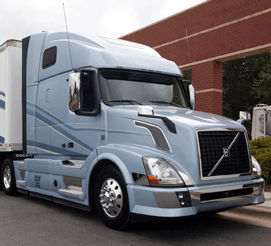
Volvo's new XE13 and Eco-Torque powertrain packages will make a big difference to drivers in ways they will never know — and a few they will.
Photo: Jim Park
What a difference a little extra engine torque makes.
I recently had the privilege of being one of the first drivers outside of test fleets to put a new fuel economy and performance concept from Volvo through its paces.
It uses no add-ons, no new hardware, nothing experimental, and won't require a major additional investment.
Actually, Volvo had two new powertrain packages for us to try on our test drive out of Greensboro, N.C.: Eco-Torque, which we'll get to shortly, and the one that gets star billing, called XE13 (XE for exceptional efficiency).
Ed Saxman, Volvo Trucks' powertrain marketing manager, says the XE13 concept is something between evolutionary and revolutionary. Simply put, it's a software modification built on the gear fast, run slow principle. Volvo calls it "downspeeding," running at a lower engine rpm at a given vehicle speed.
In this case, XE13 allows the engine to cruise at just 1,150 rpm at 65 mph, which Volvo claims improves fuel economy by about 3%, or roughly 0.2 mpg, compared to running about 200 rpm higher, which is typical with most engines today.
The revolutionary part is there's no degradation in performance or drivability at low rpm.
Balancing Torque and Horsepower
Engine speed at cruise is a delicate balancing act. You want a good blend of torque and horsepower at cruise speed, torque being found at the lower end of the engine operating range, horsepower at the higher end. Higher engine speeds mean higher fuel consumption, so engine speed at cruise has been trending downward.
At lower rpm, you run closer to peak torque, so the preference is to spec a driveline that will let you cruise at a given speed about 100 to 200 rpm above the point where the torque curve bends downward. That provides latitude for a drop in rpm when pulling a hill. You'll lose a few hundred rpm as you climb, but if the hill isn't exceptionally long or steep, you try to make it over the top without downshifting.
In developing the XE13 package, Volvo engineers did a comprehensive grade profile analysis of all the interstate highways in the country to determine the powertrain components and shifting algorithms required to keep the truck in the fuel economy "sweet spot" in any gear.
What they came up with is a powertrain package optimized for 80,000-pound, long-haul highway rigs that performs the same way the best drivers would operate the truck in those circumstances.
Volvo's XE13 Powertrain Package in a Nutshell
The XE13 package is a Volvo D13 engine with 425 horsepower and 1,750 pounds-feet of torque, an I-Shift overdrive transmission with a 0.78:1 ratio, and rear axle ratios of between 2.64:1 and 2.69:1 (overall drive ratio can be as low as 2.06:1).
Volvo software keeps the engine and the transmission communicating and sharing information at the deepest level to ensure optimum fuel economy and performance.
"With the XE package, the engine runs in its sweet spot at any given speed, never straying from its sweet spot at any gear from zero through top speed," Saxman says.
"When cruising at speeds below 60 mph, the software is designed to prompt the I-Shift transmission to downshift only when necessary for maximum fuel efficiency."
That's how XE13 works.
It's also worth mentioning that with the XE13 programming, the engine has a "sweet spot" that stretches from 1,050 to 1,500 rpm. That coincides nicely with the broad, flat torque curve programmed into XE-equipped D13 engines, and the 28% steps in the I-shift gearbox.
How does the XE13 feel out on the road? The difference that well-managed torque — delivered at the right moment — can make is astonishing.
Driving With Volvo's XE13
Volvo set up a test route running from Volvo headquarters in Greensboro, N.C., up to the company's engine plant in Hagerstown, Md. The trip up U.S. 220 and Interstate 81 provided various road profiles, from hilly to rolling to fairly flat.
Because the system's automated, and with the high level of integration between the engine and the transmission, there's little for the driver to be concerned with except dodging four-wheelers. The driver can influence the system if he or she chooses, and a good driver could probably outperform the programming.
The hilly parts of U.S. 220 are probably outside the "interstate highway" profile programmed into the system, but it was very effective at keeping the engine in its most economical range almost all the time. Because there's such a broad rpm range where torque and fuel consumption can be optimized, the tach swung between 1,200 and 1,600 rpm on most of the steeper hills. For the speed and terrain, we were in 11th gear a lot of the time, though occasionally we'd dip into 10th on a steeper or winding section.
Up on I-81, where the road turned from hilly to rolling, 12th - top gear - was the one the system usually chose. Again, the tach swung from 1,000 in most climbs to about 1,300 on the downhill side (engine brake territory beyond that).
On both road profiles, the engine stayed well within the so-called fuel economy sweet spot - which is really a sweet range. That's where Volvo's fuel economy display shows one, two, or zero dollar signs, indicating how well the driver is doing at optimizing fuel economy. The two-dollar zone is the same as the sweet spot.
The Magic of Volvo's Downspeeding Programming
The magic of this bit of programming lies in the engine's willingness to use the lowest portion of the torque band without initiating a downshift. The engine will deliver 1,750 pounds-feet of torque down as low as 1,050 rpm.
Below that, the engine will still give you about 1,400 pounds-feet at 900 rpm. It drops off fairly steeply after that, but there's a lot of margin there if you wanted to hold a gear to crest a hill. You can do that by slipping the shifter from D (drive) to M (manual). There, it will hold the selected gear until the last possible moment.
You also can forestall a downshift by easing your foot off the throttle pedal. The I-Shift's grade sensor tells it the grade is leveling out, while the change in the throttle position tells the engine you are demanding less power. The transmission will resist shifting.
But there's no point in trying to hold a gear in a climb if the revs are still dropping. Downshifting at 900 rpm will bump you down two gears, from 12th to 10th. You would do better letting the transmission drop to 11th gear at 1,100 rpm or so where it still has 1,750 pounds-feet to pull you up the hill.
Volvo's Eco-Torque Coaxes Drivers into More Fuel-Efficient Driving
Eco-Torque is a bit less spectacular but no less impressive than the XE13 package.
It's designed to improve fuel economy by encouraging drivers to do the right thing rather than bashing them over the head if they don't. Eco-Torque is available with 10-speed overdrive manual transmissions on trucks with D13 engines and tall rear-ends.
Two torque curves are programmed into the power settings (1,450 and 1,750 pounds-feet), but the beefier 1,750 pounds-foot curve is available only to drivers who operate the engine properly, and only when it's needed. They'll have 1,450 pounds-feet under normal operating conditions, but at low rpm in a pull, they can get an additional 300 pounds-feet of torque —100 more than any other current dual-torque engine.
At the other end of the power band, Volvo has programmed the engine to limit rpm gently, sending a subtle signal to the driver that it's okay to upshift. This will, when used as it was intended, encourage drivers to upshift sooner, thus reducing time at high engine rpm.
Here's how it works: At low rpm in a pull, as when climbing a rolling hill on a typical interstate, many drivers will reach for the shifter when the engine starts showing signs of straining. That often means a downshift at 1,400 to 1,500 rpm or so, which in most cases is totally unnecessary.
With Eco-Torque, if the driver lets the rpm drift down to 1,300 for at least four seconds, the engine will crank the torque up from 1,450 to 1,750 automatically in the top two gears. The effect is amazing.
The truck just quits slowing down. It doesn't give you that push-back-in-the-seat moment you sometimes get when a variable-geometry turbo spools up. It's more subtle It's like the grade just leveled out a little. You no longer need to downshift. In fact, you can lug the engine down to about 1,000 rpm before a downshift would be required. This improves drivability, and keeps the truck in a higher gear for longer.
Best of all, from the driver's perspective, when the D13 is running as low as 900 rpm, it still sounds and feels like it's running at 1,400 rpm.
Overall Impressions of Volvo's XE13 Powertrain Package
Volvo engineers have given drivers tools to improve fuel economy and even drivability. Much of what has made this possible is the close electronic integration of the engine and the transmission.
The rest of the powertrain didn't have to be beefed up to protect against the 1,750 pounds-feet of torque because of how power and torque are applied by the software. There's no additional risk of driveline damage due to low-rpm operation, Volvo says.
For years, I've favored low-rpm engine operation. I understand the value of torque and the work it does getting me up hills and up to speed.
Unfortunately, many drivers still don't. they seem to like revving the engine right to the pin on each upshift, and they'll reach for the shifter before the revs slip below 1,500 on a hill. That kills fuel economy for the sake of perceived drivability.
For Volvo customers, Eco-Torque and the XE13 package should change all that.
More Equipment

How Volvo Updated Its D13 for EPA 2027 [Watch]
Volvo’s updated D13 promises lower emissions without sacrificing performance or fuel economy. Take a closer look at what changed inside the engine in this HDT Spotlight video.
Read More →
Michelin Tire Improves Efficiency and Durability for Regional Fleets
The Michelin X Multi Energy D2 is a regional haul drive tire engineered to help fleets improve fuel efficiency, durability and traction in demanding stop-and-go operations.
Read More →
ZF Expands Commercial Vehicle Push in North America
ZF is expanding its North American commercial-vehicle presence with new transmission applications, electrification, trailer technology and autonomous-driving systems.
Read More →
Tesla Wants a Self-Driving Semi. Are Cameras Enough?
Could Tesla’s camera-only autonomous driving technology work on an 80,000-pound Semi? In this commentary, HDT's Deborah Lockridge takes a look at Tesla, Cybercab, and how autonomous trucks see the road.
Read More →
Kodiak: Driverless Long-Haul Truck Launch on Track for 2026
Kodiak AI says its driverless long-haul safety case is 93% complete and it remains on track to begin commercial operations by year-end 2026.
Read More →
What DOT’s Automated Vehicle Strategy Means for Trucking
The U.S. Department of Transportation issued a new automated-vehicle strategy that outlines plans for driverless-truck regulations, cross-state freight corridors, and federal safety standards.
Read More →
East Coast Port Launches $45M Electric Truck Push
The Port Authority of New York and New Jersey announced millions in incentives for zero-emission drayage trucks, yard tractors, and new charging hubs near the port.
Read More →
PlusAI Going Public to Fund Autonomous Truck Launch
A SPAC deal could provide PlusAI with up to $300 million as it works toward a 2027 commercial launch of factory-built autonomous trucks.
Read More →
NHTSA Moves to Rewrite Truck Fuel-Economy Rules
The National Highway Traffic Safety Administration says it lacks authority to regulate medium- and heavy-duty truck engines separately from complete vehicles, but the existing standards have not yet been eliminated.
Read More →
Detroit Opens Orders for EPA 2027 Engines
Detroit isn’t starting from scratch to meet EPA 2027 diesel emissions standards. Its Gen 6 DD13 and DD15 engines keep much of today’s platform while updating the fuel and aftertreatment systems.
Read More →