Spot Van, Reefer Rates Best Since January; Flatbeds Highest in Nearly Two Years
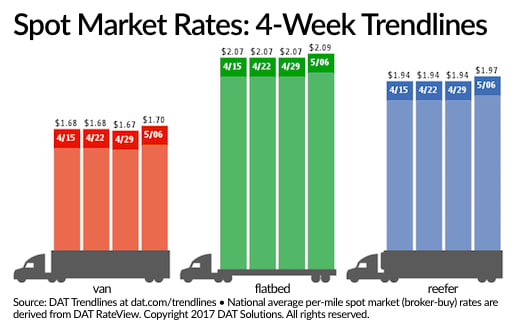
National average spot truckload rates for van, refrigerated, and flatbed freight rose during the week ending May 6, with van and reefer rates at their highest marks since January, according to DAT Solutions and its network of load boards.
National average spot truckload rates for van, refrigerated, and flatbed freight rose during the week ending May 6, with van and reefer rates at their highest marks since January, according to DAT Solutions and its network of load boards.
The number of total available loads fell 6% compared to the previous week while truck capacity was virtually unchanged, down just 0.4%. Load-to-truck ratios increased for reefer freight on the strength of produce season but dipped for vans and flatbeds:
Ad Loading...
Van ratio: 3.3 loads per truck, down 3%
Reefer ratio: 6.5 loads per truck, up 11%
Flatbed ratio: 39.4 loads per truck, down 12%
The national average van rate climbed 3 cents over the past week to $1.70 mile amid a 3% decline in freight volume while truck posts held steady. Lanes with rising rates continue to outnumber falling lanes on a week-to-week basis, with 52 of the top 100 lanes higher, 37 paying less, and 17 unchanged. Average outbound van rates in key markets:
Los Angeles: $2.02 per mile, up 4 cents
Chicago: $1.89 per mile, down 1 cent
Atlanta: $1.92 per mile, up 1 cents
Philadelphia: $1.64 per mile, down 4 cents
Houston: $1.73 per mile, up 5 cents
Two notable lanes showed increases. Houston-Chicago increased 13 cents to $1.47 per mile, and Houston to New Orleans also gained 13 cents, but for a much higher $2.38 per mile. All reported rates include fuel surcharges.
The national average spot reefer rate moved 3 cents higher to $1.97 per mile as load posts increased 9% while truck posts declined 2%.
Ad Loading...
Spot rates out of California are trending up thanks to tomato production, according to DAT. That’s good for reefer freight but processed and canned tomatoes in paste and sauces are also a boon for vans. From June to October last year, California shipped 500,000 loads of processed tomato products.
Flatbed load posts decreased 12% while truck posts were unchanged. The national average spot flatbed rate edged up 2 cents to $2.09 per mile, its highest mark in nearly two years. With these hikes some key lanes showed volatility:
Las Vegas-Los Angeles, $2.96 per mile, up 64 cents
Las Vegas-Stockton, $1.98 per mile, down 60 cents
Reno-Los Angeles, $2.33 per mile, up 39 cents
Harrisburg-Springfield, Massachusetts, $3.78 per mile, down 31 cents
Savannah-Charlotte, $3.48 per mile, up 55 cents
Rock Island, Illinois-Grand Rapids, $2.91 per mile, up 47 cents
Cargo theft has shifted from parking-lot break-ins to organized international schemes using double brokering, phishing, and even spoofing tracking signals. In this HDT Talks Trucking video podcast episode, cargo-theft investigator Scott Cornell explains what’s changed and what fleets need to do now.
Daimler Truck’s David Carson sees early signs of tightening capacity — yet buyers remain wary, extending trade cycles and resisting a pre-2027 emissions surge.
The American Transportation Research Institute's annual analysis of truck speeds through congested interchanges yielded a new worst bottleneck this year.
From pricing intelligence and compliance tools to charging infrastructure, diagnostics, tires, and AI, HDT’s 2026 Top 20 Products recognize the new tools, technologies, and ideas heavy-duty trucking fleets are using to run their businesses.
Artificial intelligence is evolving faster than fleets can keep up, and telematics must evolve with it, Cawse said during Geotab Connect. The future? A single AI coordinating every system — and leaders who know how to guide it.
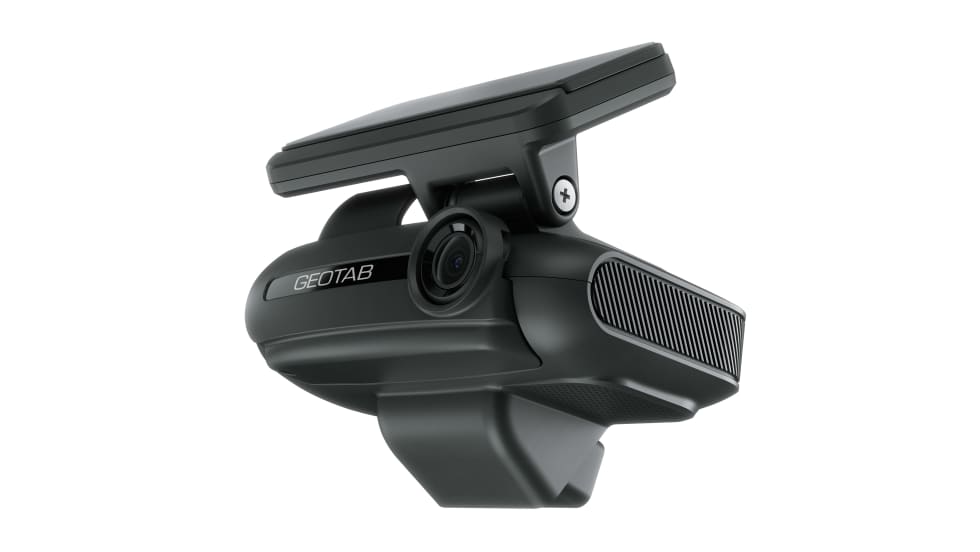
Geotab launches GO Focus Pro, an AI-powered 360-degree dash cam designed to reduce collisions, prevent fraud, and protect fleets from nuclear verdict risk.
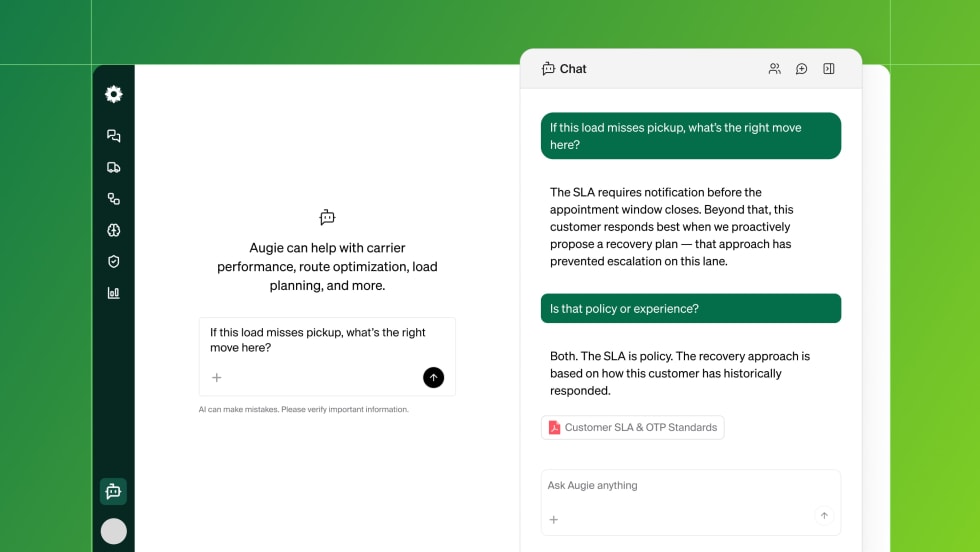
Knowledge Hub is designed to turn scattered tribal knowledge into execution-ready intelligence and help logistics teams make faster, more consistent decisions.
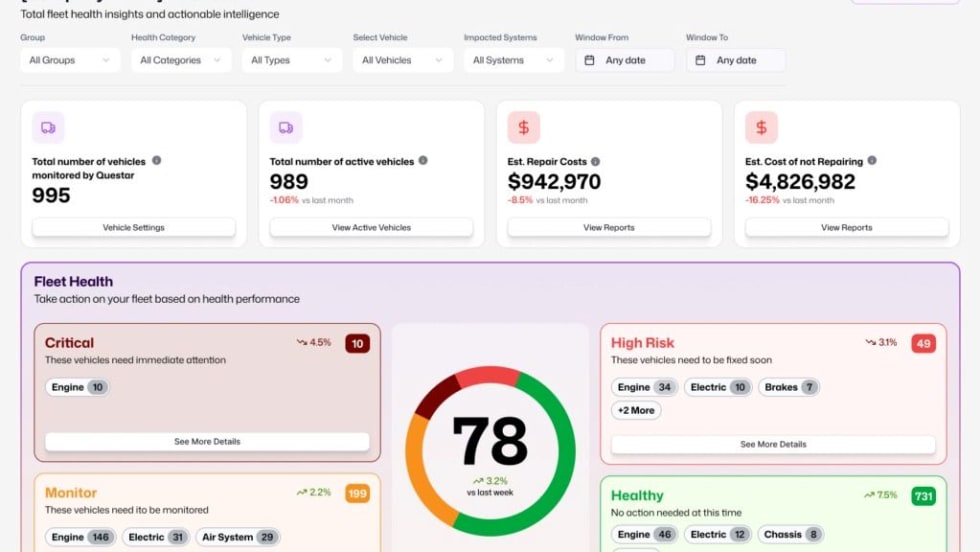
Quester’s AI-driven maintenance insights aim to help fleets reduce unplanned downtime, improve repair planning, and better understand the true cost of maintenance decisions.