




American Natural Gas Acquires Questar Fueling Company
American Natural Gas (ANG) announced that it has acquired Questar Fueling Company, including its 11 compressed natural gas (CNG) fueling stations in Arizona, Kansas, Texas, Utah, California, and Colorado.
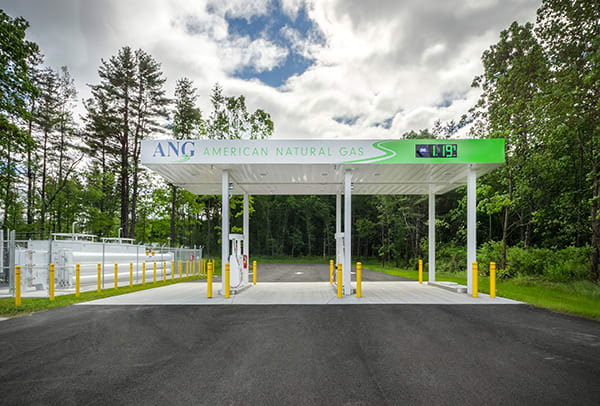
Photo of American Natural Gas station courtesy of ANG.
American Natural Gas (ANG) announced that it has acquired Questar Fueling Company, a subsidiary of Questar Corporation, including its 11 compressed natural gas (CNG) fueling stations in Arizona, Kansas, Texas, Utah, California, and Colorado. Financial terms were not disclosed.
Anchor tenants of the newly acquired stations include some of the nation’s largest fleets such as Anheuser-Busch, Frito-Lay, Swift Transportation, Central Freight Lines, and many others. The stations are designed for medium- and heavy-duty vehicles, but are also open to other fleets and members of the general public who drive natural gas-powered vehicles. Each station has between four and seven fueling lanes and either three or four compressors, guaranteeing consistent capacity and fuel pressure.
As a result of the acquisition, which closed on Dec.16, 2016, ANG now owns and operates the following 11 high-speed, high-volume Questar Fueling CNG stations:
1001 South 65th Ave., Phoenix, AZ 85043
5625 Southwest Wenger St., Topeka, KS 66609
6580 Kansas Ave., Kansas City, KS 66111
650 East Centre Park Blvd., De Soto, TX 75115
4200 Duncanville Rd., Dallas, TX 75236
5800 Mesa Drive, Houston, TX 77028
5348 East Houston St., San Antonio, TX 78220
5260 West 2400 South, West Valley City, UT 84120
35750 Highway 58, Buttonwillow, CA 93206
10405 East 40th Ave., Denver, CO 80239
14512 Aliso Drive, Fontana, CA 92337 (under construction)
Photo of American Natural Gas station courtesy of ANG.
As a result of this acquisition and that of Constellation CNG, LLC on December 20, ANG now owns and operates approximately 40 fueling stations in 13 states across the United States, inclusive of stations in process and under development, up from only two stations at the time of HC2’s initial investment in ANG in August 2014.
“Our customer’s needs are driving our expansion,” said Drew West, Chief Executive Officer of ANG. “With a national footprint, ANG is situated better than ever to support fleets in broader, more extensive adoptions of CNG. With energy prices on the rise and sustainability efforts growing more critical, there has never been a more important time to invest in alternative fuels.”
Through the transaction, ANG also acquired a new state-of-the-art mobile fueling station. The powerful, self-contained system can be mounted to a trailer and transported wherever a client needs for temporary fueling or backup redundancy.
Service at all stations will continue uninterrupted throughout the ownership transition. ANG will oversee operations with state-of-the-art 24-hour monitoring platforms and an expert “on-call” maintenance team.
Natural gas is the cleanest burning alternative fuel available that has the power to run heavy-duty vehicles. It is also quieter, safer, less expensive and abundant in America. Vehicles that run on natural gas generally emit 13% to 21% fewer greenhouse gas emissions than vehicles that run on gasoline.
For more information, visit www.americannaturalgas.com, or call (866) 264-6220 with questions.
More Fuel Smarts

Fleet Economics Shape Electric Truck Outlook
ACT Research expects costs, charging infrastructure, and technology improvements to drive zero-emission commercial vehicle adoption as federal regulations and incentives retreat.
Read More →
Wex Adds Cardless Fuel Payments for Over-the-Road Customers
A new fuel card feature for Wex customers offers convenience and security.
Read More →
New California Law Could Shed Light on Electric Truck Prices
Why do battery-electric Class 8 trucks remain so expensive? A California bill signed by Gov. Gavin Newsom would give fleets and state agencies more visibility into what manufacturers charge.
Read More →

How Volvo Updated Its D13 for EPA 2027 [Watch]
Volvo’s updated D13 promises lower emissions without sacrificing performance or fuel economy. Take a closer look at what changed inside the engine in this HDT Spotlight video.
Read More →
Diesel Price Spike Shortens Payback for Natural Gas Trucks, Report Says
Energy Vision estimates fleets could recover the higher purchase price of an RNG-fueled Class 8 tractor in 1.3 to 2.8 years under current fuel-price scenarios.
Read More →
Calstart Becomes Catalyst Mobility, Reflecting Broader Focus
Calstart is now Catalyst Mobility, reflecting the nonprofit’s growing national role in clean transportation, including zero-emission trucks, infrastructure and incentive programs.
Read More →
Record Diesel Prices Squeeze Trucking Fleets
Average U.S. diesel prices have climbed to nearly $6 a gallon, surpassing the 2022 record as tight refinery capacity and Middle East disruptions keep fuel costs elevated.
Read More →
How Fuel Delivery Shapes Engine Performance
Fuel delivery depends on more than what happens at the injector. For fleet, maintenance and technical professionals, looking at the full path from pump to injector can provide useful context for understanding engine performance.
Read More →
East Coast Port Launches $45M Electric Truck Push
The Port Authority of New York and New Jersey announced millions in incentives for zero-emission drayage trucks, yard tractors, and new charging hubs near the port.
Read More →
Detroit Opens Orders for EPA 2027 Engines
Detroit isn’t starting from scratch to meet EPA 2027 diesel emissions standards. Its Gen 6 DD13 and DD15 engines keep much of today’s platform while updating the fuel and aftertreatment systems.
Read More →