




GAO Investigators Drive Through Holes in Port Security
An investigation by the General Accountability Office has raised serious concerns about the ability of the Transportation Worker Identification Credential program to safeguard the nation's ports.
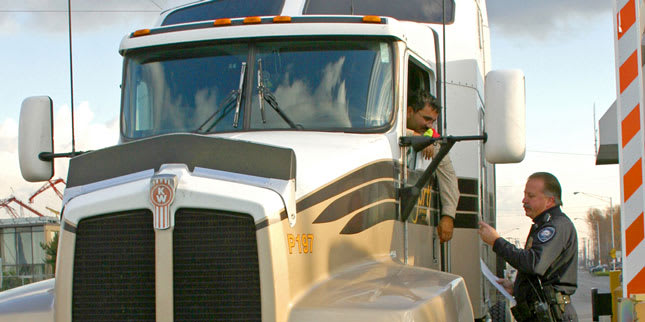
An official at the Port of Tacoma checks a driver's TWIC card.
An investigation by the General Accountability Office has raised serious concerns about the ability of the Transportation Worker Identification Credential program to safeguard the nation's ports.
The GAO found problems with the internal controls governing enrollment, background checks, and use of the TWIC to limit access to ports to only qualified workers.
In covert tests, GAO investigators were able to access ports using counterfeit TWICs, authentic TWICS obtained fraudulently, and false reasons for requesting access. According to published reports, In one case, they entered the property in a truck loaded with fake explosives.
The system was established after the September 11 terrorist attacks. TWIC cards are required for truckers, stevedores, longshoreman and others to get unescorted access to the nation's ports.
CNN reports on the response of Rep. John Mica, R-Florida, who is chairman of the House Transportation and Infrastructure Committee: "Nearly half a billion dollars has been spent since TSA was directed to issue biometric security cards to transportation workers. "Yet today, 10 years later and with no approved biometric reader, TWICs are at best no more useful than library cards."
GAO found that internal controls in the enrollment and background checking processes are not designed to provide reasonable assurance that:
Only qualified individuals can acquire TWICs
Adjudicators follow a process with clear criteria for applying discretionary authority when applicants are found to have extensive criminal convictions
Once issued a TWIC, TWIC-holders have maintained their eligibility.
The GAO concludes that the Department of Homeland Security needs to do some work.
In its public summary, the GAO said, "DHS has not assessed the TWIC program's effectiveness at enhancing security or reducing risk for MTSA-regulated facilities and vessels. Further, DHS has not demonstrated that TWIC, as currently implemented and planned, is more effective than prior approaches used to limit access to ports and facilities, such as using facility specific identity credentials with business cases."
It also noted that DHA did not conduct a risk-informed cost-benefit analysis that considered existing security risks, and has not yet completed a regulatory analysis for the upcoming rule on using TWIC with card readers.
Among other things, GAO recommends that DHS assess TWIC program internal controls to identify needed corrective actions, assess TWIC's effectiveness, and use the information to identify effective and cost-efficient methods for meeting program objectives. DHS concurred with all of the recommendations.
More Safety & Compliance
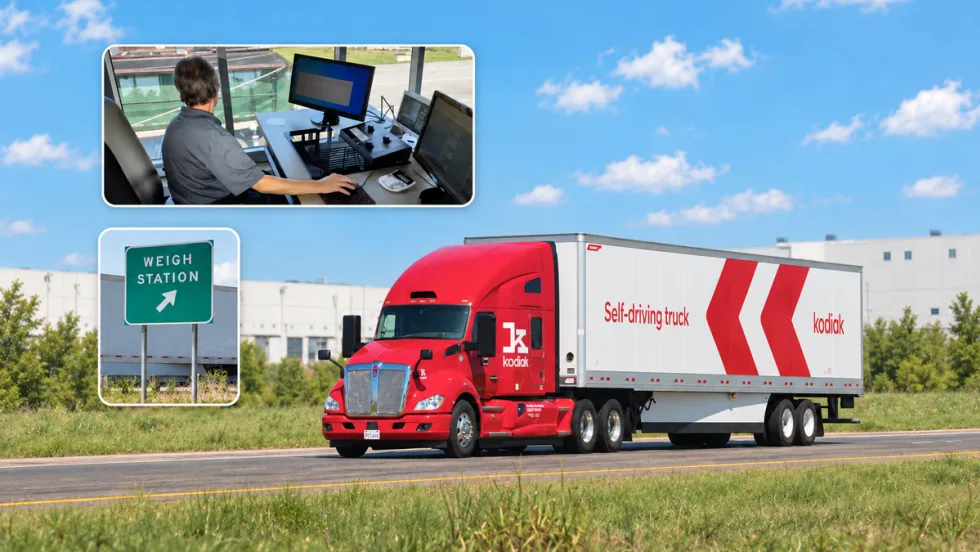
PrePass, Kodiak Connect Driverless Trucks to Roadside Enforcement
The system will allow enforcement agencies to verify Enhanced Inspection information and decide whether Kodiak’s autonomous trucks can bypass roadside screening sites.
Read More →
From One Generation to the Next: How Mentorship Builds Safer Truck Drivers
After three decades in trucking, Harold Perry shares what he's learned about driver safety, mentorship, and helping the next generation build confidence behind the wheel.
Read More →
FMCSA Pauses Biennial-Update Enforcement Amid Motus Transition
Carriers whose updates were due on or after June 1 have more time, while FMCSA works to stabilize its new registration system and warns of phishing sites impersonating its new carrier registration system, Motus.
Read More →
ZF Expands Commercial Vehicle Push in North America
ZF is expanding its North American commercial-vehicle presence with new transmission applications, electrification, trailer technology and autonomous-driving systems.
Read More →
Truck Drivers Need More Than Another Alert
Fleets have more visibility into truck health, safety events, and driver activity than ever. The next challenge is turning all that information into useful guidance for the person who has to decide what to do next.
Read More →
Tesla Wants a Self-Driving Semi. Are Cameras Enough?
Could Tesla’s camera-only autonomous driving technology work on an 80,000-pound Semi? In this commentary, HDT's Deborah Lockridge takes a look at Tesla, Cybercab, and how autonomous trucks see the road.
Read More →
What DOT’s Automated Vehicle Strategy Means for Trucking
The U.S. Department of Transportation issued a new automated-vehicle strategy that outlines plans for driverless-truck regulations, cross-state freight corridors, and federal safety standards.
Read More →
NYC Expands Speed, Pedestrian Safety Tech Across Fleet
New York City is expanding intelligent speed assistance and pedestrian-alert systems across its municipal fleet, moving the technologies from pilot programs into vehicle procurement and retrofit requirements.
Read More →
FMCSA Removes 110 Truck Driver Training Schools from Certified ELDT List
Federal regulators also are targeting more than 160 additional training providers and launching a nationwide audit of third-party CDL skills testers as part of a broader crackdown on trucking fraud.
Read More →
Beyond DOT Compliance: What Makes a Trucking Fleet Truly Safe?
A trucking fleet can follow every rule and still make unsafe decisions. The real test comes when safety conflicts with freight, productivity, or cost.
Read More →