





2022: California’s Straight-Truck TRU Deadline Puts the Squeeze on Fleets
EPA Puts Brakes on California's Zero-Emission TRU Requirements for Trucks
Trucking companies that operate refrigerated trucks and trailers in California can breathe a sigh of relief, as the state’s requirement for transitioning to zero-emission transport refrigeration units is on hold.
June 11, 2025
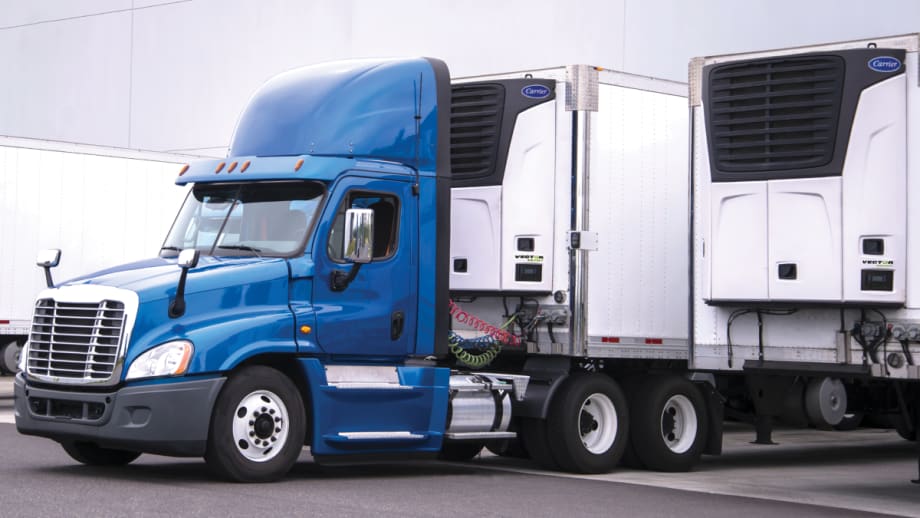
Carrier Transicold said when it introduced its Vector 8811MT refrigeration unit last fall for center-divide trailers that it would offer lifetime compliance with CARB regulations.
Photo: Carrier Transicold
5 min to read
Trucking companies that operate refrigerated trucks and trailers in California can breathe a sigh of relief, as the state’s requirement for transitioning to zero-emission transport refrigeration units is on hold.
The Environmental Protection Agency earlier this year issued a waiver to CARB for most parts of its 2022 amendments to the Transport Refrigeration Unit Air Toxic Control Measure (TRU ATCM) for In-Use Diesel-Fueled TRUs, effective October 1, 2022.
That rule would have gradually required all truck TRUs operating in California to be zero‑emission by the end of 2029.
On January 3, 2025, U.S. EPA waived federal preemption for all but the zero-emission TRU requirements.
“EPA is not acting at this time on CARB’s ZETRU requirements for the turnover of at least 15 percent of their diesel-fueled truck TRU fleet to ZETRU by December 31, 2023, (and each year thereafter),” said the Federal Register notice.
Other requirements of the 2022 TRU rules, however, were granted an EPA waiver, including a particulate matter emission standard for newly manufactured non-truck TRU engines (on trailers, domestic shipping containers, railcars, and generator set units); the use of lower global warming potential refrigerants; facility registration and reporting; expanded reporting and labeling; and fees.
What Does This Mean for Truck Owners and TRU Makers?
On June 11, CARB posted a TRU ATCM Implementation Update 2025 and accompanying Frequently Asked Questions (FAQs) document.
Manufacturers of transport refrigeration units may manufacture, for sale or use in California, new diesel-fueled truck TRUs that are otherwise compliant with the TRU ATCM. And California dealers may sell newly-manufactured diesel-fueled truck TRUs that are otherwise compliant with the TRU ATCM.
All TRU owners or owners/operators must comply with the requirements of the 2022 Amendments to the TRU ATCM, except:
Truck TRU owners or owners/operators are not required to turnover their truck TRU fleet to zero-emission.
Truck TRU owners or owners/operators may purchase newly-manufactured diesel-fueled truck TRUs from California dealers that use a refrigerant with a global warming potential (GWP) value less than or equal to 2,200, or use no refrigerant at all, and are otherwise compliant with the TRU ATCM.
In addition, CARB reminded truck operators that they are still not required to pay the TRU operating fees that were created in those amendments, thanks to a December 4, 2023, trial court decision.
That decision prohibited CARB from collecting the fees included in the 2022 amendments to the Airborne Toxic Control Measure for In-Use Diesel-Fueled Transport Refrigeration Units (TRU) and TRU Generator Sets, and Facilities Where TRUs Operate (TRU ATCM).
CARB is currently working on the next TRU rulemaking aimed at increasing the use of zero-emission technology across all TRU categories (including truck TRUs). The specifics and timing of this regulation have not been determined at this time.
All TRUs operating in California still must be reported to CARB in the ARBER System regardless of whether they are California-based or non-California-based.
Can I Still Use My Diesel TRUs?
According to the FAQ, trucking operations may continue to use their diesel-powered TRUs.
Model year 2014 and older truck TRU engines were required to comply with the ultralow-emission in-use performance standard seven years after the engine model year. Model year 2015 and newer TRUs are not currently subject to an in-use standard.
However, CARB said, truck TRU owners and owner/operators must ensure their TRUs use a refrigerant with global warming potential less than or equal to 2,200 or no refrigerant at all, meet reporting and labeling requirements, and are otherwise compliant with the TRU ATCM.
ZE TRU Technology Just Not Ready
Although the North American Council for Freight Efficiency last year reported that eTRU technology is evolving rapidly, it also identified and discussed challenges, including:
Battery size
Weight
Initial cost
Charging infrastructure and shore power cost
Availability
Operational changes
And those reflect the comments of trucking groups and companies operating refrigerated transportation on the EPA docket regarding the EPA waiver approval on the TRU changes.
The American Trucking Associations and the California Trucking Association focused their joint comments exclusively on the zero-emission truck TRU requirements (aka ZETTRU).
“The consistent message our organizations hear from refrigerated fleets is the ZETTRU
requirements are ahead of the technology,” the associations said in their comment.
“Fleets are not able to meet the compliance requirements and are having to submit extension applications to the California Air Resources Board (CARB) because the technology is not available or in limited or pre-production stages.
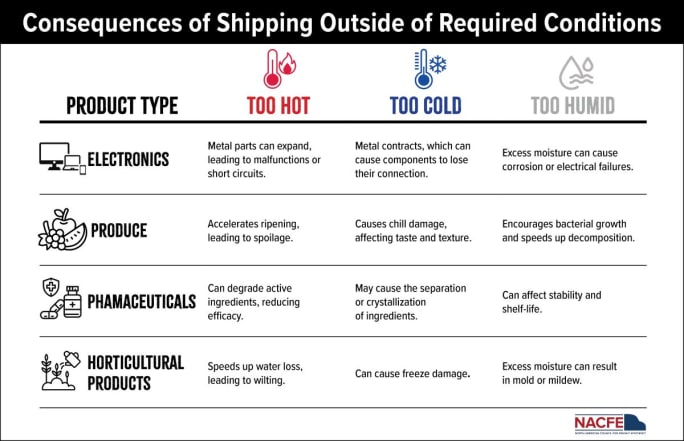
One challenge eTRU designers must contend with are the wide range of temperature control challenges refrigerated carriers must deal with on a daily basis.
Source: NACFE
"While extensions can temporarily delay compliance, these obligations compound (i.e., 15% in 2023, 30% in 2024, 45% in 2025, etc.) and will require fleets to make large-scale deployments when the technology is available and/or validated."
ATA and CTA also pointed out that fleets would have to install zero emission TRUs on diesel trucks because of the slow transition to electric trucks in the state. And this was before the Trump Administration and Congress took unprecedented action to revoke EPA waivers for the Advanced Clean Trucks regulation.
"Our organizations support the advancement of technologies that reduce emissions; however, these technologies must be thoroughly tested, evaluated and validated; especially given the food safety requirements that are associated with the transport of refrigerated and frozen foods.
"The ability of fleets to validate this technology prior to the ZETTRU standards taking effect has been severely limited due to the limited availability or total lack of technology."
Small-Fleet ZET TRU Challenges
The Atlantis Food Services Corp. in its comments on the EPA docket explained that with a fleet of three 26-foot refrigerated trucks, the requirement would double or triple its monthly lease payments. The battery weight, they said, would reduce the amount of cargo they would be able to carry, meaning higher operating costs.
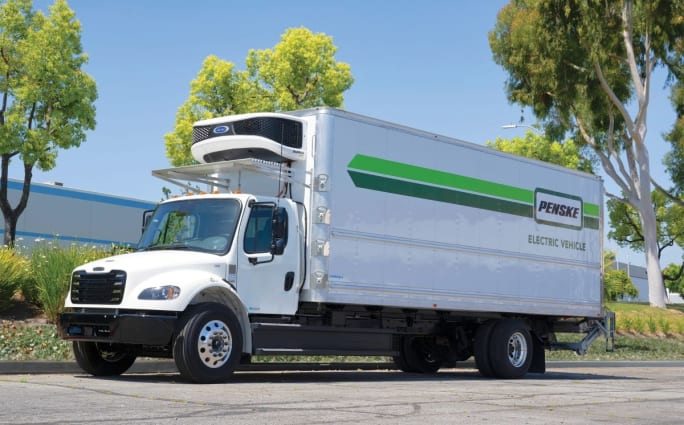
Last year, Penske and Daimler Trucks North American showcased a Class-7 Freightliner eM2 battery-electric truck with Carrier Transicold’s Supra e11 eCool electric refrigeration unit.
Photo: Carrier Transicold
Their landlord, they said, was not willing to help with future charging units that would be needed, and PG&E told them the commercial complex may not be capable of providing power to all four of the companies in the facility using refrigerated trucks and vans.
And Madera Produce commented that turning over all California TRUs to zero-emission by 2029 was unrealistic.
“Not only can our state not provide enough power, but there is also a massive shortage of all zero-emission equipment. Shortage is just another word for costly in any business. Not to mention, many TRUs manufacturing are only years old, with vast complications and unreliability," Madera's comments explained.
“Technology needs to improve before a regulation like this can go into effect. Especially the DEF component. We are having major mechanical errors with our compliant TRUs.”
They also pointed to the risk of not keeping perishables within the required temperature range, which could happen if charging were not available.
“We urge you to table this regulation until there is a more reliable, sustainable solution. Our state will suffer if not.”
More Fuel Smarts

How Volvo Updated Its D13 for EPA 2027 [Watch]
Volvo’s updated D13 promises lower emissions without sacrificing performance or fuel economy. Take a closer look at what changed inside the engine in this HDT Spotlight video.
Read More →
Diesel Price Spike Shortens Payback for Natural Gas Trucks, Report Says
Energy Vision estimates fleets could recover the higher purchase price of an RNG-fueled Class 8 tractor in 1.3 to 2.8 years under current fuel-price scenarios.
Read More →
Calstart Becomes Catalyst Mobility, Reflecting Broader Focus
Calstart is now Catalyst Mobility, reflecting the nonprofit’s growing national role in clean transportation, including zero-emission trucks, infrastructure and incentive programs.
Read More →

Record Diesel Prices Squeeze Trucking Fleets
Average U.S. diesel prices have climbed to nearly $6 a gallon, surpassing the 2022 record as tight refinery capacity and Middle East disruptions keep fuel costs elevated.
Read More →
Sponsored•September 9, 2026
How Fuel Delivery Shapes Engine Performance
Fuel delivery depends on more than what happens at the injector. For fleet, maintenance and technical professionals, looking at the full path from pump to injector can provide useful context for understanding engine performance.
Read More →
East Coast Port Launches $45M Electric Truck Push
The Port Authority of New York and New Jersey announced millions in incentives for zero-emission drayage trucks, yard tractors, and new charging hubs near the port.
Read More →
California Bill Could Shed Light on Electric Truck Prices
Why do battery-electric Class 8 trucks remain so expensive? A California bill headed to Gov. Gavin Newsom would give fleets and state agencies more visibility into what manufacturers charge.
Read More →
Detroit Opens Orders for EPA 2027 Engines
Detroit isn’t starting from scratch to meet EPA 2027 diesel emissions standards. Its Gen 6 DD13 and DD15 engines keep much of today’s platform while updating the fuel and aftertreatment systems.
Read More →
Zero-Emission Truck Corridor Planned for West Coast
California, Oregon, Washington, British Columbia and Baja California are coordinating plans for truck charging and hydrogen fueling from Canada to Mexico.
Read More →
A Closer Look at Kenworth’s Electric T880E Vocational Truck [Video]
Learn more about Kenworth's T880E battery-electric vocational truck at the Paccar Technical Center, including its range, applications, upfitting considerations, and PTO options, in this HDT Spotlight video.
Read More →