




Carrier Transicold to Standardize More Environmentally Sustainable Refrigerant
Later this year, new-generation refrigerant R-452A will become the standard for new Carrier Transicold transport refrigeration units in North America.

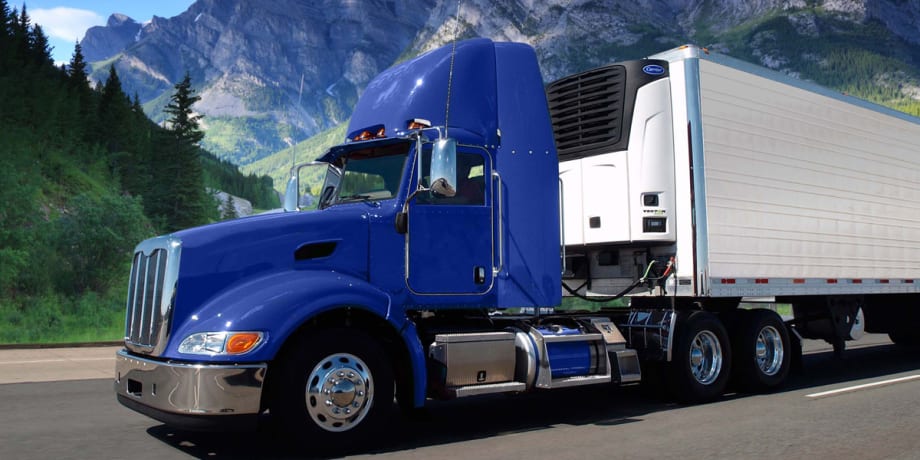
Later this year, new-generation refrigerant R-452A will become the standard for new Carrier Transicold transport refrigeration units in North America.
Photo: Carrier Transicold
With significantly reduced global warming potential, new-generation refrigerant R-452A will become the standard for new Carrier Transicold transport refrigeration units in North America beginning in October.
“Carrier Transicold truck and trailer refrigeration units have been qualified for R‑452A since 2017, and it has been available as a customer-specified option for several years,” said Bill Maddox, senior manager of product management for Carrier Transicold, in a press release. “R‑452A is already standard with some of our newer units, and we’re pleased to expand this standardization to the broader array of Carrier Transicold products, effectively halving the refrigerant [global warming potential] of our transport refrigeration offerings.”
Later this year, R-452A with a global warming potential of 2,140, will become the standard refrigerant for all Carrier Transicold models that currently use R-404A, which has a global warming potential of 3,922.
The timing of the transition will help California customers placing orders for 2023, according to the company. The California Air Resources Board this year approved a measure requiring all new transport refrigeration units placed into service in 2023 to use a refrigerant with a global warming potential of less than 2,200.
In 2025, Canada will require refrigerants with a global warming potential of less than 2,200 in new transport refrigeration units, to reduce greenhouse gas emissions in accordance with the Kigali Agreement of the Montreal Protocol.
Previously, there was a significant cost differential between the new and traditional refrigerants, however over the last several years that has diminished with changing demand and refrigerant production trends, helping to encourage adoption of the more sustainable R-452A, company officials said.
Maddox added some customers may consider switching refrigerants for units already in service, noting that with relative ease, Carrier Transicold customers can transition newer existing equipment from R-404A to R-452A. Unlike some competitive systems that require replacement of a thermal expansion valve when converting, late-model Carrier Transicold systems – those with an electronic expansion valve – require a software upgrade along with purging the R-404A and replacing it with R-452A. On Carrier Transicold truck units and older trailer units that use a mechanical expansion valve, the valve will require a manual adjustment or, in some cases, replacement based on the age of the model.
Standardizing on lower global warming potential refrigerants is part of Carrier’s commitment to reducing its customers' carbon footprint by more than one gigaton, while also achieving carbon neutral operations by 2030, as outlined in its Environmental, Social and Governance Goals.
More Equipment

How Volvo Updated Its D13 for EPA 2027 [Watch]
Volvo’s updated D13 promises lower emissions without sacrificing performance or fuel economy. Take a closer look at what changed inside the engine in this HDT Spotlight video.
Read More →
Michelin Tire Improves Efficiency and Durability for Regional Fleets
The Michelin X Multi Energy D2 is a regional haul drive tire engineered to help fleets improve fuel efficiency, durability and traction in demanding stop-and-go operations.
Read More →
ZF Expands Commercial Vehicle Push in North America
ZF is expanding its North American commercial-vehicle presence with new transmission applications, electrification, trailer technology and autonomous-driving systems.
Read More →
Tesla Wants a Self-Driving Semi. Are Cameras Enough?
Could Tesla’s camera-only autonomous driving technology work on an 80,000-pound Semi? In this commentary, HDT's Deborah Lockridge takes a look at Tesla, Cybercab, and how autonomous trucks see the road.
Read More →
Kodiak: Driverless Long-Haul Truck Launch on Track for 2026
Kodiak AI says its driverless long-haul safety case is 93% complete and it remains on track to begin commercial operations by year-end 2026.
Read More →
What DOT’s Automated Vehicle Strategy Means for Trucking
The U.S. Department of Transportation issued a new automated-vehicle strategy that outlines plans for driverless-truck regulations, cross-state freight corridors, and federal safety standards.
Read More →
East Coast Port Launches $45M Electric Truck Push
The Port Authority of New York and New Jersey announced millions in incentives for zero-emission drayage trucks, yard tractors, and new charging hubs near the port.
Read More →
PlusAI Going Public to Fund Autonomous Truck Launch
A SPAC deal could provide PlusAI with up to $300 million as it works toward a 2027 commercial launch of factory-built autonomous trucks.
Read More →
NHTSA Moves to Rewrite Truck Fuel-Economy Rules
The National Highway Traffic Safety Administration says it lacks authority to regulate medium- and heavy-duty truck engines separately from complete vehicles, but the existing standards have not yet been eliminated.
Read More →
Detroit Opens Orders for EPA 2027 Engines
Detroit isn’t starting from scratch to meet EPA 2027 diesel emissions standards. Its Gen 6 DD13 and DD15 engines keep much of today’s platform while updating the fuel and aftertreatment systems.
Read More →